

How to Build Net Worth: Where to Start
Learning how to build net worth starts with an honest number, not a shortcut. Your bank balance isn’t the same as your net worth and that distinction matters more than most people realize. Net worth is simply everything you own minus everything you owe. If that number is zero, negative, or you’ve genuinely never calculated it, you’re not behind. You’re just starting from an honest baseline, and that’s the best place to build from.

This guide breaks down exactly how to go from $0 to a growing net worth, using habits that actually hold up in real life — not theory. We’ll walk through the math, the common mistakes that quietly stall progress, and the tools that make tracking effortless.
Step 1: Calculate Your Actual Starting Number
You can’t grow what you don’t measure. Add up everything you own — cash, savings, retirement accounts, your car’s resale value — then subtract everything you owe: credit cards, loans, and any other debt.
Don’t panic if the number is negative. Most people starting out are. The point of this step isn’t to feel good about the number — it’s to have a baseline you can track against every month.

Write it down somewhere you’ll actually revisit. A note on your phone works fine to start; a dedicated net worth tracker works even better once you’re ready to make this a habit.
Step 2: Stop the Bleeding Before You Build
Before investing a single dollar, close the gaps that are actively working against you:
- Build a starter emergency fund of $1,000. This alone prevents most financial setbacks from turning into new debt.
- Stop high-interest debt from growing. A credit card balance at 20%+ interest will outpace almost any investment return you could realistically earn. Pay this down aggressively before anything else.
- Audit recurring subscriptions. Small, forgotten charges quietly drain money every month. A 10-minute review of your bank statement usually finds $30–$100 in waste.

Think of this step as plugging leaks in a boat before you try to sail it faster. Every dollar lost to avoidable interest or forgotten subscriptions is a dollar that never gets the chance to compound.
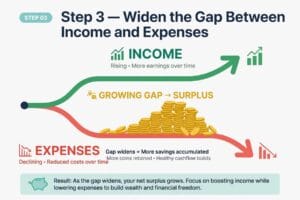
Step 3: Widen the Gap Between What You Earn and What You Spend
Net worth only grows when there’s a surplus — money left over after expenses that you can actually put to work. There are two ways to create that gap, and combining both works fastest.
Increase income. Even a modest raise or a strategic job change tends to move the needle faster than trimming a budget ever could. Side income — freelance work, a skill-based side hustle — also counts, especially early on when your investable base is small.
Lower expenses without misery. You don’t need to cut everything. Focus on your biggest recurring costs first (housing, transportation, subscriptions) rather than agonizing over small purchases.
A simple guardrail that works well here: before any non-essential purchase, ask whether it’s worth more than 1% of your current net worth. It keeps spending proportional as your wealth grows, instead of a fixed budget rule that never adjusts.
Step 4: Automate the Surplus Before You Can Spend It
Whatever gap you create between income and expenses needs somewhere to go automatically — the moment you get paid, not at the end of the month when there’s nothing left. Set up an automatic transfer, even if it’s small, into:
- Your emergency fund (until it covers 3–6 months of expenses)
- A retirement account (401(k) match first, then a Roth IRA or similar)
- A low-cost, diversified index fund for anything beyond that
The amount matters less than the automation. A $50 automatic transfer that happens every month beats a $500 one you “mean to do” but keep skipping.

A Simple Example: What This Looks Like in Practice
Numbers make this easier to picture. Say someone starts at $0 net worth, with $150 a month in surplus after expenses and debt payments.
- Months 1–6: That $150/month goes toward a $1,000 starter emergency fund and clearing a small credit card balance. Net worth moves from $0 to roughly $500, mostly by eliminating debt.
- Months 7–24: With debt gone, the full $150/month is automated into a retirement account and an index fund. By month 24, consistent contributions plus modest market growth put net worth somewhere around $3,000–$3,500.
- Year 3 onward: As income grows (even slightly) and the invested base gets larger, growth starts coming from the money itself — not just new contributions. This is where compounding starts pulling its own weight.
Nothing about this example requires a six-figure income or a lucky investment pick. It’s the same $150/month, applied consistently, in the right order.
Common Mistakes That Quietly Stall Progress
- Investing before the emergency fund exists. Without a cash cushion, one unexpected expense forces you to sell investments at the worst possible time, or go back into debt.
- Checking net worth too often. Daily tracking turns a long-term project into a source of anxiety over normal market noise. Monthly is enough.
- Letting lifestyle inflation eat every raise. A raise that immediately becomes a bigger apartment or a nicer car adds nothing to net worth — it just moves the goalposts.
- Chasing complexity. Individual stock picking, timing the market, or exotic investment products rarely outperform a boring, consistent, low-cost index fund approach — especially in the early years.
- Waiting for the “right” amount to start. $25 automated every month, started today, beats $500 automated “once things settle down” that never actually starts.
Simple Tools to Track Your Net Worth
- A basic spreadsheet with two columns — assets and liabilities — updated once a month.
- A dedicated net worth tracker tool, which does the subtraction for you and shows the trend over time.
- Your bank and brokerage apps, most of which now show real-time balances that make monthly updates a five-minute task.
The tool matters far less than the habit of actually opening it once a month.
Step 5: Let Time Do the Heavy Lifting
This is the part most guides gloss over: the first few years of building net worth from zero are the slowest and least rewarding to watch. Compound growth is backloaded — it looks unimpressive early and accelerates later, once there’s a real base to grow from.
That means the actual skill being built in year one isn’t investment returns — it’s the habit of consistency. Review your net worth monthly, and let the automated system run quietly in the background rather than trying to manually optimize every dollar.

Step 6: Protect What You’re Building
As your net worth grows past the very early stages, protecting it becomes part of the strategy too — not an afterthought:
- Keep your emergency fund topped up as expenses grow.
- Reassess insurance coverage periodically so a single bad event can’t undo years of progress.
- Avoid lifestyle inflation that quietly eats every raise before it reaches your savings rate.

Frequently Asked Questions
How long does it take to build net worth from zero?
It varies with income and expenses, but most people see a meaningful, motivating shift within 12–24 months of consistent automated saving — even before the numbers look impressive.
Should I pay off debt or invest first?
High-interest debt (generally above 7–8%) should usually be paid off first. Lower-interest debt can often be paid down alongside modest investing, especially if there’s an employer retirement match on the table.
Is a negative net worth normal?
Very common, especially for anyone with student loans or a recent large purchase like a car. What matters is the trend line, not the starting number.
The Bottom Line on How to Build Net Worth
Building net worth from zero isn’t about finding a shortcut — it’s mechanics, repeated consistently: track your number, close the leaks, widen the gap between income and spending, automate the surplus, and give it time. None of it requires a high income or special financial knowledge to start.
Zero isn’t a verdict on where you’ll end up. It’s just where the tracking starts.