Bond Sinking Fund Explained: How It Works for Beginners

You may have come across the term bond sinking fund while reading about corporate bonds, studying for a finance class, or researching where to put your money. It sounds technical, but the idea behind it is surprisingly simple. A bond sinking fund is a way for a company or government to set aside money regularly so it can repay its bondholders without being hit by one giant bill at the end.

If you are a beginner investor, understanding how a bond sinking fund works helps you judge how safe a bond might be, what could happen to your investment before it matures, and which questions to ask before you buy. In this guide, you will learn what a bond sinking fund is, how it works step by step, the main types, a simple numerical example, and the benefits and risks for investors.

What Is a Bond Sinking Fund?

A bond sinking fund is a pool of money that a bond issuer sets aside over time to pay off its bonds. The issuer is the company or government that borrowed money by selling bonds. Instead of waiting until the maturity date and repaying the entire amount at once, the issuer makes regular payments into a bond sinking fund or uses those payments to retire part of the debt early.

The rules are written into the bond’s legal agreement, which is called the indenture. The section describing the payment schedule is often called the sinking fund provision. It tells you how much the issuer must set aside, how often, and what it must do with the money. The SEC’s investor education site describes this kind of sinking fund redemption as a requirement for the issuer to redeem a portion of the bonds on a fixed schedule.

In simple terms, a bond sinking fund is a repayment plan built into the bond. The goal is to reduce the chance that the issuer will struggle to repay everything when the bond matures. For a quick definition of the general concept, see our guide on what is a sinking fund.
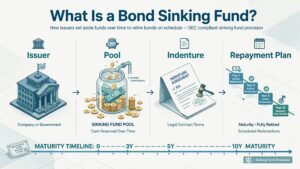
Bond sinking fund diagram showing an issuer setting aside money to repay bondholders

Why Do Issuers Use a Bond Sinking Fund?

Issuers do not create a bond sinking fund only to be generous. There are practical reasons on both sides of the deal.

  • It lowers the repayment burden at maturity. Without a bond sinking fund, the issuer may owe a very large lump sum, sometimes called a balloon payment, on a single day.
  • It can reduce borrowing costs. Investors often see a bond sinking fund as a safety feature, so the issuer may be able to offer a lower interest rate than it otherwise would.
  • It builds investor confidence. A clear repayment schedule shows that the issuer has a plan to pay back the debt.
  • It spreads the cost over time. Regular payments are easier to manage than one huge payment later.

This is very similar to the personal finance habit of saving a little each month for a known future expense. If that idea is new to you, read sinking fund vs emergency fund to see how households use the same principle.

How a Bond Sinking Fund Works, Step by Step

Here is how a typical bond sinking fund operates from start to finish.

  1. The issuer sells bonds. A company raises, for example, $10 million by selling bonds that mature in 10 years.
  2. The indenture includes a sinking fund provision. It states how much the issuer must set aside and when, such as every year starting in year five.
  3. The issuer makes regular payments. These payments go to a trustee, an independent party that manages the money for bondholders.
  4. The money is used to retire bonds. The trustee uses the funds to buy back bonds or to call some of them for early redemption.
  5. The remaining bonds mature as planned. By the end, most of the debt has already been paid, so the final payment is smaller.

The key point is that a bond sinking fund does not always mean the money sits in a savings account. In many cases, the issuer uses the payments directly to reduce the amount of bonds outstanding.

Bond sinking fund diagram showing an issuer setting aside money to repay bondholders

How Are Bonds Retired Through a Sinking Fund?

Most bond sinking fund provisions allow the issuer to retire bonds in one of two ways.

1. Buying bonds in the open market

The issuer or trustee buys the bonds on the market at the current price. If interest rates have risen and the bonds trade below face value, this can be cheaper for the issuer. Investors who sell receive the market price.

2. Calling bonds at a set price

The issuer calls a portion of the bonds, often chosen by lottery, and pays the bondholders a set price, commonly the face value (also called par value). If your bond is selected, you receive that price and your bond ends, even if you wanted to keep holding it.

The issuer usually chooses whichever method costs less. If bond prices are below par, buying in the open market makes sense. If prices are above par, calling at par is cheaper. This is why a bond sinking fund can affect investors in different ways depending on interest rates.

Types of Bond Sinking Fund Provisions

Not every bond sinking fund looks the same. Here are the common variations beginners should know.

  • Fixed payment schedule: The issuer retires a set amount of bonds on specific dates, for example $1 million every year.
  • Increasing payments: The amount grows over time, so early payments are small and later ones are larger.
  • Optional (accelerated) provisions: The issuer may retire more than the minimum if it wants to, which can shorten the life of the debt.
  • Balloon with a sinking fund: A portion is retired through the fund, and the remainder is paid at maturity.

Always read the details of the specific bond, because the exact terms of a bond sinking fund vary from one issue to another.

Bond sinking fund diagram showing an issuer setting aside money to repay bondholders

A Simple Bond Sinking Fund Example

Numbers make the idea much easier to understand. Imagine a company issues $10 million in bonds that mature in 10 years. Instead of repaying everything at the end, it decides to build a bond sinking fund that earns an assumed 4 percent per year.

The standard formula for the yearly payment into a sinking fund is:

Payment = Target amount × r ÷ [(1 + r)n − 1]

Here, r is the annual return and n is the number of years. Using our example:

  • Target amount: $10,000,000
  • Annual return (r): 4 percent, or 0.04
  • Years (n): 10

The calculation gives a yearly payment of roughly $832,900. By depositing that amount every year, the company would reach about $10 million at the end of 10 years, because the money also grows with interest. This is an illustration only, since real issuers may retire bonds directly instead of investing the cash.

The same math works for personal goals. Our free Sinking Fund Planner lets you enter a target and a deadline and shows how much to save each month.

Benefits of a Bond Sinking Fund for Investors

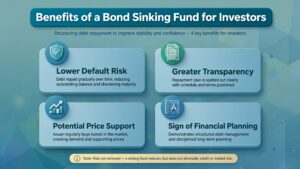
For a beginner, a bond sinking fund can be a helpful sign of discipline. Here are the main benefits.

  • Lower default risk: Because debt is paid down gradually, the issuer faces a smaller payment at maturity, which can make a default less likely.
  • Greater transparency: The repayment plan is spelled out, so investors know how the debt will be handled.
  • Potential price support: When an issuer buys bonds in the open market, that demand can help support the bond’s price.
  • A sign of financial planning: Issuers that commit to a bond sinking fund often show a structured approach to managing debt.

Remember that a bond sinking fund reduces risk but does not remove it. A weak issuer can still fail to make its sinking fund payments, and no feature makes a bond completely safe.
Bond sinking fund diagram showing an issuer setting aside money to repay bondholders

Risks and Drawbacks of a Bond Sinking Fund

There are also trade-offs, and beginners should understand them before investing.

  • Call risk: If your bond is called, you receive your money back earlier than you expected. This often happens when interest rates have fallen, which means you may have to reinvest at a lower rate. FINRA explains this in its guide to callable bonds, including how sinking fund redemptions fit in.
  • Reinvestment risk: After your bond is retired, finding another investment with the same yield may be difficult.
  • Uncertain timing: With lottery-style calls, you cannot know in advance whether your particular bond will be selected.
  • Possible lower yield: Because a bond sinking fund makes the investment safer, these bonds may pay slightly lower interest than similar bonds without one.

In short, a bond sinking fund gives you more safety but less control. Whether that is a good trade depends on your goals and your comfort with risk.

Bond Sinking Fund vs a Personal Sinking Fund

The term “sinking fund” appears in two very different places, so it helps to separate them.

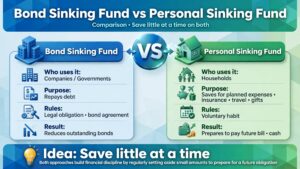
  • Who uses it: A bond sinking fund is used by companies and governments. A personal sinking fund is used by households.
  • Purpose: A bond sinking fund repays debt. A personal sinking fund saves for planned expenses like insurance, travel, or gifts.
  • Rules: A bond sinking fund is a legal obligation written into the bond agreement. A personal sinking fund is a voluntary habit.
  • Result: A bond sinking fund reduces outstanding bonds. A personal sinking fund prepares you to pay a future bill in cash.

The idea behind both is the same: save a little at a time so a big payment does not become a problem. To see household examples, check our list of sinking fund categories.
Bond sinking fund diagram showing an issuer setting aside money to repay bondholders

Which Bonds Have a Sinking Fund?

A bond sinking fund is more common in certain parts of the market.

  • Corporate bonds: Many corporate bonds, especially long-term ones, include a sinking fund provision.
  • Municipal bonds: Some bonds issued by cities, states, and public agencies use a sinking fund to repay debt over time. You can look up official documents for these bonds on the EMMA municipal bond website.
  • Not typical for Treasuries: U.S. Treasury securities generally do not use a sinking fund. You can learn how they work on TreasuryDirect.

The only way to know for sure is to check the bond’s prospectus or offering documents, which describe the sinking fund terms.

How to Check If a Bond Has a Sinking Fund

  1. Find the offering documents. Look for the prospectus or official statement for the bond issue.
  2. Search for the key terms. Look for phrases such as “sinking fund,” “mandatory redemption,” or “sinking fund provision.”
  3. Note the schedule. See when payments start and how much is retired each year.
  4. Check the call price. Find out whether bonds are called at par or at another price.
  5. Compare with similar bonds. Look at yield and maturity against bonds that have no sinking fund.

Your broker or a financial professional can also help you read these documents if the language feels confusing.

Is a Bond Sinking Fund Good for Beginner Investors?

For many beginners, a bond sinking fund is a positive feature, not a requirement. It shows that the issuer has a plan to repay its debt, and that can add a layer of comfort. At the same time, the possibility of an early call means you should not count on holding the bond until the final maturity date.

If you are just starting to invest, consider building a diversified portfolio rather than focusing on one feature of a single bond. Our guide on how to start investing with little money is a good place to begin, and you can find more in our investing guides. Keep in mind that this article is educational, so consider speaking with a qualified financial professional before making investment decisions.

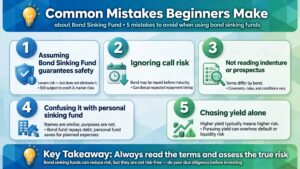
Common Mistakes Beginners Make

  • Assuming a bond sinking fund guarantees safety. It lowers risk but does not eliminate it.
  • Ignoring call risk. Many beginners forget that a bond may be repaid before maturity.
  • Not reading the indenture or prospectus. The terms of each bond sinking fund are different.
  • Confusing it with a personal sinking fund. The names are the same, but the purposes are not.
  • Chasing yield alone. A higher yield may come with more risk, with or without a sinking fund.
Bond sinking fund diagram showing an issuer setting aside money to repay bondholders

Frequently Asked Questions

What is a bond sinking fund in simple words?

It is a repayment plan where the bond issuer regularly sets aside money or retires part of its bonds so it does not face one huge payment at maturity.

Is a bond sinking fund good for investors?

It can be, because it may lower default risk and show disciplined debt management. However, it also adds call risk, which means your bond could be repaid early.

What happens if my bond is called through a sinking fund?

You receive the call price, usually the face value, and your bond ends. You may then need to reinvest your money, possibly at a lower interest rate.

Do all bonds have a sinking fund?

No. A bond sinking fund appears mostly in some corporate and municipal bonds. U.S. Treasury securities generally do not have one.

What is the difference between a sinking fund and a bond sinking fund?

A personal sinking fund is a savings habit for planned expenses. A bond sinking fund is a legal repayment mechanism used by issuers to pay back bondholders. You can see how the personal version works in our free financial tools.

Where can I find the sinking fund terms of a bond?

Check the bond’s prospectus, official statement, or indenture, and look for the sinking fund provision.

Final Thoughts

A bond sinking fund is a simple but powerful idea: pay back debt gradually instead of all at once. For investors, it can signal stronger planning and lower default risk, but it also brings call and reinvestment risk. Before buying any bond, read its terms, understand how the bond sinking fund works, and decide whether the trade-off fits your goals.

The same principle works in your own life. Pick one upcoming expense, divide it by the months left, and start saving today with our free financial tools.

Disclaimer: This article is for educational purposes only and is not financial or investment advice. Consider speaking with a qualified financial professional about your personal situation.

Index Funds vs ETFs: The Simple Difference Explained (2026)

The question of index funds vs ETFs confuses almost every new investor, and the reason is simple: they are not really opposites. An index fund describes what a fund does, which is track a market index. An ETF describes how a fund is built and traded, which is on a stock exchange. Many ETFs are index funds, and many index funds are mutual funds, so the real choice is usually between an index mutual fund and an index ETF.

In this guide to index funds vs ETFs you will learn how the two overlap, how they differ on trading, fees, taxes, and minimums, and how to pick the one that fits your account and habits. All growth examples are hypothetical, and investing always involves risk, including the possible loss of money.

Index Funds vs ETFs: The Quick Answer

If you want the short version, here it is:

Question Short Answer
Are they the same thing? No. Index fund is a strategy, ETF is a structure, and the two can overlap
Which is cheaper? Both can be very low cost, so compare the expense ratio of each fund
Which is better for taxes? ETFs are often more tax efficient in taxable accounts
Which is easier for automatic investing? Index mutual funds often make it simple, though many brokers now support ETFs too
Which is better for beginners? Whichever low-cost option fits your account, such as a mutual fund in a 401(k) or an ETF in a brokerage account

What Is an Index Fund?

An index fund is a fund that tries to match the performance of a market index, such as a broad index of large U.S. companies. Instead of a manager picking investments, the fund simply holds the same companies as the index, in similar proportions.

Because there is no team trying to beat the market, index funds usually have low costs. An index fund can be set up as a mutual fund or as an ETF, which is why the two terms are often mixed up.

What Is an ETF?

An ETF, or exchange-traded fund, is a fund that trades on a stock exchange throughout the day, just like a single company’s stock. You buy and sell ETF shares through a brokerage account at the current market price.

ETFs can follow an index, which makes them index funds, or they can be actively managed, which means a manager chooses the investments. For a deeper look at how ETFs compare with traditional funds, read our guide on ETF vs mutual fund.

How Index Funds vs ETFs Overlap

The easiest way to understand index funds vs ETFs is to look at the four combinations that exist:

Type Structure Strategy
Index mutual fund Mutual fund, priced once a day Tracks an index
Index ETF Exchange-traded, trades all day Tracks an index
Actively managed mutual fund Mutual fund, priced once a day Manager picks investments
Actively managed ETF Exchange-traded, trades all day Manager picks investments

When people ask about index funds vs ETFs, they usually mean the first two rows: an index mutual fund compared with an index ETF. Both give you the same basic idea, which is low-cost exposure to a whole market.

Index Funds vs ETFs: Key Differences

Once you compare an index mutual fund with an index ETF, the differences come down to how you buy, what it costs, and how it is taxed:

Feature Index Mutual Fund Index ETF
How it trades Once per day at the closing price On an exchange all day at market prices
Minimum investment Sometimes a minimum, such as $1,000 or more Price of one share, or less with fractional shares
Automatic investing Usually easy to set up in exact dollar amounts Depends on your broker
Tax efficiency Good, but may pay more capital gains Often more tax efficient
Trading costs Usually none, but some funds charge fees Small bid-ask spread, and possible broker fees
Where it is common Workplace retirement plans Brokerage accounts and IRAs

Index Funds vs ETFs: Fees and Costs

Fees matter more than almost anything else when you compare index funds vs ETFs. The main cost is the expense ratio, an annual percentage charged by the fund. Both index mutual funds and index ETFs can have very low expense ratios, so do not assume one type is always cheaper. Always compare the exact funds you are considering.

Here is how much different expense ratios could cost over time. This hypothetical example starts with $10,000, assumes a 7% yearly return before fees, and adds no new money:

Expense Ratio Value After 20 Years Value After 30 Years
0.05% About $38,300 About $75,100
0.20% About $37,300 About $72,000
0.50% About $35,200 About $66,100
1.00% About $32,100 About $57,400

The difference between a 0.05% fund and a 1.00% fund is about $6,300 after 20 years and about $17,600 after 30 years in this example. The 7% return is only an assumption, and real returns vary, but the example shows why fees deserve attention.

Index Funds vs ETFs: Taxes

In a regular taxable brokerage account, taxes can influence the index funds vs ETFs decision. ETFs are often more tax efficient because of how they are created and redeemed, which usually results in fewer taxable capital gains payouts to shareholders. Index mutual funds are also fairly tax efficient because they trade less than active funds, but they may still pass along some gains.

Inside a tax-advantaged account such as an IRA or 401(k), this difference matters much less, because you generally do not pay tax on distributions each year. Tax rules vary, so check the current details or ask a qualified tax professional.

Index Funds vs ETFs: Trading and Flexibility

ETFs trade all day, so you can choose the moment you buy and use tools such as limit orders. Index mutual funds are priced once a day, so you get the closing price after the market ends.

For a long-term investor, this rarely matters. Whether you buy at 10 a.m. or at the end of the day, the difference over many years is tiny. Trading often is usually a mistake for beginners, so do not treat ETF flexibility as a reason to trade more.

Index Funds vs ETFs: Minimums and Automatic Investing

Some mutual funds require a minimum initial investment, which can be a barrier when you are starting small. ETFs only require the price of one share, and many brokers now offer fractional shares, so you can often start with $25 or $100. If you are just getting started, see our guides on how to invest $100 and how to invest $500.

For automatic monthly investing, mutual funds have traditionally been simpler, because you can set a dollar amount on a schedule. Many brokers now support automatic ETF purchases too, so check how your broker handles it. Investing the same amount on a schedule is called dollar-cost averaging, and our guide to dollar-cost averaging explains how it works.

What Is Tracking Difference?

Even two funds that follow the same index will not perform exactly the same. The gap between a fund’s return and its index’s return is called tracking difference, and it is mostly caused by fees and small trading costs. A well-run index fund keeps this gap small. When you compare index funds vs ETFs, a low expense ratio and a small tracking difference are good signs.

Which Is Better for Beginners?

There is no single winner in index funds vs ETFs, because the better choice depends on your situation. Here is a simple way to decide:

  • Investing through a 401(k). You will likely use whatever index funds the plan offers, which are usually mutual funds.
  • Investing in a taxable brokerage account. An index ETF is often a good fit because of tax efficiency and low minimums.
  • Investing in an IRA. Either works, so choose the lowest-cost fund that matches your goal.
  • Investing small monthly amounts. Either works if your broker supports fractional shares or automatic purchases.

Many investors use both, with index mutual funds in a workplace plan and index ETFs in a brokerage account. What matters most is low cost, broad diversification, and investing regularly. For the full picture, read our complete guide to investing for beginners.

How to Choose Between Index Funds and ETFs: 5 Steps

If you are still unsure about index funds vs ETFs, follow these five steps:

Step 1: Check your account. Your account type decides what is available. A 401(k) may only offer mutual funds, while a brokerage account usually offers both.

Step 2: Pick the index. Choose a broad, diversified index that matches your goal, such as a total market or large-company index.

Step 3: Compare expense ratios. Choose the lowest cost among funds that follow the same or a similar index.

Step 4: Check minimums and trading rules. Make sure you can afford the minimum and that your broker makes regular investing easy.

Step 5: Start small and automate. Set up a recurring investment so you build the habit. You can estimate how steady contributions might grow with our free Investment Growth Calculator.

Common Mistakes in the Index Funds vs ETFs Decision

  • Treating them as opposites. Many ETFs are index funds, so compare the exact funds, not the labels.
  • Ignoring fees. A higher expense ratio reduces your returns every year.
  • Trading too often. The ability to trade ETFs all day does not mean you should.
  • Buying overlapping funds. Owning several funds that hold the same companies adds little diversification.
  • Choosing a narrow fund by accident. Some index funds track a small slice of the market, which carries more risk than a broad one.
  • Waiting for the perfect time. Time in the market usually matters more than timing the market.

Tips for Choosing Between Index Funds and ETFs

  • Read the fund’s fact sheet. Look at the index it follows, the expense ratio, and the holdings.
  • Keep it simple. One or two broad funds are enough for many beginners.
  • Use the cheapest option that fits. Fees are one of the few things you can control.
  • Automate your contributions. Regular investing matters more than the perfect fund.

The U.S. Securities and Exchange Commission offers free, plain-language guides at Investor.gov, and you can check the background of a broker or advisor with FINRA.

Frequently Asked Questions About Index Funds vs ETFs

Is an ETF an index fund?

Many ETFs are index funds, because they track an index. But some ETFs are actively managed, so not every ETF is an index fund.

What is the main difference in index funds vs ETFs?

An index fund is a strategy of tracking an index, while an ETF is a fund structure that trades on an exchange. An index fund can be a mutual fund or an ETF.

Are ETFs cheaper than index funds?

Not always. Both index mutual funds and index ETFs can have very low expense ratios. Compare the specific funds you are considering.

Which is better for long-term investing, index funds or ETFs?

Both work well for long-term investing. The best choice depends on your account, minimums, taxes, and how you prefer to invest, rather than on the label alone.

Can I own both index funds and ETFs?

Yes. Many investors hold index mutual funds in a workplace plan and index ETFs in a brokerage account. Just avoid owning funds that overlap heavily.

Which is better for a beginner in the index funds vs ETFs choice?

Neither is automatically better. A low-cost, broadly diversified fund is the key, whether it is a mutual fund or an ETF.

Final Thoughts

The index funds vs ETFs debate is smaller than it looks. An index fund is about what the fund holds, an ETF is about how it trades, and the best choice is usually a low-cost, broadly diversified fund that fits your account and your habits. Compare expense ratios, check minimums, and set up automatic investing.

Ready to see what steady investing could look like? Try our free Investment Growth Calculator to estimate how your contributions could grow, and read our guide on how to start investing with little money to take the next step.

This article is for educational purposes only and is not financial or investment advice. All investing involves risk, including the possible loss of money, and past performance does not guarantee future results. Consider speaking with a qualified professional about your specific situation.

Investing for Beginners: A Simple Step-by-Step Guide (2026)

Investing for beginners can feel confusing, but the core idea is simple: you put money into assets such as stocks, bonds, or funds so it has the chance to grow over time. You do not need to be rich, and you do not need to pick winning stocks. For most people, the best plan is to cover the basics, open the right account, choose a low-cost diversified fund, and invest regularly for many years.

This guide to investing for beginners walks you through the whole process in plain English. You will learn what investing is, how to start in seven steps, which accounts and investments beginners commonly use, how fees and risk work, and which mistakes to avoid. All growth examples are hypothetical, and investing always involves risk, including the possible loss of money.

Investing for Beginners: What Is Investing?

Investing means using your money to buy something that may increase in value or produce income. Common examples include shares of companies (stocks), loans to governments or companies (bonds), and funds that hold many of these together.

The difference between investing and saving is risk and time. Savings sit in a safe account and earn modest interest, which makes them good for short-term goals and emergencies. Investments can grow faster over long periods, but their value goes up and down, which makes them better for goals that are many years away.

investing for beginners guide with a simple step-by-step plan and growing savings

Why Start Investing for Beginners Early?

The biggest advantage in investing for beginners is time. When your investments earn returns, those returns can earn returns too, which is called compound growth. The longer your money stays invested, the more this effect can help.

That is why starting with a small amount today often beats waiting to start with a large amount later. If you want to see how steady contributions might grow, try our free Investment Growth Calculator.

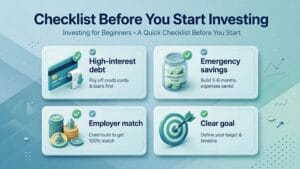
Investing for Beginners: A Quick Checklist Before You Start

Investing works best when your foundation is stable. Check these four things first:

  • High-interest debt. Paying off a credit card with a high interest rate often beats investing, because the interest you avoid can be larger than what you might earn. See our plan on how to get out of debt.
  • Emergency savings. Keep a cushion so you never have to sell investments at a bad time. Our guide to sinking fund vs emergency fund explains how to organize your savings.
  • An employer match. If your employer matches retirement contributions, that is extra money you should usually capture first.
  • A clear goal. Know what the money is for and when you will need it.

investing for beginners guide with a simple step-by-step plan and growing savings

Investing for Beginners in 7 Simple Steps

Follow these seven steps in order. Most beginners can complete the setup in a single afternoon.

Step 1: Set Your Goals and Time Horizon

Write down what you are investing for, such as retirement, a home, or long-term wealth, and when you will need the money. Many people use five years as a rough guide: money you may need sooner is usually better kept in savings, while money for later goals can handle market ups and downs.

Step 2: Decide How Much You Can Invest

Start with an amount you can keep up, even if it is small. A budget makes investing for beginners much easier, and our guide to the 50/30/20 rule shows where investing fits. For a full overview, read our guide on how to budget.

Step 3: Choose the Right Account

Your account affects taxes and access to your money. Here are the most common options:

Account How It Works Good For
Workplace plan (such as a 401(k)) Contributions come from your paycheck, and some employers add a match Retirement, especially if there is a match
Traditional IRA An individual retirement account with potential tax benefits on contributions Retirement savings outside work
Roth IRA Contributions are made with after-tax money, and qualified withdrawals can be tax-free Long-term retirement savings
Taxable brokerage account A flexible account with no special tax advantages Goals other than retirement

Retirement accounts have rules about contributions, income, and withdrawals, and those rules change over time. Check the current details on the IRS website, or ask a qualified tax professional.

Step 4: Learn the Basic Types of Investments

You do not need to master every product. Understanding these basics is enough to start:

Investment What It Is General Risk Level
Stocks Shares of ownership in a company Higher, with larger ups and downs
Bonds Loans to a government or company that pay interest Usually lower than stocks, but not risk-free
Mutual funds Pooled money invested in many assets, priced once a day Depends on what the fund holds
ETFs Funds that trade on an exchange like a stock Depends on what the fund holds
Index funds Funds that track a market index at low cost Follows the market they track
Target-date funds Funds that adjust their mix as a goal date gets closer Becomes more conservative over time

If you are comparing fund types, read our guide on ETF vs mutual fund to see how they differ on fees, taxes, and trading.

Step 5: Pick Low-Cost, Diversified Investments

For investing for beginners, a broad index fund is a common starting point, because it spreads your money across many companies and usually has low fees. Diversification means you do not rely on any single company, which lowers the risk that one bad result damages your whole portfolio.

Step 6: Invest Regularly and Automate It

The easiest habit in investing for beginners is automation. Set up automatic monthly contributions, so investing happens without effort. Putting in the same amount on a schedule is called dollar-cost averaging, and our guide to dollar-cost averaging explains how it works and its limits.

Step 7: Review Once or Twice a Year

Check that your goals, amounts, and investments still match, then leave your plan alone. Frequent checking and changing usually leads to emotional decisions, which can hurt long-term results.

Investing for Beginners: How Much Should You Invest?

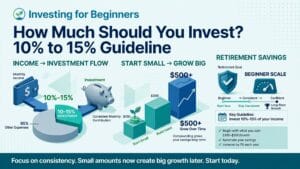
There is no single right number, because it depends on your income, debts, and goals. A common guideline for retirement is to save around 10% to 15% of your income, including any employer match, but treat this as a starting point rather than a rule. If that feels like too much, begin with a smaller amount and raise it when your income grows.

If you are starting with a small amount, our guides on how to invest $100 and how to invest $500 show how to begin at different levels.

investing for beginners guide with a simple step-by-step plan and growing savings

Investing for Beginners: How Risk and Diversification Work

All investing involves risk, and higher potential returns usually come with larger swings in value. Understanding risk is a key part of investing for beginners, because it helps you stay calm when markets fall.

  • Risk tolerance. How large a drop in value you can handle without panicking and selling.
  • Time horizon. The longer you can leave money invested, the more time it has to recover from downturns.
  • Diversification. Spreading money across many investments so one failure does not ruin your plan.

Diversification does not remove risk or guarantee a profit, but it can reduce the damage from any single investment.

How Fees Affect Your Returns

Fees quietly reduce your returns every year, so they matter a lot over decades. The main cost is the expense ratio, an annual percentage charged by a fund. Here is what different expense ratios cost each year on a $10,000 balance:

Expense Ratio Yearly Cost on $10,000
0.05% $5
0.50% $50
1.00% $100

The gap grows as your balance grows, so comparing costs is one of the easiest wins in investing for beginners and one of the simplest ways to improve your results. Also check for trading commissions and account fees before you invest.

What Could Regular Investing Grow Into?

Here is a hypothetical example, assuming an average return of 7% a year, compounded monthly. This return is only an assumption for illustration, real returns change every year, and your investments can lose value:

Years Total You Contribute at $200 a Month Estimated Value
10 years $24,000 About $34,600
20 years $48,000 About $104,200
30 years $72,000 About $244,000

The lesson in investing for beginners is that consistency and time usually matter more than the size of any single deposit.

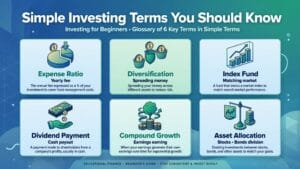
Investing for Beginners: Simple Terms You Should Know

  • Expense ratio: the yearly fee a fund charges, shown as a percentage.
  • Diversification: spreading money across many investments to reduce risk.
  • Index fund: a fund that tries to match the performance of a market index.
  • Dividend: a payment some companies make to their shareholders.
  • Compound growth: earnings that begin to earn their own earnings over time.
  • Asset allocation: how your money is divided between stocks, bonds, and other assets.

investing for beginners guide with a simple step-by-step plan and growing savings

Common Mistakes in Investing for Beginners

  • Waiting for the perfect moment. Time in the market usually matters more than timing the market.
  • Investing money you need soon. Short-term bills belong in savings.
  • Putting everything in one stock. A single company carries far more risk than a diversified fund.
  • Ignoring fees. A higher expense ratio reduces returns every year.
  • Chasing hype. Be cautious with anyone promising quick or guaranteed returns.
  • Panic selling. Selling after a drop can lock in losses and miss the recovery.
  • Investing while carrying expensive debt. High interest can outweigh what investments might earn.

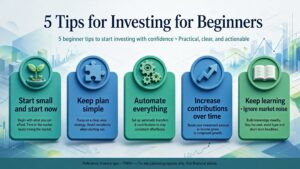
Tips for Investing for Beginners

  • Start small and start now. A habit started today beats a perfect plan started next year.
  • Keep your plan simple. One or two diversified funds are enough for many beginners.
  • Automate everything. Automatic transfers remove the need for willpower.
  • Increase contributions over time. Raise them whenever your income grows.
  • Keep learning. Read one trusted guide a month, and ignore daily market noise.

For free, plain-language education, the U.S. Securities and Exchange Commission runs Investor.gov, and you can check the background of a broker or advisor with FINRA.

investing for beginners guide with a simple step-by-step plan and growing savings

Where to Go Next

If you want to go deeper, these guides build on what you learned here:

Frequently Asked Questions About Investing for Beginners

What is the best way to start investing for beginners?

For many people, the best way is to cover high-interest debt and build a small emergency fund, open a retirement or brokerage account, choose a low-cost diversified fund, and invest a set amount every month.

How much money do I need to start investing?

Not much. Many brokers have no account minimum, and fractional shares let you start with small amounts such as $25 or $100. The habit matters more than the starting amount.

Is investing safe for beginners?

All investing involves risk, including the possible loss of money. Diversified, low-cost funds and a long time horizon can reduce risk, but they cannot remove it.

Should I invest or pay off debt first?

If your debt carries a high interest rate, paying it down often comes first, because avoiding interest has no market risk. For low-interest debt, investing alongside payments may make sense.

What should a beginner invest in?

Many beginners start with a broad index fund or ETF, because it is diversified and usually low cost. The right choice depends on your goals, time horizon, and comfort with risk.

How often should beginners check their investments?

Once or twice a year is enough for most long-term investors. Checking every day often leads to emotional decisions.

Can I start investing with $100?

Yes. Many beginners start with $100 or less, using fractional shares or a low-minimum fund. Our guide on how to invest $100 explains the steps.

Final Thoughts

Investing for beginners does not have to be complicated. Cover your basics, choose an account, pick a low-cost diversified fund, automate your contributions, and give your money time to grow. You will make mistakes along the way, and that is normal, but a simple plan that you follow consistently is better than a complex plan you abandon.

Ready to take the first step? Try our free Investment Growth Calculator to see how your contributions could grow, and start with our guide on how to start investing with little money.

This article is for educational purposes only and is not financial or investment advice. All investing involves risk, including the possible loss of money, and past performance does not guarantee future results. Consider speaking with a qualified professional about your specific situation.

How to Invest $500: 6 Smart Beginner Strategies (2026)

If you have $500 and want to know how to invest $500, the simple answer is this: make sure your basics are covered, open a brokerage or retirement account, put the money into a diversified low-cost fund, and keep adding to it over time. $500 is enough to start building real habits and to choose between several sensible paths, which this guide will walk you through.

You will learn how to invest $500 in six steps, six common ways beginners use it, when paying off debt or building savings may be a better first move, and what $500 could grow into over time. All growth examples are hypothetical, and investing always involves risk.

Is $500 Enough? How to Invest $500 as a Beginner

Yes. Many brokers have no account minimum and allow fractional shares, so $500 can buy a diversified fund, a starter position in a retirement account, or a split between investing and savings. If you only have $100 right now, our guide on how to invest $100 covers the same steps with a smaller amount.

The key is to match the money to your situation. The best answer to how to invest $500 depends on your debts, savings, and goals, not only on the market.

how to invest $500 with a beginner investment plan and growing savings

Before You Decide How to Invest $500: What Comes First?

Investing makes the most sense once your foundation is stable. Use this table to see what often deserves your $500 first:

Your Situation Often a Better First Move
Credit card debt at a high interest rate Pay down the debt first
No emergency savings at all Build a starter emergency fund
Employer retirement plan with a match Contribute enough to get the full match
Basics covered, money you will not need for years Invest in a diversified fund

This is general education, not personal advice, but it shows why the same $500 can have different best uses for different people. For help with debt, see our plan on how to get out of debt, and for the savings side, read our guide to sinking fund vs emergency fund.

How to Invest $500 in 6 Steps

Follow these steps in order. Most people finish them in less than an hour.

Step 1: Set Your Goal and Time Horizon

Your goal shapes how to invest $500. Decide when you will need the money. Goals more than five years away, such as retirement, can handle market ups and downs. Goals within a few years are usually better suited to savings.

Step 2: Choose Your Account Type

Common options are a taxable brokerage account and a retirement account such as an IRA. Retirement accounts offer tax advantages but have rules about contributions and withdrawals, and contribution limits change over time. You can read the current rules on the IRS website.

Step 3: Choose Your Investment

For most beginners, the starting point is a broad, low-cost index fund. If you are unsure whether an ETF or a mutual fund fits you better, read our comparison of ETF vs mutual fund.

Step 4: Decide How to Put the Money In

How to invest $500 also depends on timing. You can invest the full $500 at once, or split it into smaller amounts over several months. Investing at once puts all your money to work immediately, while spreading it out can feel safer. Our guide to dollar-cost averaging explains the staged approach.

Step 5: Place Your Order

Transfer the money, search for the fund, and enter the dollar amount if your broker supports fractional shares. Review everything before you confirm, and check the fund’s expense ratio first.

Step 6: Automate and Review

Set up automatic monthly contributions, even small ones, and review your plan once or twice a year. Consistency usually matters more than the first deposit.

how to invest $500 with a beginner investment plan and growing savings

How to Invest $500: 6 Smart Ways to Do It

Here are six common choices for people learning how to invest $500. Each one suits a different situation:

1. A Broad Index ETF

An ETF holds many investments in one purchase and trades on an exchange. A broad index ETF is a common choice for long-term money because it is diversified and usually low cost.

2. An Index Mutual Fund

Index mutual funds work in a similar way, but they are priced once per day and often make automatic monthly investing easy. Check whether the fund has a minimum investment.

3. An IRA Contribution

An IRA is an account, not an investment, so you still choose what to hold inside it. It can be a good home for long-term money because of its tax advantages, but withdrawals before retirement may have rules or penalties.

4. Splitting Between Savings and Investing

If you have no cushion, you might put part of the $500 into an emergency fund and part into investments. Even a few hundred dollars in savings can keep you from selling investments at a bad time.

5. Paying Off High-Interest Debt

Paying off high-interest debt is not investing in the market, but it can be one of the best uses of $500. Avoiding interest is like earning a return with no market risk. We compare this with investing in the next section.

6. A Robo-Advisor

A robo-advisor builds and manages a diversified portfolio for you based on a few questions. It is hands-off, but you should compare the management fee before you choose.

How to Invest $500 vs Paying Off Debt: A Simple Comparison

This is one of the most common questions when people decide how to invest $500. A simple estimate can help. Suppose you have a credit card with a 22% interest rate. If you use $500 to pay it off, you avoid roughly $110 a year in interest, using a simple estimate that ignores compounding and minimum payments.

If you invested the same $500 and earned a hypothetical 7% in a year, you would gain about $35, with no guarantee, because markets can also fall. The numbers are only illustrations, but they show why high-interest debt often deserves attention first. If you want to compare debt options, read our guide on debt consolidation vs balance transfer.

how to invest $500 with a beginner investment plan and growing savings

What Could $500 Grow Into?

Here is a hypothetical example, assuming an average return of 7% a year, compounded monthly. This return is only an assumption for illustration, real returns change every year, and your investments can lose value:

Years $500 Invested Once $500 Plus $100 a Month Total You Contribute
10 years About $1,005 About $18,300 $12,500
20 years About $2,020 About $54,100 $24,500
30 years About $4,060 About $126,100 $36,500

The lesson is the same as with smaller amounts: the first $500 helps, but adding to it regularly is what builds meaningful results. Test your own numbers in our free Investment Growth Calculator.

How to Invest $500 and Keep Fees Low

Fees come out of your returns every year, even on small balances. The main cost is the fund’s expense ratio, an annual percentage. Here is what different expense ratios cost on $500 for one year:

Expense Ratio Yearly Cost on $500
0.05% $0.25
0.50% $2.50
1.00% $5.00

The dollar amounts look small now, but they grow as your balance grows. Also check for trading commissions and account fees before you invest.

How to Invest $500: Sample Plans for Different Situations

These examples are illustrations, not recommendations. They show how the same question, how to invest $500, can lead to different choices:

Situation Possible Use of $500
Carries a credit card balance at a high rate Put most or all toward the card, since avoiding interest has no market risk
Has no emergency savings Put $300 in a starter emergency fund and invest $200 in a diversified fund
Has savings and no high-interest debt Invest the full $500 in a diversified fund or an IRA, then add monthly
Nervous about timing the market Invest $100 a month for five months instead of all at once

Risks to Understand Before You Invest $500

All investing involves risk, including the possible loss of money. Keep these points in mind:

  • Prices fluctuate. Even diversified funds can fall during downturns.
  • Single stocks are riskier. One company can drop sharply, so many beginners prefer diversified funds.
  • Be careful with promises. Anyone guaranteeing high returns deserves skepticism.
  • Do not invest money you need soon. Short-term bills belong in savings.

The U.S. Securities and Exchange Commission offers free investor education at Investor.gov, and you can check a broker’s background with FINRA.

how to invest $500 with a beginner investment plan and growing savings

How to Invest $500 Without Straining Your Budget

If you do not have $500 sitting around, you can build it. Look for it in your wants category, in a bonus, or in a tax refund. Investing belongs in the 20% savings and debt category of the 50/30/20 rule, and our guide on how to budget shows how to create room for it. For a broader overview, read our guide on how to start investing with little money.

Common Mistakes When Learning How to Invest $500

  • Ignoring high-interest debt. Interest you pay can outweigh what you might earn.
  • Skipping emergency savings. Without a cushion, you may be forced to sell at a bad time.
  • Putting everything in one stock. A single company carries far more risk than a diversified fund.
  • Ignoring fees. Always check the expense ratio and account fees.
  • Trying to time the market. Waiting for the perfect moment often means missing months of growth.
  • Stopping after the first deposit. Regular contributions drive long-term results.

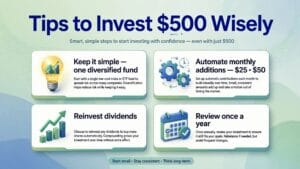
Tips for How to Invest $500 Wisely

These habits help you keep how to invest $500 simple and sustainable:

  • Keep it simple. One diversified fund is enough to start.
  • Automate monthly additions. Even $25 or $50 a month adds up.
  • Reinvest dividends. It helps your balance grow faster over time.
  • Review once a year. Check that your plan still matches your goals.

how to invest $500 with a beginner investment plan and growing savings

Frequently Asked Questions About How to Invest $500

What is the best way to invest $500?

For many beginners with long-term goals and no high-interest debt, a low-cost, diversified index fund or ETF is a common choice. The best way depends on your goals, time frame, and financial situation.

Should I invest $500 or pay off debt?

If your debt carries a high interest rate, paying it down often makes sense first, because avoiding interest has no market risk. For low-interest debt, investing may be a reasonable alternative.

Can I invest $500 in an IRA?

Yes, you can contribute $500 to an IRA as long as you are within the contribution rules. The account is only the container, so you still choose what to invest in.

How much will $500 grow in 10 years?

No one knows. If you assume 7% a year, which is only an assumption, $500 could grow to about $1,000. Real results will vary and can be lower.

Is $500 enough to start investing in stocks?

Yes. With fractional shares and no-minimum accounts, $500 is enough to start. A diversified fund usually involves less risk than a few individual stocks.

Should I invest $500 all at once or over time?

Both are reasonable. Investing at once puts all your money to work immediately, while spreading it out can reduce the stress of bad timing.

Final Thoughts

Learning how to invest $500 is mostly about order. Cover high-interest debt and a small cushion first, then put what is left into a diversified low-cost fund and keep adding to it. The first $500 matters, but the habit of investing every month matters more.

Ready to put how to invest $500 into practice? Try our free Investment Growth Calculator to estimate how your contributions could grow, and read our guide on how to invest $100 for a smaller starting point.

This article is for educational purposes only and is not financial or investment advice. All investing involves risk, including the possible loss of money, and past performance does not guarantee future results. Consider speaking with a qualified professional about your specific situation.

Dollar-Cost Averaging Explained: How It Works and When to Use It

One of the biggest fears for new investors is putting money into the market right before it drops. Dollar-cost averaging is a simple strategy designed to take that fear out of investing. Instead of trying to guess the perfect moment to buy, you invest the same amount of money on a regular schedule, no matter what the market is doing.

In this guide you will learn what dollar-cost averaging is, how it works with a clear example, how it compares with investing a lump sum, and how to set it up step by step. You will also learn where it helps, where it falls short, and the mistakes to avoid.

What Is Dollar-Cost Averaging?

Dollar-cost averaging is an investing method where you put a fixed amount of money into the same investment at regular intervals, such as $100 every month. You keep investing on schedule whether prices are high, low, or somewhere in between.

Because the dollar amount stays the same, you automatically buy more shares when the price is low and fewer shares when the price is high. Over time, this can smooth out your average purchase price. The idea behind dollar-cost averaging is not to beat the market, but to remove the stress of timing it and to turn investing into a steady habit.

How Dollar-Cost Averaging Works: A Simple Example

Imagine you invest $200 every month for six months into the same fund, and the share price moves up and down. These numbers are illustrative, but they show how dollar-cost averaging works in practice:

Month Amount Invested Share Price Shares Bought
1 $200 $20 10.00
2 $200 $16 12.50
3 $200 $10 20.00
4 $200 $12 16.67
5 $200 $16 12.50
6 $200 $20 10.00

In total, you invested $1,200 and bought about 81.67 shares. Your average cost per share is about $14.69, which is lower than the simple average of the six prices, about $15.67. When the price returns to $20 in month six, your shares are worth about $1,633. If you had invested the entire $1,200 in month one at $20, you would own 60 shares worth only $1,200 at the same final price.

This example shows the strength of dollar-cost averaging in a bumpy market, because the dip in months two to four let you buy more shares at lower prices. It does not guarantee a profit, and in a market that rises steadily, the result can look different, as you will see next.

Benefits of Dollar-Cost Averaging

  • Removes the pressure of timing. You do not need to predict highs and lows, which even professionals struggle to do.
  • Builds a habit. Investing the same amount every month makes saving automatic and consistent.
  • Reduces emotional decisions. A fixed plan helps you avoid panic selling or buying out of excitement.
  • Works with small amounts. You can start with $25 or $50, which makes investing accessible on any budget.
  • Lowers the risk of one bad entry. Spreading purchases over time means no single price decides your whole result.

Dollar-Cost Averaging vs Lump Sum Investing

Lump sum investing means putting all of your available money into the market at once. Dollar-cost averaging spreads the same money over many purchases. Here is how they compare:

Feature Dollar-Cost Averaging Lump Sum
How you invest Equal amounts on a schedule All at once
Timing risk Lower, spread over time Higher, one entry point
Emotional comfort Easier for nervous investors Harder if the market drops soon after
Potential return May lag in rising markets Often higher when markets rise
Best for Regular income and steady investing A large sum you already have

Research from large fund companies has found that investing a lump sum right away has beaten dollar-cost averaging in a majority of historical periods, because markets tend to rise over the long run and money that sits in cash misses that growth. However, for most people the question is not really lump sum vs dollar-cost averaging. If you earn a paycheck and invest from each one, you are already dollar-cost averaging by default.

When Dollar-Cost Averaging Makes Sense

  • You invest from your regular paycheck, which is how most people build wealth.
  • You are new to investing and worry about buying at the wrong time.
  • You receive a large sum and want to ease into the market over several months.
  • You want a simple, automatic plan that does not require constant attention.

When This Strategy May Not Be the Best Choice

  • You already have a large lump sum and a long time horizon. Investing it all at once has often done better historically, though it feels riskier.
  • The fees are high. If every purchase triggers a trading fee, frequent small investments can cost more than they should.
  • You need the money soon. Money you will need within a few years is usually safer outside the stock market.

How to Start Dollar-Cost Averaging Step by Step

You can set up a dollar-cost averaging plan in less than an hour. Follow these five steps:

Step 1: Build a small safety net first. Keep emergency savings separate so you never have to sell investments in a bad moment. If you need a framework for your monthly budget, see our guide to the 50/30/20 rule.

Step 2: Choose an amount you can keep up. Pick a number that fits your budget even in a tight month. Consistency matters more than size, and you can always increase it later.

Step 3: Pick a diversified investment. Many beginners use a low-cost index fund or ETF that holds hundreds of companies. If you are unsure which type to choose, read our comparison of ETF vs mutual fund.

Step 4: Choose a schedule. Weekly, every two weeks, or monthly all work. Many people match the schedule to their paycheck so investing happens right after payday.

Step 5: Automate and leave it alone. Set up automatic transfers and automatic investing through your broker or retirement plan. Check in a few times a year, not every day.

What to Invest in With This Strategy

Dollar-cost averaging works best with broadly diversified investments, such as a total market or large-company index fund. These spread your money across many businesses, which lowers the risk of any single company hurting your results. It is usually a poor fit for a single risky stock, because regular buying does not protect you if that company keeps falling.

Look at the fund’s expense ratio and any fees before you start, because costs reduce your returns every year. For a deeper look at costs, taxes, and account options, see our guide on how to start investing with little money.

How Often Should You Use Dollar-Cost Averaging?

There is no magic schedule. Studies of different frequencies tend to show small differences, so choose the one that fits your income and keeps you consistent. Here is a simple way to think about it:

  • Monthly: the easiest to track and the most common choice.
  • Every two weeks: matches a biweekly paycheck.
  • Weekly: works well if your broker charges no trading fees and supports fractional shares.

Dollar-Cost Averaging in a 401(k)

If you contribute to a workplace retirement plan such as a 401(k), you are already using dollar-cost averaging. A fixed percentage of every paycheck goes into your chosen funds, and your purchases happen automatically at whatever the price is that day. If your employer offers a match, contribute at least enough to receive it, because that is extra money added to your plan.

This is one reason retirement plans work so well for beginners. The investing is automatic, the amounts are steady, and you are less likely to react to market news. You can estimate how steady contributions might grow with our free Investment Growth Calculator.

What Could Steady Monthly Investing Add Up To?

Small, regular amounts can grow into something meaningful because of compounding, which means your earnings start earning too. Here is a hypothetical example of investing $200 per month with an assumed average yearly return of 7%. This return is only an assumption for illustration, real returns vary from year to year and are never guaranteed:

Years Total You Contribute Estimated Value
10 years $24,000 About $34,600
20 years $48,000 About $104,200
30 years $72,000 About $244,000

The lesson is that time and consistency matter more than the size of any single deposit. Starting early, even with a small amount, gives compounding more years to work. You can test your own numbers in our Investment Growth Calculator.

Tips to Make Your Investing Plan Easier to Stick With

  • Increase the amount when your income rises. Even a small raise to your monthly contribution can add up over the years.
  • Use a separate account. Keeping investments apart from everyday spending makes them harder to touch.
  • Review once or twice a year. Check that your amount and funds still match your goals, then leave it alone.
  • Ignore the daily headlines. Market news changes constantly, and a steady plan is built to ride through it.

Risks and Limitations to Keep in Mind

This approach is a useful habit, but it is not magic. Here is what it cannot do:

  • It does not guarantee a profit. If the investment keeps falling, you can still lose money.
  • It does not protect against a falling market. It only changes the price you pay along the way.
  • It can lag a rising market. Money waiting to be invested may miss early gains.
  • It does not replace a good investment. A poor or very costly fund stays poor even with regular buying.

All investing involves risk, including the possible loss of money. The U.S. Securities and Exchange Commission offers free, plain-language investor education at Investor.gov, and you can check the background of a broker or advisor with FINRA.

Common Mistakes to Avoid

  • Stopping when the market falls. Dips are when the strategy buys more shares at lower prices. Pausing defeats the purpose.
  • Investing money you may need soon. Keep short-term money separate from long-term investments.
  • Ignoring fees. High fund costs or trading fees can eat into your returns.
  • Chasing one risky stock. Choose diversified investments instead of putting everything into one company.
  • Investing while carrying expensive debt. High-interest debt can cost more than investments typically earn, so see our plan for how to get out of debt first.
  • Checking your balance every day. Frequent checking often leads to emotional decisions.

Frequently Asked Questions About Dollar-Cost Averaging

What is dollar-cost averaging in simple terms?

It means investing the same amount of money at regular intervals, such as every month, regardless of the price. You buy more shares when prices are low and fewer when prices are high.

Is dollar-cost averaging a good strategy for beginners?

Yes, it is one of the most beginner-friendly approaches because it is simple, works with small amounts, and builds a steady habit without requiring you to time the market.

Does dollar-cost averaging reduce risk?

It reduces the risk of investing everything at a bad moment, but it does not remove market risk. Your investments can still lose value if the market falls.

Is dollar-cost averaging better than lump sum investing?

Not always. Historically, lump sum investing has often performed better in rising markets, while dollar-cost averaging can feel safer and works well when you invest from regular income.

How often should I use dollar-cost averaging?

Choose a schedule you can keep, such as monthly or every paycheck. Consistency matters more than the exact frequency.

Can I use dollar-cost averaging with ETFs and mutual funds?

Yes. It works with both ETFs and mutual funds, and many brokers let you automate recurring investments in either one.

Final Thoughts

Dollar-cost averaging will not make you rich overnight, but it can make you a consistent investor, and that matters more than perfect timing. Choose a diversified, low-cost investment, pick an amount you can keep up, automate it, and stay with the plan through the ups and downs.

Ready to see what steady investing can do? Try our free Investment Growth Calculator to estimate how your monthly contributions could grow, and explore our other beginner guides to keep building your plan.

This article is for educational purposes only and is not financial or investment advice. All investing involves risk, including the possible loss of money. Consider speaking with a qualified professional about your specific situation.