
You may have come across the term bond sinking fund while reading about corporate bonds, studying for a finance class, or researching where to put your money. It sounds technical, but the idea behind it is surprisingly simple. A bond sinking fund is a way for a company or government to set aside money regularly so it can repay its bondholders without being hit by one giant bill at the end.
If you are a beginner investor, understanding how a bond sinking fund works helps you judge how safe a bond might be, what could happen to your investment before it matures, and which questions to ask before you buy. In this guide, you will learn what a bond sinking fund is, how it works step by step, the main types, a simple numerical example, and the benefits and risks for investors.
What Is a Bond Sinking Fund?
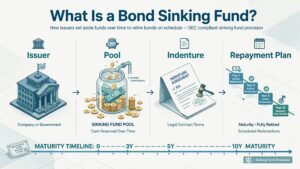
A bond sinking fund is a pool of money that a bond issuer sets aside over time to pay off its bonds. The issuer is the company or government that borrowed money by selling bonds. Instead of waiting until the maturity date and repaying the entire amount at once, the issuer makes regular payments into a bond sinking fund or uses those payments to retire part of the debt early.
The rules are written into the bond’s legal agreement, which is called the indenture. The section describing the payment schedule is often called the sinking fund provision. It tells you how much the issuer must set aside, how often, and what it must do with the money. The SEC’s investor education site describes this kind of sinking fund redemption as a requirement for the issuer to redeem a portion of the bonds on a fixed schedule.
In simple terms, a bond sinking fund is a repayment plan built into the bond. The goal is to reduce the chance that the issuer will struggle to repay everything when the bond matures. For a quick definition of the general concept, see our guide on what is a sinking fund.
Why Do Issuers Use a Bond Sinking Fund?
Issuers do not create a bond sinking fund only to be generous. There are practical reasons on both sides of the deal.
- It lowers the repayment burden at maturity. Without a bond sinking fund, the issuer may owe a very large lump sum, sometimes called a balloon payment, on a single day.
- It can reduce borrowing costs. Investors often see a bond sinking fund as a safety feature, so the issuer may be able to offer a lower interest rate than it otherwise would.
- It builds investor confidence. A clear repayment schedule shows that the issuer has a plan to pay back the debt.
- It spreads the cost over time. Regular payments are easier to manage than one huge payment later.
This is very similar to the personal finance habit of saving a little each month for a known future expense. If that idea is new to you, read sinking fund vs emergency fund to see how households use the same principle.
How a Bond Sinking Fund Works, Step by Step
Here is how a typical bond sinking fund operates from start to finish.
- The issuer sells bonds. A company raises, for example, $10 million by selling bonds that mature in 10 years.
- The indenture includes a sinking fund provision. It states how much the issuer must set aside and when, such as every year starting in year five.
- The issuer makes regular payments. These payments go to a trustee, an independent party that manages the money for bondholders.
- The money is used to retire bonds. The trustee uses the funds to buy back bonds or to call some of them for early redemption.
- The remaining bonds mature as planned. By the end, most of the debt has already been paid, so the final payment is smaller.
The key point is that a bond sinking fund does not always mean the money sits in a savings account. In many cases, the issuer uses the payments directly to reduce the amount of bonds outstanding.

How Are Bonds Retired Through a Sinking Fund?
Most bond sinking fund provisions allow the issuer to retire bonds in one of two ways.
1. Buying bonds in the open market
The issuer or trustee buys the bonds on the market at the current price. If interest rates have risen and the bonds trade below face value, this can be cheaper for the issuer. Investors who sell receive the market price.
2. Calling bonds at a set price
The issuer calls a portion of the bonds, often chosen by lottery, and pays the bondholders a set price, commonly the face value (also called par value). If your bond is selected, you receive that price and your bond ends, even if you wanted to keep holding it.
The issuer usually chooses whichever method costs less. If bond prices are below par, buying in the open market makes sense. If prices are above par, calling at par is cheaper. This is why a bond sinking fund can affect investors in different ways depending on interest rates.
Types of Bond Sinking Fund Provisions
Not every bond sinking fund looks the same. Here are the common variations beginners should know.
- Fixed payment schedule: The issuer retires a set amount of bonds on specific dates, for example $1 million every year.
- Increasing payments: The amount grows over time, so early payments are small and later ones are larger.
- Optional (accelerated) provisions: The issuer may retire more than the minimum if it wants to, which can shorten the life of the debt.
- Balloon with a sinking fund: A portion is retired through the fund, and the remainder is paid at maturity.
Always read the details of the specific bond, because the exact terms of a bond sinking fund vary from one issue to another.

A Simple Bond Sinking Fund Example
Numbers make the idea much easier to understand. Imagine a company issues $10 million in bonds that mature in 10 years. Instead of repaying everything at the end, it decides to build a bond sinking fund that earns an assumed 4 percent per year.
The standard formula for the yearly payment into a sinking fund is:
Payment = Target amount × r ÷ [(1 + r)n − 1]
Here, r is the annual return and n is the number of years. Using our example:
- Target amount: $10,000,000
- Annual return (r): 4 percent, or 0.04
- Years (n): 10
The calculation gives a yearly payment of roughly $832,900. By depositing that amount every year, the company would reach about $10 million at the end of 10 years, because the money also grows with interest. This is an illustration only, since real issuers may retire bonds directly instead of investing the cash.
The same math works for personal goals. Our free Sinking Fund Planner lets you enter a target and a deadline and shows how much to save each month.
Benefits of a Bond Sinking Fund for Investors
For a beginner, a bond sinking fund can be a helpful sign of discipline. Here are the main benefits.
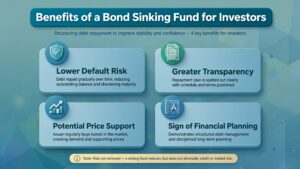
- Lower default risk: Because debt is paid down gradually, the issuer faces a smaller payment at maturity, which can make a default less likely.
- Greater transparency: The repayment plan is spelled out, so investors know how the debt will be handled.
- Potential price support: When an issuer buys bonds in the open market, that demand can help support the bond’s price.
- A sign of financial planning: Issuers that commit to a bond sinking fund often show a structured approach to managing debt.
Remember that a bond sinking fund reduces risk but does not remove it. A weak issuer can still fail to make its sinking fund payments, and no feature makes a bond completely safe.
Risks and Drawbacks of a Bond Sinking Fund
There are also trade-offs, and beginners should understand them before investing.
- Call risk: If your bond is called, you receive your money back earlier than you expected. This often happens when interest rates have fallen, which means you may have to reinvest at a lower rate. FINRA explains this in its guide to callable bonds, including how sinking fund redemptions fit in.
- Reinvestment risk: After your bond is retired, finding another investment with the same yield may be difficult.
- Uncertain timing: With lottery-style calls, you cannot know in advance whether your particular bond will be selected.
- Possible lower yield: Because a bond sinking fund makes the investment safer, these bonds may pay slightly lower interest than similar bonds without one.
In short, a bond sinking fund gives you more safety but less control. Whether that is a good trade depends on your goals and your comfort with risk.
Bond Sinking Fund vs a Personal Sinking Fund
The term “sinking fund” appears in two very different places, so it helps to separate them.
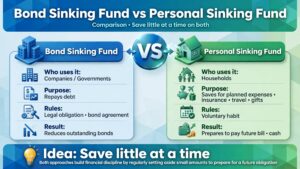
- Who uses it: A bond sinking fund is used by companies and governments. A personal sinking fund is used by households.
- Purpose: A bond sinking fund repays debt. A personal sinking fund saves for planned expenses like insurance, travel, or gifts.
- Rules: A bond sinking fund is a legal obligation written into the bond agreement. A personal sinking fund is a voluntary habit.
- Result: A bond sinking fund reduces outstanding bonds. A personal sinking fund prepares you to pay a future bill in cash.
The idea behind both is the same: save a little at a time so a big payment does not become a problem. To see household examples, check our list of sinking fund categories.
Which Bonds Have a Sinking Fund?
A bond sinking fund is more common in certain parts of the market.
- Corporate bonds: Many corporate bonds, especially long-term ones, include a sinking fund provision.
- Municipal bonds: Some bonds issued by cities, states, and public agencies use a sinking fund to repay debt over time. You can look up official documents for these bonds on the EMMA municipal bond website.
- Not typical for Treasuries: U.S. Treasury securities generally do not use a sinking fund. You can learn how they work on TreasuryDirect.
The only way to know for sure is to check the bond’s prospectus or offering documents, which describe the sinking fund terms.
How to Check If a Bond Has a Sinking Fund
- Find the offering documents. Look for the prospectus or official statement for the bond issue.
- Search for the key terms. Look for phrases such as “sinking fund,” “mandatory redemption,” or “sinking fund provision.”
- Note the schedule. See when payments start and how much is retired each year.
- Check the call price. Find out whether bonds are called at par or at another price.
- Compare with similar bonds. Look at yield and maturity against bonds that have no sinking fund.
Your broker or a financial professional can also help you read these documents if the language feels confusing.
Is a Bond Sinking Fund Good for Beginner Investors?
For many beginners, a bond sinking fund is a positive feature, not a requirement. It shows that the issuer has a plan to repay its debt, and that can add a layer of comfort. At the same time, the possibility of an early call means you should not count on holding the bond until the final maturity date.
If you are just starting to invest, consider building a diversified portfolio rather than focusing on one feature of a single bond. Our guide on how to start investing with little money is a good place to begin, and you can find more in our investing guides. Keep in mind that this article is educational, so consider speaking with a qualified financial professional before making investment decisions.
Common Mistakes Beginners Make
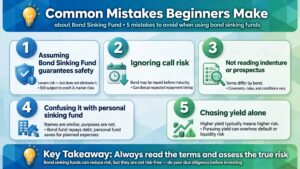
- Assuming a bond sinking fund guarantees safety. It lowers risk but does not eliminate it.
- Ignoring call risk. Many beginners forget that a bond may be repaid before maturity.
- Not reading the indenture or prospectus. The terms of each bond sinking fund are different.
- Confusing it with a personal sinking fund. The names are the same, but the purposes are not.
- Chasing yield alone. A higher yield may come with more risk, with or without a sinking fund.
Frequently Asked Questions
What is a bond sinking fund in simple words?
It is a repayment plan where the bond issuer regularly sets aside money or retires part of its bonds so it does not face one huge payment at maturity.
Is a bond sinking fund good for investors?
It can be, because it may lower default risk and show disciplined debt management. However, it also adds call risk, which means your bond could be repaid early.
What happens if my bond is called through a sinking fund?
You receive the call price, usually the face value, and your bond ends. You may then need to reinvest your money, possibly at a lower interest rate.
Do all bonds have a sinking fund?
No. A bond sinking fund appears mostly in some corporate and municipal bonds. U.S. Treasury securities generally do not have one.
What is the difference between a sinking fund and a bond sinking fund?
A personal sinking fund is a savings habit for planned expenses. A bond sinking fund is a legal repayment mechanism used by issuers to pay back bondholders. You can see how the personal version works in our free financial tools.
Where can I find the sinking fund terms of a bond?
Check the bond’s prospectus, official statement, or indenture, and look for the sinking fund provision.
Final Thoughts
A bond sinking fund is a simple but powerful idea: pay back debt gradually instead of all at once. For investors, it can signal stronger planning and lower default risk, but it also brings call and reinvestment risk. Before buying any bond, read its terms, understand how the bond sinking fund works, and decide whether the trade-off fits your goals.
The same principle works in your own life. Pick one upcoming expense, divide it by the months left, and start saving today with our free financial tools.
Disclaimer: This article is for educational purposes only and is not financial or investment advice. Consider speaking with a qualified financial professional about your personal situation.