Small Business Tax Deductions: 12 You Might Be Missing

Many new business owners pay more tax than they need to simply because they don’t know which small business tax deductions they qualify for. Deductions reduce your taxable income, which directly lowers your tax bill — but only if you claim them correctly and keep proper records. This guide covers 12 commonly overlooked deductions, how they work, and what documentation you need to claim them with confidence.

This article is for general educational purposes only. Tax rules vary by business structure, location, and individual circumstances — always confirm specifics with a qualified tax professional before filing.

Why Small Business Tax Deductions Matter So Much

Every legitimate deduction reduces the amount of income the government taxes you on. For a small business with modest margins, properly claimed deductions can represent thousands of dollars in tax savings each year — money that stays in the business or in your pocket instead of going toward taxes you didn’t actually owe.

1. Home Office Deduction

If you use part of your home regularly and exclusively for business, you may be able to deduct a portion of your rent or mortgage, utilities, insurance, and repairs based on the percentage of your home used for business purposes. This is one of the most commonly missed small business tax deductions because owners assume it only applies to a dedicated separate room, when a clearly defined work area can also qualify.

small business tax deductions checklist

2. Business Mileage and Vehicle Expenses

If you use a vehicle for business purposes — client visits, supply runs, deliveries — you can generally deduct either actual vehicle expenses or a standard mileage rate, whichever method you choose. Keeping a simple mileage log with dates, destinations, and business purpose is essential, since this is one of the most commonly audited small business tax deductions.

3. Business Insurance Premiums

Premiums for insurance policies that protect your business — liability insurance, professional insurance, or business property insurance — are generally deductible business expenses, separate from personal insurance costs.

small business tax deductions checklist

4. Professional Services and Fees

Fees paid to accountants, bookkeepers, lawyers, and consultants for business-related work are typically deductible. This includes tax preparation fees specifically related to your business filings.

5. Software and Subscriptions

Many small business owners overlook this category of small business tax deductions entirely. Software subscriptions used for invoicing, project management, design, accounting, or communication with clients are generally deductible business expenses, even when billed monthly in smaller amounts.

small business tax deductions checklist

6. Business Use of Your Phone and Internet

If you use your personal phone or internet connection for business purposes, you can typically deduct the business-use percentage of these costs. Keeping a record of how you calculated the percentage helps support the deduction if questioned later.

7. Advertising and Marketing Costs

Costs for advertising your business — social media ads, business cards, website hosting and design, promotional materials — are deductible expenses directly tied to generating revenue.

small business tax deductions checklist

8. Retirement Contributions for Self-Employed Individuals

Many self-employed business owners can contribute to specific retirement accounts designed for small business owners, and these contributions are often tax-deductible while simultaneously building long-term savings. Our guide on Roth IRA vs traditional IRA explains the tax tradeoffs relevant to retirement account choices, though self-employed individuals often have additional account options worth researching separately.

9. Business Travel Expenses

Travel undertaken primarily for business purposes — transportation, lodging, and a portion of meals — is generally deductible. Keep receipts and a clear record of the business purpose for each trip, since personal travel mixed with a small amount of business activity doesn’t automatically qualify the entire trip.

small business tax deductions checklist

10. Startup Costs

Costs incurred before your business officially opened — market research, initial advertising, legal fees for setting up the business structure — can often be deducted, sometimes spread over multiple years depending on the total amount and current tax rules.

11. Bad Debts (For Certain Business Types)

If your business extends credit to customers and some of that money becomes genuinely uncollectible, certain business structures may be able to deduct these bad debts, though specific rules apply depending on your accounting method.

small business tax deductions checklist

12. Continuing Education and Training

Courses, certifications, and training that maintain or improve skills required for your current business are often deductible, whereas education for an entirely new, unrelated field typically is not.

How to Actually Claim These Deductions

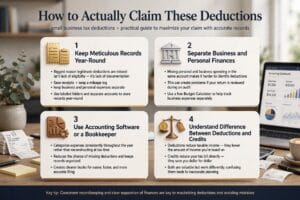
Keep Meticulous Records Year-Round

The biggest reason legitimate small business tax deductions get missed isn’t lack of eligibility — it’s lack of documentation. Save receipts, maintain a mileage log, and keep business and personal expenses in separate accounts from the start.

Separate Business and Personal Finances

Mixing personal and business spending in the same account makes it significantly harder to identify legitimate deductions at tax time and can create problems if your return is ever reviewed. Our free Budget Calculator can help you track business finances separately from personal spending as your venture grows.

Use Accounting Software or a Bookkeeper

Categorizing expenses consistently throughout the year, rather than reconstructing everything at tax time, dramatically reduces the chance of missing eligible small business tax deductions.

Understand the Difference Between Deductions and Credits

Deductions reduce your taxable income; credits reduce your tax bill directly, dollar for dollar. Both are valuable, but they work differently, and confusing the two can lead to inaccurate tax planning throughout the year.
small business tax deductions checklist

Common Mistakes That Cost Business Owners Money

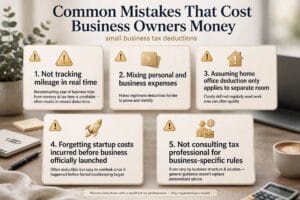
  • Not tracking mileage in real time. Reconstructing a year of business trips from memory at tax time is unreliable and often results in missed deductions.
  • Mixing personal and business expenses. This makes legitimate deductions harder to prove and identify.
  • Assuming the home office deduction only applies to a separate room. A clearly defined, regularly used work area can often qualify.
  • Forgetting startup costs incurred before the business officially launched. These are often deductible but easy to overlook since they happened before formal bookkeeping began.
  • Not consulting a tax professional for business-specific rules. Rules vary by business structure and location, and general guidance doesn’t replace personalized advice.
small business tax deductions checklist

Why Working With a Tax Professional Matters

While understanding common small business tax deductions helps you stay organized throughout the year, tax rules are detailed and change periodically. A qualified tax professional can confirm which deductions apply to your specific business structure and ensure you’re claiming everything you’re legitimately entitled to, while avoiding mistakes that could trigger a review. The IRS Small Business and Self-Employed Tax Center is also a reliable source for official, up-to-date guidance directly from the tax authority.

Building Deduction Tracking Into Your Business Habits

Rather than scrambling at tax time, build small habits throughout the year: photograph receipts immediately, log mileage after each business trip, and review your expense categories monthly. If you’re just getting your business finances organized, our guide on how to start a business with no money covers foundational steps for keeping business and personal finances separate from day one.

Final Thoughts

Small business tax deductions exist to ensure you’re only taxed on your actual profit, not your gross revenue — but claiming them requires organization and accurate records throughout the year, not just effort at tax time. Review this list against your own expenses, start tracking anything you may have missed, and confirm the specifics with a tax professional who understands your business structure.

As your business grows, keeping personal and business finances organized becomes even more important. Try our free Budget Calculator to stay on top of your numbers year-round.


How to Start a Business With No Money: 8 Realistic Steps

how to start a business with no money steps

Learning how to start a business with no money sounds impossible at first, but thousands of successful businesses started exactly this way — with resourcefulness instead of capital. While some industries genuinely require significant upfront investment, many service-based and digital businesses can launch with little more than time, skill, and a laptop. This guide covers 8 realistic steps to get started, even on a nearly nonexistent budget.

Step 1: Choose a Business Model That Doesn’t Require Capital

The single biggest factor in how to start a business with no money is choosing the right type of business from the beginning. Some models are naturally low-cost to launch:

  • Service-based businesses: Consulting, freelance writing, virtual assistance, tutoring — you’re selling your time and expertise, not inventory
  • Digital products: eBooks, templates, courses — created once, sold repeatedly with no ongoing production cost
  • Dropshipping or print-on-demand: No inventory investment since products are made and shipped only after a sale
  • Freelance skills you already have: Design, writing, coding, marketing — monetizing existing expertise requires no startup capital at all

Avoid business models requiring significant upfront inventory, equipment, or a physical location until you’ve validated demand and generated some initial revenue.

how to start a business with no money steps

Step 2: Validate Your Idea Before Spending Anything

Before building anything, confirm people actually want what you’re planning to offer. This doesn’t require money — it requires conversations. Talk to potential customers, post in relevant online communities, or offer a small version of your service to a few people for free or at a discount in exchange for honest feedback.

This step alone prevents one of the most common startup mistakes: investing time and effort into something nobody actually wants to pay for.

how to start a business with no money steps


Step 3: Use Free Tools to Build Your Foundation

You don’t need expensive software to start. Free or low-cost alternatives exist for nearly every business need:

  • Website: Free website builders or a simple landing page tool
  • Design: Free graphic design platforms for logos and marketing materials
  • Bookkeeping: Free spreadsheet templates or basic accounting software with free tiers
  • Marketing: Organic social media, free email marketing tiers, and word of mouth

The goal in the earliest stage isn’t polish — it’s proof that your business idea works before investing in premium tools.

how to start a business with no money steps

Step 4: Start as a Side Hustle First

One of the most realistic ways to learn how to start a business with no money is to build it alongside your current job, rather than quitting immediately. This approach lets you reinvest early revenue directly into the business while maintaining financial stability, rather than draining personal savings to cover basic expenses.

For more ideas on generating initial income while building your business, see our guide on 21 side hustle ideas to make extra money.

how to start a business with no money steps

Step 5: Trade Skills Instead of Paying for Services

If you need something you can’t do yourself — a logo, a website, legal advice — consider bartering skills with other freelancers or small business owners. A graphic designer might trade a logo design for social media management, for example. This is a common, practical way entrepreneurs fill skill gaps without spending cash they don’t have yet.

how to start a business with no money steps

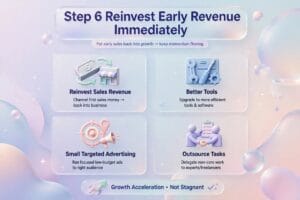
Step 6: Reinvest Early Revenue Immediately

Once you make your first sales, resist the urge to treat that money as personal income right away. Reinvesting early revenue back into the business — better tools, small amounts of targeted advertising, outsourcing a task that’s eating too much of your time — accelerates growth far more than letting the business stay stagnant at its bootstrapped starting point.

how to start a business with no money steps

Step 7: Keep Personal and Business Finances Separate From Day One

Even with no startup capital, opening a separate business bank account (many are free) and tracking business income and expenses separately from personal finances is critical. This makes tax time significantly easier and gives you a clear, honest picture of whether the business is actually profitable. Our free Budget Calculator can help you track this alongside your personal finances as the business grows.

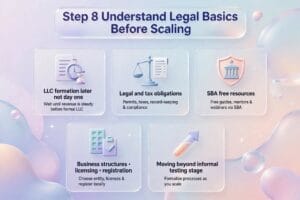
Step 8: Understand Legal Basics Before Scaling

You don’t need to form an LLC or hire a lawyer on day one, but as your business generates consistent revenue, understanding basic legal and tax obligations becomes important. The U.S. Small Business Administration offers free resources on business structures, licensing, and registration requirements that apply once your business moves beyond the informal, testing stage.

how to start a business with no money steps

Realistic Business Ideas That Require Little to No Capital

Freelance Services

Writing, design, virtual assistance, bookkeeping, or consulting in your area of expertise — all sellable with nothing more than a laptop and an internet connection.

Content Creation

Blogging, YouTube, or social media content built around a specific niche can eventually generate income through ads, sponsorships, or affiliate marketing, though this path typically takes longer to become profitable.

Reselling or Flipping

Buying underpriced or secondhand items and reselling them for profit requires minimal starting capital and can scale as profits are reinvested.

Coaching or Tutoring

If you have expertise in a subject, sport, or skill, coaching or tutoring others is a direct way to monetize knowledge you already possess.

how to start a business with no money steps

How to Fund Growth Once You’ve Started

Once your no-money business starts generating consistent revenue, you may eventually need small amounts of capital to scale. At that point, options include:

  • Reinvested profits: The most common and lowest-risk funding source for early-stage businesses
  • Small business grants: Available through various organizations, particularly for underrepresented business owners
  • Microloans: Smaller loan amounts specifically designed for early-stage small businesses
  • Crowdfunding: Useful for product-based businesses with a compelling story or pre-sale model

how to start a business with no money steps

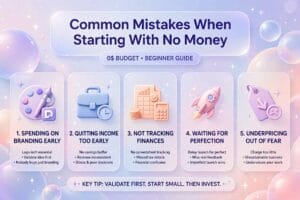
Common Mistakes When Starting With No Money

  • Spending on branding before validating the idea. A beautiful logo doesn’t matter if nobody wants what you’re selling.
  • Quitting a stable income too early. Without savings or consistent business revenue, this creates unnecessary financial stress that can hurt decision-making.
  • Not tracking finances from the start. Even a simple spreadsheet prevents confusion and missed tax obligations later.
  • Trying to do everything perfectly before launching. An imperfect launch that generates real feedback beats an endlessly delayed “perfect” one.
  • Underpricing services out of fear. New entrepreneurs often charge too little, which is unsustainable and undervalues the actual work being done.

how to start a business with no money steps

Final Thoughts

Figuring out how to start a business with no money comes down to choosing a low-capital business model, validating demand before spending, and reinvesting early revenue strategically. It won’t look like a big funded launch — it will look like consistent, resourceful progress, one client or sale at a time.

Once your business starts generating income, keeping your personal and business finances organized becomes essential. Try our free Budget Calculator to track your finances as your new venture grows.

21 Best Side Hustle Ideas to Make Extra Money in 2026

Looking for real side hustle ideas that actually work in 2026? Between rising costs and stagnant wages, more people than ever are turning to side income to cover bills, pay off debt, or build savings faster. This guide covers 21 practical side hustle ideas — organized by how much time, skill, or money they require — so you can find one that fits your actual schedule, not just an influencer’s highlight reel.

Side Hustle Ideas That Require No Startup Cost

These side hustle ideas are the easiest to start today, using skills or items you likely already have.

1. Freelance Writing

Businesses constantly need blog posts, product descriptions, and marketing copy. If you can write clearly, freelance platforms let you find paying clients within days, with no upfront investment required.

2. Virtual Assistant Work

Answering emails, managing calendars, and handling admin tasks remotely is one of the most in-demand side hustle ideas for people who are organized and reliable, requiring no special equipment beyond a laptop.

3. Sell Unused Items Online

Before considering other side hustle ideas, look around your home. Clothes, electronics, furniture, and collectibles sitting unused can be converted to cash quickly through online marketplaces.

4. Pet Sitting or Dog Walking

If you enjoy animals, pet-related side hustle ideas are flexible, require no certifications, and often pay well per hour compared to other entry-level options.

5. Tutoring or Teaching a Skill

Whether it’s academic subjects, a musical instrument, or a language, tutoring is one of the more rewarding side hustle ideas — you set your own rates and schedule around your existing commitments.

side hustle ideas make extra money

Side Hustle Ideas That Use a Skill You Already Have

6. Graphic Design

Logos, social media graphics, and marketing materials are constantly in demand. This is one of the higher-paying side hustle ideas for anyone with design skills and a portfolio to showcase.

7. Bookkeeping for Small Businesses

Small business owners frequently outsource bookkeeping rather than hire full-time staff. If you’re detail-oriented and organized, this is a steady, recurring side hustle idea with long-term client relationships.

8. Social Media Management

Many small businesses know they need a social media presence but don’t have time to manage it. Offering to run their accounts is a flexible side hustle that can often be done entirely on your own schedule.

9. Web or App Development

Technical skills translate directly into high-value freelance work. Even part-time, development-based side hustle ideas often pay significantly more per hour than non-technical alternatives.

10. Photography Services

Events, portraits, and product photography for small businesses are all realistic side hustle ideas for anyone with a camera and an eye for composition — no formal training required to get started.

Side Hustle Ideas That Use a Skill You Already Have
6. Graphic Design

Logos, social media graphics, and marketing materials are constantly in demand. This is one of the higher-paying side hustle ideas for anyone with design skills and a portfolio to showcase.

7. Bookkeeping for Small Businesses

Small business owners frequently outsource bookkeeping rather than hire full-time staff. If you're detail-oriented and organized, this is a steady, recurring side hustle idea with long-term client relationships.

8. Social Media Management

Many small businesses know they need a social media presence but don't have time to manage it. Offering to run their accounts is a flexible side hustle that can often be done entirely on your own schedule.

9. Web or App Development

Technical skills translate directly into high-value freelance work. Even part-time, development-based side hustle ideas often pay significantly more per hour than non-technical alternatives.

10. Photography Services

Events, portraits, and product photography for small businesses are all realistic side hustle ideas for anyone with a camera and an eye for composition — no formal training required to get started.

Side Hustle Ideas You Can Build Into Passive Income

11. Print-on-Demand Products

Designing artwork for print-on-demand platforms lets you sell physical products without handling inventory, shipping, or customer service — one of the more scalable side hustle ideas on this list.

12. Affiliate Marketing

Recommending products through a blog, social media, or YouTube channel and earning commission is a slower-building but potentially long-lasting side hustle, especially once you’ve built an audience.

13. Create and Sell an Online Course

If you have expertise in something, packaging it into a course means the work is front-loaded — once created, it can generate income with minimal ongoing effort.

14. Stock Photography

Licensing your photos or videos on stock media platforms is a side hustle idea that keeps earning from work you’ve already done, long after the original shoot.

Side Hustle Ideas You Can Build Into Passive Income
11. Print-on-Demand Products

Designing artwork for print-on-demand platforms lets you sell physical products without handling inventory, shipping, or customer service — one of the more scalable side hustle ideas on this list.

12. Affiliate Marketing

Recommending products through a blog, social media, or YouTube channel and earning commission is a slower-building but potentially long-lasting side hustle, especially once you've built an audience.

13. Create and Sell an Online Course

If you have expertise in something, packaging it into a course means the work is front-loaded — once created, it can generate income with minimal ongoing effort.

14. Stock Photography

Licensing your photos or videos on stock media platforms is a side hustle idea that keeps earning from work you've already done, long after the original shoot.

Side Hustle Ideas With Physical or Local Work

15. Rideshare or Delivery Driving

Flexible, app-based driving work remains one of the most accessible side hustle ideas — you control your own hours entirely, with no interview or application wait time.

16. Handyman or Home Repair Services

If you’re skilled with basic repairs, assembly, or small home projects, there’s steady demand in most neighborhoods for reliable, reasonably-priced help.

17. Cleaning Services

Residential and small office cleaning is a straightforward side hustle idea with low startup costs and consistent, repeat-client demand.

18. Yard Work and Landscaping

Seasonal but reliable, offering lawn care or landscaping help is one of the easiest side hustle ideas to start with equipment you may already own.

Side Hustle Ideas With Physical or Local Work
15. Rideshare or Delivery Driving

Flexible, app-based driving work remains one of the most accessible side hustle ideas — you control your own hours entirely, with no interview or application wait time.

16. Handyman or Home Repair Services

If you're skilled with basic repairs, assembly, or small home projects, there's steady demand in most neighborhoods for reliable, reasonably-priced help.

17. Cleaning Services

Residential and small office cleaning is a straightforward side hustle idea with low startup costs and consistent, repeat-client demand.

18. Yard Work and Landscaping

Seasonal but reliable, offering lawn care or landscaping help is one of the easiest side hustle ideas to start with equipment you may already own.

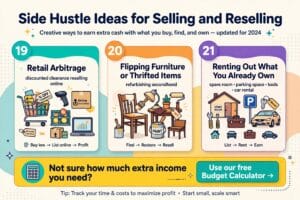
Side Hustle Ideas for Selling and Reselling

19. Retail Arbitrage

Buying discounted or clearance items and reselling them online for profit is a legitimate side hustle for people who enjoy shopping and spotting deals.

20. Flipping Furniture or Thrifted Items

Refurbishing and reselling furniture or secondhand finds combines creativity with profit — a popular side hustle idea for people who enjoy hands-on projects.

21. Renting Out What You Already Own

A spare room, parking space, tools, or even a car can generate passive income when rented out during periods you’re not using them yourself.

Not sure how much extra income you actually need? Use our free Budget Calculator to see exactly where your money is going and how much a side hustle could realistically close the gap.

Side Hustle Ideas for Selling and Reselling
19. Retail Arbitrage

Buying discounted or clearance items and reselling them online for profit is a legitimate side hustle for people who enjoy shopping and spotting deals.

20. Flipping Furniture or Thrifted Items

Refurbishing and reselling furniture or secondhand finds combines creativity with profit — a popular side hustle idea for people who enjoy hands-on projects.

21. Renting Out What You Already Own

A spare room, parking space, tools, or even a car can generate passive income when rented out during periods you're not using them yourself.

Not sure how much extra income you actually need? Use our free Budget Calculator to see exactly where your money is going and how much a side hustle could realistically close the gap.

How to Choose the Right Side Hustle Ideas for You

With 21 side hustle ideas to choose from, narrowing it down comes down to three questions:

  • How much time do you actually have? Some side hustle ideas need a few hours a week; others need more consistent daily effort.
  • Do you want quick cash or long-term income? Selling items and driving pay fast; content-based side hustle ideas build slower but can become more passive over time.
  • What skills do you already have? The fastest path to earning is usually a side hustle built on something you’re already good at, rather than starting from zero.

How Much Can a Side Hustle Actually Earn?

Income from side hustle ideas varies widely depending on the type, time invested, and local demand. According to the U.S. Bureau of Labor Statistics, a meaningful share of workers engage in some form of supplemental or gig income, reflecting how mainstream side hustles have become.

As a general guide:

  • Low-effort, flexible side hustle ideas (selling items, driving): typically $10-$25/hour
  • Skill-based side hustle ideas (design, writing, tutoring): typically $25-$75/hour
  • Passive/scalable side hustle ideas (courses, affiliate income): variable, often slower to start but with long-term upside

How Much Can a Side Hustle Actually Earn?

Income from side hustle ideas varies widely depending on the type, time invested, and local demand. According to the U.S. Bureau of Labor Statistics, a meaningful share of workers engage in some form of supplemental or gig income, reflecting how mainstream side hustles have become.

As a general guide:

Low-effort, flexible side hustle ideas (selling items, driving): typically $10-$25/hour
Skill-based side hustle ideas (design, writing, tutoring): typically $25-$75/hour
Passive/scalable side hustle ideas (courses, affiliate income): variable, often slower to start but with long-term upside

What to Do With Your Side Hustle Income

Once your side hustle starts generating consistent income, direct it with intention rather than letting it blend into regular spending:

  1. Build or top off your emergency fund first. Our Emergency Fund Calculator can help you set a target.
  2. Pay down high-interest debt — side hustle income is ideal for accelerating payoff without touching your regular budget.
  3. Fund specific sinking funds for known upcoming expenses. See 50 sinking fund examples for ideas.
  4. Invest the surplus once your short-term goals are covered.

Common Mistakes to Avoid

  • Trying too many side hustle ideas at once. Spreading effort across five options usually means none of them get enough attention to actually earn meaningful income.
  • Ignoring taxes. Side hustle income is still taxable — set aside a percentage from the start rather than being surprised later.
  • Underpricing your work. Especially with skill-based side hustles, new freelancers often charge too little out of fear of losing clients, which is unsustainable long-term.
  • Quitting too early. Most side hustle ideas take a few weeks or months to build momentum — especially content or audience-based ones.

Common Mistakes to Avoid
Trying too many side hustle ideas at once. Spreading effort across five options usually means none of them get enough attention to actually earn meaningful income.
Ignoring taxes. Side hustle income is still taxable — set aside a percentage from the start rather than being surprised later.
Underpricing your work. Especially with skill-based side hustles, new freelancers often charge too little out of fear of losing clients, which is unsustainable long-term.
Quitting too early. Most side hustle ideas take a few weeks or months to build momentum — especially content or audience-based ones.

Final Thoughts

The best side hustle ideas aren’t necessarily the trendiest ones — they’re the ones that realistically fit your schedule, skills, and income goals. Start with one or two options from this list, commit to them consistently for a few months, and use the extra income to strengthen your overall financial foundation.

Ready to see how a side hustle could impact your budget? Try our free Budget Calculator and map out exactly where the extra income should go.