ETF vs Mutual Fund: Key Differences and Which to Choose

If you are starting to invest, one question comes up almost immediately: ETF vs mutual fund, which one is better? Both let you own hundreds or even thousands of stocks and bonds in a single purchase, and both can help you build wealth without picking individual companies. But they work differently when it comes to fees, taxes, trading, and minimum investments, and those differences can quietly add up over many years.

In this guide you will learn exactly how the ETF vs mutual fund choice works, how the two compare side by side, and how to decide which one fits your goals, your account type, and your budget. No jargon, just clear answers.

What Is an ETF?

An ETF, short for exchange-traded fund, is a basket of investments that trades on a stock exchange just like a single company’s stock. When you buy one share of an ETF, you own a small slice of everything inside the basket. Many ETFs simply track an index, such as a broad stock market index, which means they aim to match the market rather than beat it.

Because ETFs trade on an exchange, their price changes throughout the trading day. You can buy or sell them whenever the market is open, using a brokerage account. Many brokers also let you buy fractional shares, so you can start with a small dollar amount instead of the full price of one share.
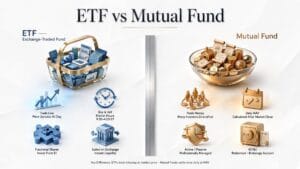
ETF vs mutual fund comparison chart showing fees, taxes and trading differences

What Is a Mutual Fund?

A mutual fund also pools money from many investors to buy a diversified mix of stocks, bonds, or other assets. The difference is how you buy and sell it. Mutual fund shares are not traded on an exchange during the day. Instead, orders are processed once per day at the fund’s net asset value (NAV), which is calculated after the market closes.

Mutual funds can be actively managed, where a professional tries to beat the market, or passively managed, where the fund tracks an index. You can buy them through a brokerage, directly from the fund company, or through a workplace retirement plan such as a 401(k), where they are often the main option. Understanding these basics makes the ETF vs mutual fund comparison much easier.

ETF vs Mutual Fund: Key Differences at a Glance

Here is a quick side-by-side view of the ETF vs mutual fund comparison before we go deeper into each point:

Feature ETF Mutual Fund
How it trades On an exchange all day Once per day at NAV
Typical fees Often very low for index ETFs Varies, can be higher for active funds
Minimum to start Price of one share (or less with fractional shares) Sometimes a minimum such as $1,000 or more
Tax efficiency Often more tax efficient May pay out more taxable gains
Automatic investing Depends on your broker Usually easy to set up
Management style Mostly passive, some active Both active and passive

The table gives you the big picture of the ETF vs mutual fund comparison, but the details behind each row matter. Let’s look at them one by one.

ETF vs Mutual Fund: Fees and Costs

Fees are one of the most important parts of the ETF vs mutual fund decision, because they come out of your returns every single year. The main cost is the expense ratio, an annual percentage charged by the fund. An expense ratio of 0.05% means you pay about $0.50 per year for every $1,000 invested.

Index ETFs and index mutual funds can both have very low expense ratios. Actively managed mutual funds usually cost more, because you are paying for research and a management team. Here is how much different expense ratios cost each year on a $10,000 investment:

Expense Ratio Yearly Cost on $10,000
0.05% $5
0.50% $50
1.00% $100

That gap may look small in one year, but over decades the difference compounds, because those dollars are not invested and growing. When comparing an ETF vs mutual fund, always compare the expense ratio of the exact funds you are considering, not just the category.

Also watch for other costs. Some mutual funds charge a sales load, which is a commission when you buy or sell, and some charge ongoing marketing fees. Many investors prefer no-load funds to avoid these charges. ETFs do not have sales loads, but they have a small trading cost called the bid-ask spread, which is usually tiny for large, popular ETFs.
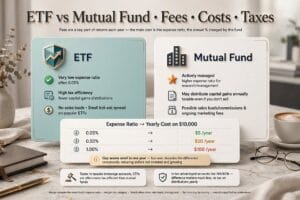
ETF vs mutual fund comparison chart showing fees, taxes and trading differences

ETF vs Mutual Fund: Taxes

In a regular taxable brokerage account, taxes can be another deciding factor in the ETF vs mutual fund choice. ETFs are often more tax efficient because of how they are built and traded, which usually means fewer taxable capital gains payouts to shareholders. Mutual funds, especially actively managed ones, may distribute capital gains at the end of the year, and you may owe tax on them even if you did not sell any shares.

Inside a tax-advantaged account such as an IRA or a 401(k), this difference matters much less, because you are not taxed on distributions each year. Tax rules vary by country and situation, so check the rules that apply to you or speak with a qualified tax professional before deciding.

ETF vs Mutual Fund: Trading and Flexibility

This is where the ETF vs mutual fund difference is easiest to see. With an ETF, you can place an order at any time during market hours and know the price you are getting. You can also use tools such as limit orders. With a mutual fund, you place an order and receive the price calculated at the end of the day.

For a long-term investor, this difference rarely matters. If you plan to hold for years, whether you buy at 10 a.m. or at the end of the day makes almost no difference. Frequent trading is usually a mistake for beginners, so do not treat ETF flexibility as a reason to trade more often.

ETF vs Mutual Fund: Minimum Investment

Some mutual funds require a minimum initial investment, which can range from a few hundred to a few thousand dollars. That can be a barrier if you are starting small. ETFs have no required minimum beyond the price of a share, and many brokers now offer fractional shares, so you can invest a small amount such as $25 or $50.

That said, many brokers also offer mutual funds with no minimum or very low minimums, so check the details of your platform. If you are just getting started with a small budget, our guide on how to start investing with little money walks through the first steps.

ETF vs Mutual Fund: Active vs Passive Management

Another part of the ETF vs mutual fund question is management style. A passive fund tracks an index and tries to match its performance at low cost. An active fund has a manager who tries to beat the index by choosing investments, and usually charges higher fees for that effort.

Most ETFs are passive, while mutual funds include both types. However, active ETFs and index mutual funds both exist, so do not assume the label tells you the strategy. Always read the fund’s description to see whether it tracks an index and what it charges. Research from many sources has shown that many active funds struggle to beat their benchmark after fees over long periods, which is why low-cost index funds are popular with beginners.

ETF vs Mutual Fund: Which Is Better for Beginners?

There is no single winner in the ETF vs mutual fund debate, because the better choice depends on how and where you invest. For many beginners, a low-cost, broadly diversified index fund is the most important part. Whether that fund is an ETF or a mutual fund matters less than its fees and how easily you can keep investing in it.
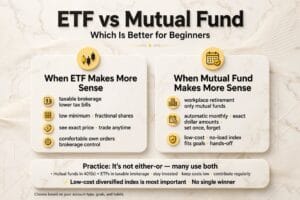
ETF vs mutual fund comparison chart showing fees, taxes and trading differences

When an ETF Makes More Sense

  • You invest in a taxable brokerage account and want potentially lower tax bills.
  • You want a low minimum and the option to buy fractional shares.
  • You prefer to see the exact price you pay when you place an order.
  • You are comfortable placing your own orders through a broker.

When a Mutual Fund Makes More Sense

  • Your workplace retirement plan only offers mutual funds.
  • You want simple, automatic monthly investments in exact dollar amounts.
  • You prefer to set up a plan once and not think about trading.
  • You found a low-cost, no-load index mutual fund that fits your goals.

In practice, the ETF vs mutual fund question is not either-or, because many investors use both. For example, you might hold mutual funds inside a 401(k) and ETFs in a taxable brokerage account. What matters most is staying invested, keeping costs low, and contributing regularly.

How to Choose Between an ETF and a Mutual Fund

If you are still unsure about the ETF vs mutual fund choice, follow these simple steps:

Step 1: Decide where you will invest. Your account type sets your ETF vs mutual fund options. A 401(k) may only offer mutual funds, while a brokerage account usually offers both.

Step 2: Pick your goal and time horizon. Money you need within a few years usually belongs in safer places than stocks. Long-term goals, such as retirement, can handle more growth-focused funds.

Step 3: Compare expense ratios. Choose the lowest-cost fund that matches the market or sector you want, whether it is an ETF or a mutual fund.

Step 4: Check minimums and trading rules. Make sure you can afford the minimum and that your broker makes it easy to invest regularly.

Step 5: Start with a small amount and automate. Set up a recurring investment so you build the habit. You can estimate how steady contributions grow with our free Investment Growth Calculator.
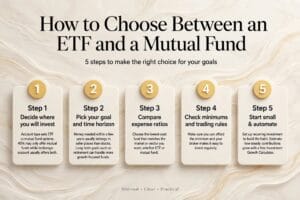
ETF vs mutual fund comparison chart showing fees, taxes and trading differences

Common Mistakes in the ETF vs Mutual Fund Decision

  • Choosing based on the label alone. An ETF is not automatically better than a mutual fund, or the other way around. Compare costs and holdings.
  • Ignoring fees. A higher expense ratio quietly reduces your returns every year.
  • Trading too often. The ability to trade ETFs all day does not mean you should.
  • Buying funds that overlap. Owning several funds that hold the same companies does not add real diversification.
  • Investing money you may need soon. Investments can lose value, so keep emergency savings separate, as explained in our guide to the 50/30/20 rule.
  • Investing while carrying expensive debt. High-interest debt can cost more than investments typically earn, so see our plan for how to get out of debt first.

Where to Learn More Before You Invest

Before you settle the ETF vs mutual fund question and buy any fund, read its prospectus and fee table, which explain the costs, risks, and strategy. The U.S. Securities and Exchange Commission offers free, plain-language guides at Investor.gov, including information on funds and fees. You can also check a broker or advisor’s background with FINRA.

Frequently Asked Questions About ETF vs Mutual Fund

What is the main difference in an ETF vs mutual fund?

The main difference is how they trade. ETFs trade on an exchange throughout the day at changing prices, while mutual funds are priced and traded once per day after the market closes.

Is an ETF vs mutual fund better for beginners?

Neither is automatically better. A low-cost, diversified index fund is the key. Beginners often like ETFs for low minimums and mutual funds for easy automatic investing, so choose the one that fits your account and habits.

Are ETFs cheaper than mutual funds?

Often, but not always. Index ETFs and index mutual funds can both have very low expense ratios, while actively managed mutual funds usually cost more. Compare the specific funds you are considering.

Which is more tax efficient in the ETF vs mutual fund comparison?

ETFs are generally more tax efficient in taxable accounts because they tend to pay out fewer capital gains. In retirement accounts such as an IRA or 401(k), the difference matters much less.

Can I own both ETFs and mutual funds?

Yes. Many investors hold mutual funds in a workplace retirement plan and ETFs in a brokerage account. Just make sure your funds do not overlap too much.

How much money do I need to start investing in an ETF or mutual fund?

It depends on the fund and the broker. Some mutual funds require a minimum of $1,000 or more, while ETFs can be bought for the price of one share, and fractional shares let you start with even less.

Final Thoughts

The ETF vs mutual fund decision is smaller than it looks. Both are good tools for building long-term wealth, and what matters most is low fees, broad diversification, and the habit of investing regularly. Start by checking which options your account offers, compare expense ratios, and begin with an amount you are comfortable with.

Ready to see what steady investing can do? Try our free Investment Growth Calculator to estimate how your contributions could grow over time, and explore our other beginner guides to keep building your plan.

This article is for educational purposes only and is not financial or investment advice. All investing involves risk, including the possible loss of money. Consider speaking with a qualified professional about your specific situation.

Invest Daily: 7 Proven Steps to Start With Little Money

Want to invest daily but not sure where to begin? The idea is simple: instead of waiting until you have a large lump sum, you commit a small amount — even $5 a day — and put it to work consistently. This guide explains how to invest daily with little money, what the habit really does for your wealth (and what it doesn’t), and the exact steps to set it up this week.

The habit of choosing to invest daily matters more than the size of any single deposit. Small amounts repeated over years can grow into serious money, and you don’t need a high salary to get started.

invest daily with small amounts guide


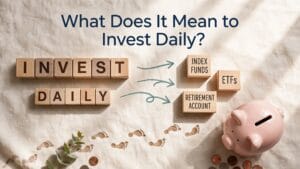
What Does It Mean to Invest Daily?

To invest daily means setting aside a small, fixed amount of money every day — or building a daily habit of contributing — and putting it into assets such as index funds, ETFs, or a retirement account. Some people literally invest daily through apps that round up their purchases. Others save a daily amount and invest it weekly or monthly. Both approaches serve the same goal: making investing automatic, small, and consistent.

Think of it as the investing version of a daily walk. You won’t see dramatic results after one day, but people who invest daily for years often end up far ahead of those who wait for the “perfect” moment.

invest daily with small amounts guide

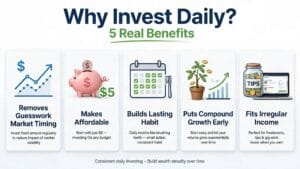
Why Invest Daily? 5 Real Benefits

1. It Removes the Guesswork of Market Timing

When you invest daily, you buy at many different prices — some high, some low. This approach is called dollar-cost averaging. It means you never bet everything on a single day, and over time it smooths out your average purchase price.

2. It Makes Investing Affordable

You don’t need $1,000 to start. If you can start with just a few dollars a day, the barrier to entry nearly disappears. Many platforms now offer fractional shares, so $5 can buy a slice of a broad index fund.

3. It Builds a Lasting Habit

Behavior matters more than talent in investing. When you invest daily, investing stops being a big decision and becomes routine, like brushing your teeth. Routines survive bad moods, scary headlines, and busy weeks.

4. It Puts Compound Growth to Work Early

The earlier each dollar is invested, the longer it can compound. Our guide on how compound interest works shows why starting early matters so much, and choosing to invest daily is one of the easiest ways to start early.

5. It Fits Irregular Income

If your income arrives in small pieces — freelance work, tips, gig income — a daily habit lets you invest daily from whatever you earn instead of waiting for a large lump sum.

invest daily with small amounts guide

Is It Better to Invest Daily or Monthly? An Honest Answer

Here is what many articles skip: investing every day is not magically more profitable than investing weekly or monthly. Research published by large investment firms has found that how much you invest and how long you stay invested matter far more than contribution frequency. The real advantage when you invest daily is behavioral — it keeps you consistent.

So if your platform only allows weekly or monthly automatic investments, that is perfectly fine. You can still invest daily in spirit by moving a set amount into a separate savings pot each day and investing the total on a schedule. The goal is consistency, not a specific frequency.

What Could You Build If You Invest Daily?

The table below shows what different daily amounts could grow into, assuming a 7% average annual return with monthly compounding. These are illustrations, not promises — real returns vary every year, and markets can and do fall.

Daily Amount About Per Month After 10 Years After 20 Years
$5 $150 ~$26,000 ~$78,000
$10 $300 ~$52,000 ~$156,000
$20 $600 ~$104,000 ~$313,000

Notice the pattern: when you invest daily for 20 years, most of the final balance comes from growth rather than deposits. Someone who puts in $5 a day contributes roughly $36,000 over 20 years, yet the illustration shows a balance near $78,000. Want to test your own numbers? Try our free Investment Growth Calculator.

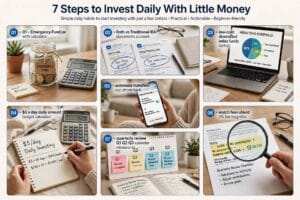
7 Steps to Invest Daily With Little Money

Step 1: Build a Starter Emergency Fund

Before you invest daily, keep a small cash cushion so an unexpected bill doesn’t force you to sell investments at a bad time. Use our free Emergency Fund Calculator to set a target, or read our guide on how much you should save for an emergency fund.

Step 2: Pick the Right Account

Where you invest daily affects your taxes. A retirement account often comes first, especially if your employer matches contributions. Our comparison of Roth IRA vs traditional IRA explains the difference, and a regular brokerage account works well for goals outside retirement.

Step 3: Choose Low-Cost, Diversified Investments

The simplest way to invest daily without stress is a broad, low-cost index fund. You get instant diversification and don’t need to pick winners. If funds are new to you, start with our guide to index funds for beginners.

Step 4: Decide Your Daily Amount

Start with an amount that never strains your budget. Our free Budget Calculator can show what you can comfortably put aside each day after essentials. A common starting point is $5 a day, which you can raise whenever your income grows.

Step 5: Automate Everything

Set up automatic transfers on payday, or recurring purchases where your platform allows. If you want to invest daily but your platform offers only weekly or monthly schedules, automate the closest option. Automation removes willpower from the equation.

Step 6: Watch Out for Fees

This step matters most when you invest tiny amounts each day. A flat fee per trade can eat a large share of a $5 purchase. Choose platforms with no per-trade commissions, low fund expense ratios, and no monthly fees that outweigh your contributions.

Step 7: Review Quarterly, Not Daily

The irony of this approach is that you should not check your balance every day. Review your investments every three months, rebalance if needed, and increase your daily amount whenever your income rises.

invest daily with small amounts guide

How to Find Your Daily Amount in Your Budget

Not sure where $5 or $10 a day will come from? Most budgets have more room than people expect. Here are practical places to look:

  • Unused subscriptions: Two or three forgotten subscriptions can equal $30 or more each month.
  • Food spending: Meal planning and fewer takeout orders often free up $100 or more monthly.
  • Bills you can negotiate: A single call to your internet or phone provider can lower a recurring bill.
  • Windfalls: Tax refunds, bonuses, and gifts can fund several months of contributions at once.
  • Extra income: Even a small side gig can cover your daily amount entirely.

For more ideas, see our guides on how to save money fast and side hustle ideas to make extra money.

Best Places to Invest Daily

The right place depends on your goals, but the main options are:

  • Employer retirement plan: Often the best first stop, especially when your employer matches contributions.
  • Individual retirement account (IRA): Offers tax advantages and more investment choices than many workplace plans.
  • Brokerage account with fractional shares: Flexible and well suited to goals outside retirement.
  • Micro-investing apps: Convenient for small amounts, but compare fees carefully before committing.

Whichever you choose, read the fee schedule before you commit. The SEC’s Investor.gov offers a beginner-friendly overview of investing basics and how to compare providers.

invest daily with small amounts guide

Common Mistakes When You Invest Daily

  • Ignoring fees. Small accounts suffer most from flat charges, so always check costs first.
  • Checking the balance constantly. Daily price swings are noise, and reacting to them often leads to selling at the wrong time.
  • Investing money you will need soon. Cash for rent, bills, or a purchase within a few years does not belong in the market.
  • Skipping the emergency fund. Without one, a surprise expense can force you to sell your investments.
  • Chasing whatever is trending. Buying hot stocks or coins is speculation, not a long-term plan.
  • Stopping when markets fall. People who keep going through downturns buy more shares at lower prices.

Should You Invest Daily If You Have Debt?

It depends on the interest rate. If you carry high-interest credit card debt, paying it off usually beats any investment return you can reasonably expect, so pause before you invest daily. Our guides on debt snowball vs avalanche and how to pay off student loans faster can help you choose a payoff plan.

If your debt has a low interest rate, doing both — paying it down while investing a small amount — is often reasonable.

How to Invest Daily Like a Pro

Professionals rely on rules, not hunches. Stay diversified, keep costs low, ignore short-term noise, and stay invested for the long term. Our guide on how to invest like a pro covers 10 of these rules in detail, and they apply just as well to small daily amounts.

Frequently Asked Questions

Can I really start with $1 a day?

Yes, if your platform supports fractional shares and doesn’t charge per-trade fees. $1 a day is roughly $30 a month. It’s a fine way to build the habit, and you can raise the amount as your budget allows.

Is it safe to invest daily?

All investing carries risk. A diversified fund reduces the risk of a single company failing, but its value can still fall, sometimes sharply. Only invest money you won’t need for several years.

How long until I see results?

Think in years, not weeks. Meaningful growth usually takes five to ten years or more, and no timeline is guaranteed.

Do I pay taxes on my investments?

It depends on the account. Retirement accounts have special tax rules, while dividends and gains in taxable accounts can be taxed. The IRS guidance on investment income is a good starting point, and a tax professional can answer questions specific to you.

Final Thoughts: Start to Invest Daily Today

You don’t need a fortune to begin. You need a small amount, a low-cost fund, and the discipline to keep going. For many people, the best time to invest daily is once a starter emergency fund is in place, high-interest debt is under control, and platform fees are low.

Ready to see what your daily amount could become? Try our free Investment Growth Calculator, then decide your number, automate it, and invest daily for a full year before judging the results.

This article is for educational purposes only and is not personal financial advice. All investing involves risk, including the possible loss of principal.

7 Key Differences: Roth IRA vs Traditional IRA Explained

Choosing between a Roth IRA vs traditional IRA is one of the most common decisions new investors face, and it’s a decision that can meaningfully affect how much you keep in retirement. Both accounts offer valuable tax advantages, but they work in opposite ways — understanding the Roth IRA vs traditional IRA difference now can save or cost you significant money over decades of investing.

This guide breaks down exactly how each account works, walks through the Roth IRA vs traditional IRA tax rules, and helps you decide which one fits your specific situation.
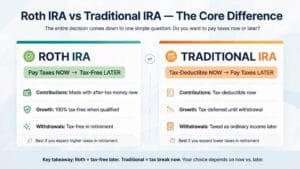
Roth IRA vs Traditional IRA: The Core Difference

The entire Roth IRA vs traditional IRA decision comes down to one simple question: do you want to pay taxes now, or later?

  • Traditional IRA: Contributions are typically tax-deductible now, but withdrawals in retirement are taxed as ordinary income.
  • Roth IRA: Contributions are made with after-tax money now, but qualified withdrawals in retirement — including all growth — are completely tax-free.

Everything else in the Roth IRA vs traditional IRA comparison flows from this single distinction.

roth ira vs traditional ira comparison

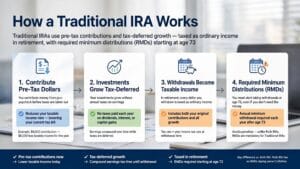
How a Traditional IRA Works

When comparing Roth IRA vs traditional IRA mechanics, the traditional IRA is the more familiar structure to most people. You contribute pre-tax dollars, meaning your taxable income for the year is reduced by your contribution amount, potentially lowering your current tax bill.

Your investments then grow tax-deferred — you don’t pay taxes on dividends, interest, or capital gains each year. However, when you withdraw money in retirement, every dollar is taxed as ordinary income, including your original contributions and all the growth that accumulated over time.

Traditional IRAs also require you to begin taking required minimum distributions (RMDs) starting at a certain age, whether you need the money or not — a rule that doesn’t apply to Roth IRAs during the original owner’s lifetime.

roth ira vs traditional ira comparison

How a Roth IRA Works

The Roth IRA flips the traditional IRA structure. You contribute after-tax dollars — meaning you don’t get an upfront tax deduction — but your investments grow completely tax-free, and qualified withdrawals in retirement are also entirely tax-free, including all the growth your investments accumulated over decades.

This is the central appeal in the Roth IRA vs traditional IRA debate for younger investors: if you expect your tax rate to be similar or higher in retirement than it is now, paying taxes today at a known rate, rather than an unknown future rate, can work significantly in your favor.

Roth IRA vs Traditional IRA: A Side-by-Side Comparison

Feature Traditional IRA Roth IRA
Tax on contributions Often deductible now Paid now, no deduction
Tax on withdrawals Taxed as income Tax-free if qualified
Required minimum distributions Yes, at a set age No, during owner’s lifetime
Income limits to contribute None for contributions Yes, phases out at higher incomes
Early withdrawal flexibility Penalties generally apply Contributions can be withdrawn penalty-free

Roth IRA vs Traditional IRA: Which Is Better for Young Investors?

For many people early in their careers, the Roth IRA vs traditional IRA decision often favors the Roth. Early-career earners are frequently in a lower tax bracket now than they expect to be later in their careers, making it advantageous to pay taxes at today’s lower rate rather than deferring taxes to a future year when income — and potentially tax rates — may be higher.

Additionally, decades of tax-free growth inside a Roth IRA can be extremely valuable. As explained in our guide on how compound interest works, the earlier money is invested, the more time it has to grow — and with a Roth IRA, all of that growth is eventually withdrawn completely tax-free.

roth ira vs traditional ira comparison

Roth IRA vs Traditional IRA: When Traditional Might Make More Sense

The traditional IRA side of the Roth IRA vs traditional IRA decision tends to make more sense for:

  • Higher earners currently in a high tax bracket who expect their tax rate to be lower in retirement
  • People who want to lower their current taxable income for an immediate tax benefit
  • Investors close to retirement who won’t benefit as much from decades of tax-free compound growth
  • People who exceed Roth IRA income limits and don’t want to pursue a backdoor Roth conversion strategy

Can You Have Both a Roth IRA and a Traditional IRA?

Yes — the Roth IRA vs traditional IRA choice doesn’t have to be all-or-nothing. Many investors contribute to both account types, a strategy sometimes called “tax diversification.” This provides flexibility in retirement, allowing withdrawals from whichever account makes more sense tax-wise in a given year, rather than being locked into one tax treatment for all retirement income.

Keep in mind that combined annual contribution limits across both a Roth and traditional IRA are shared, not doubled — contributing to both simply splits your total allowed contribution between the two accounts rather than allowing extra total contributions.

roth ira vs traditional ira comparison

Income Limits: A Key Roth IRA vs Traditional IRA Difference

One important distinction in the Roth IRA vs traditional IRA comparison is that Roth IRAs have income limits — once your income exceeds a certain threshold, your ability to contribute directly phases out and eventually disappears entirely. Traditional IRAs don’t have income limits on contributions, though the tax deductibility of those contributions can be limited if you or a spouse have access to a workplace retirement plan.

High earners who exceed Roth IRA income limits sometimes use a “backdoor Roth” strategy — contributing to a traditional IRA and then converting it to a Roth — though this involves tax considerations that are worth researching carefully or discussing with a tax professional.

Early Withdrawal Rules: Roth IRA vs Traditional IRA

This is an underrated part of the Roth IRA vs traditional IRA comparison. With a Roth IRA, you can withdraw your original contributions (not earnings) at any time, for any reason, without taxes or penalties, since you already paid taxes on that money. This provides more flexibility in emergencies compared to a traditional IRA, where early withdrawals of any amount are generally subject to both income tax and an additional penalty.

That said, an IRA — Roth or traditional — should never replace a proper emergency fund. Use our free Emergency Fund Calculator to build a cash cushion first, so retirement accounts stay invested and untouched.

roth ira vs traditional ira comparison

How to Decide: Roth IRA vs Traditional IRA Questions to Ask Yourself

  1. Do I expect to be in a higher or lower tax bracket in retirement? Higher favors Roth; lower favors traditional.
  2. Do I need the tax deduction right now? If reducing this year’s taxable income is a priority, traditional may be more appealing.
  3. How many years until retirement? More years favors Roth, due to more time for tax-free compound growth.
  4. Am I above the Roth income limit? If so, a traditional IRA or backdoor Roth strategy may be necessary.

roth ira vs traditional ira comparison

A Practical Example

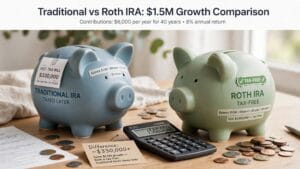
Imagine two 25-year-olds, both contributing $6,000 a year for 40 years at an 8% average annual return, ending with roughly $1.5 million each before taxes are considered.

  • Traditional IRA investor: Withdraws funds in retirement and pays income tax on the full amount at whatever their retirement tax rate happens to be.
  • Roth IRA investor: Withdraws the same amount completely tax-free, having already paid taxes on contributions decades earlier at a potentially much lower rate.

Depending on future tax rates, this difference in the Roth IRA vs traditional IRA outcome can represent hundreds of thousands of dollars in retirement — illustrating why this decision deserves careful thought rather than a random choice.

Common Mistakes in the Roth IRA vs Traditional IRA Decision

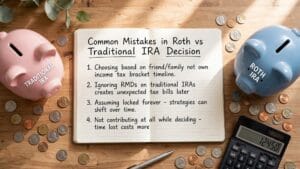
  • Choosing based on which one a friend or family member uses, rather than your own income, tax bracket, and retirement timeline.
  • Ignoring required minimum distributions on traditional IRAs, which can create unexpected tax bills later in retirement if not planned for.
  • Assuming you’re locked into one choice forever. Contribution strategies can shift over time as income and tax situations change.
  • Not contributing at all while deciding. Time lost while overthinking the Roth IRA vs traditional IRA decision often costs more than simply choosing one and starting.

For official contribution limits and eligibility rules, which change periodically, the IRS’s official IRA guidance is the most reliable source to confirm current numbers.

roth ira vs traditional ira comparison

Final Thoughts: Roth IRA vs Traditional IRA

There’s no universally “correct” answer in the Roth IRA vs traditional IRA debate — the right choice depends on your current tax bracket, expected future income, and how many years you have until retirement. Younger investors in lower tax brackets often lean toward Roth IRAs for decades of tax-free growth, while higher earners closer to retirement may benefit more from a traditional IRA’s upfront tax deduction.

Whichever you choose, the most important step is simply starting. Ready to see how consistent contributions could grow inside either account? Try our free Investment Growth Calculator and visualize your own long-term numbers.

Index Funds for Beginners: The Simple Guide to Getting Started

If you’re new to investing, index funds for beginners is probably the single most important phrase to understand before you buy anything else. Index funds are the foundation most successful long-term investors build on — simple, low-cost, and proven over decades. This guide explains exactly what they are, why they work, and how to buy your first one, even with no prior investing experience.

What Is an Index Fund?

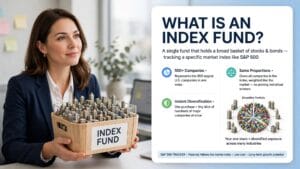
An index fund is a type of investment that holds a broad basket of stocks or bonds designed to track a specific market index — like the S&P 500, which represents 500 of the largest U.S. companies. Instead of trying to pick individual winning stocks, an index fund simply owns all of them (or a representative sample) in the same proportions as the index it tracks.

When you buy one share of an S&P 500 index fund, you’re effectively buying a tiny slice of hundreds of major companies at once — instant diversification in a single purchase.

index funds for beginners guide

Why Index Funds for Beginners Makes So Much Sense

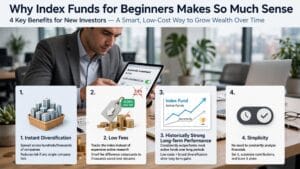
1. Instant Diversification

Rather than researching and picking individual stocks — a task even professional fund managers frequently struggle to do successfully over the long term — index funds spread your investment across hundreds or thousands of companies automatically, reducing the risk of any single company’s failure sinking your entire investment.

2. Low Fees

Because index funds simply track a market index rather than requiring active research and stock-picking, they typically have significantly lower fees than actively managed funds. Over decades, this fee difference compounds into a substantial amount of money saved — or lost, if you choose a high-fee alternative instead.

3. Historically Strong Long-Term Performance

Broad market index funds have historically outperformed the majority of actively managed funds over long time periods, largely due to their low costs and broad diversification. This doesn’t mean they never decline — they absolutely do during market downturns — but over multi-decade timelines, they’ve been a reliable wealth-building tool.

4. Simplicity

For index funds for beginners specifically, simplicity matters enormously. You don’t need to analyze company financials, follow market news constantly, or make frequent trading decisions — you can set up automatic contributions and largely leave the fund alone for years.

index funds for beginners guide

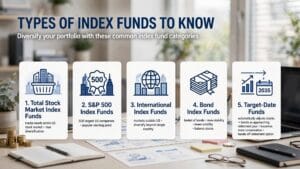
Types of Index Funds to Know

Total Stock Market Index Funds

Track nearly the entire U.S. stock market, offering maximum diversification across companies of all sizes.

S&P 500 Index Funds

Track the 500 largest U.S. companies — a popular starting point due to its long track record and broad exposure to major businesses.

International Index Funds

Track markets outside the U.S., helping diversify beyond a single country’s economic performance.

Bond Index Funds

Track a broad basket of bonds rather than stocks, generally offering more stability and lower volatility, often used to balance out stock holdings.

Target-Date Funds

A specific type of fund that automatically adjusts its mix of stocks and bonds as you approach a target retirement year, becoming more conservative over time — a popular hands-off option within retirement accounts.

index funds for beginners guide

Index Funds vs. Individual Stocks

A common question when learning about index funds for beginners is why not just buy individual stocks instead. The honest answer: picking individual stocks that consistently outperform the market requires significant research, time, and often luck — and even professional fund managers frequently underperform simple index funds over long periods.

Index funds trade the potential for extraordinary individual stock gains for consistent, diversified, lower-risk growth — a trade-off that suits the vast majority of long-term investors, especially beginners.

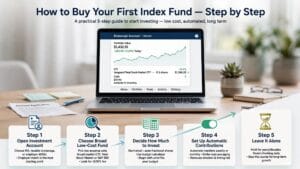
How to Buy Your First Index Fund: Step by Step

Step 1: Open an Investment Account

Depending on your goals, this might be an employer retirement plan, an IRA, or a standard taxable brokerage account. If your employer offers a retirement plan with a match, that’s typically the best starting point.

Step 2: Choose a Broad, Low-Cost Fund

Look for funds with low expense ratios and broad market exposure — a total stock market or S&P 500 index fund is a reasonable, well-established starting point for most beginners.

Step 3: Decide How Much to Invest

Start with an amount that fits your budget, even if it’s small. Many platforms now allow fractional shares, meaning you don’t need hundreds of dollars to get started. Our free Budget Calculator can help you find room in your monthly budget for consistent investing.

Step 4: Set Up Automatic Contributions

Automating your investments removes the temptation to time the market and ensures consistent progress, a strategy known as dollar-cost averaging.

Step 5: Leave It Alone

This is the hardest step for many beginners — resisting the urge to check daily or react to short-term market news. Index funds are designed to be held for years or decades, not traded frequently.

index funds for beginners guide

How Much Can You Expect to Earn?

Historically, broad U.S. stock market index funds have returned an average of roughly 7-10% annually over long time periods, though any individual year can vary significantly — including negative years. Want to see how consistent contributions to an index fund could grow over time? Try our free Investment Growth Calculator to visualize your own numbers, and read more about how compound interest works to understand why time matters so much.

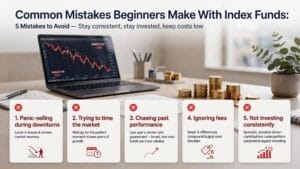
Common Mistakes Beginners Make With Index Funds

  • Panic-selling during market downturns. This locks in losses and misses the recovery that historically follows most downturns.
  • Trying to time the market. Waiting for the “perfect” moment to invest often means missing years of potential growth while waiting on the sidelines.
  • Chasing past performance. A fund that performed well last year isn’t guaranteed to repeat that performance — broad, low-cost funds remain a more reliable long-term strategy than chasing trends.
  • Ignoring fees. Even small percentage differences in fees compound significantly over decades of investing.
  • Not investing consistently. Sporadic, emotion-driven investing tends to underperform simple, automated, regular contributions.

index funds for beginners guide

Are Index Funds Right for Everyone?

Index funds for beginners work particularly well for people who want a straightforward, low-maintenance investing approach without constantly monitoring individual stocks. According to guidance from the U.S. Securities and Exchange Commission’s Investor.gov, understanding fund fees, diversification, and long-term risk tolerance are all essential parts of choosing investments that match your personal financial goals.

That said, before investing aggressively, make sure you have a starter emergency fund in place — our Emergency Fund Calculator can help you determine a target so you’re not forced to sell investments during a personal financial emergency.

Final Thoughts

For most people starting their investing journey, index funds for beginners isn’t just a beginner strategy — it’s the same core approach many experienced, long-term investors continue to rely on throughout their entire investing lives. Broad diversification, low fees, and consistent contributions over time have proven to be one of the most reliable paths to building long-term wealth.

Ready to see how your own investing plan could grow? Try our free Investment Growth Calculator and map out your path forward.

How Compound Interest Works: The Secret to Building Wealth

Albert Einstein reportedly called compound interest the eighth wonder of the world — and once you understand how compound interest works, it’s easy to see why. It’s the single most powerful force behind long-term wealth building, yet most people never learn how to actually use it to their advantage. This guide breaks down exactly how compound interest works, with real numbers, and why starting early matters more than almost anything else in investing.

Simple Interest vs. Compound Interest

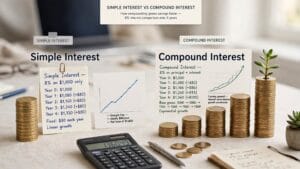
To understand how compound interest works, it helps to first understand what it’s different from: simple interest, which is calculated only on your original amount, every time.

For example, $1,000 earning 8% simple interest annually earns exactly $80 every year, forever — because it’s always calculated on the same original $1,000.

Compound interest, on the other hand, is calculated on your original amount plus all the interest you’ve already earned. So instead of always earning interest on $1,000, you eventually earn interest on $1,080, then $1,166, then $1,260, and so on — the base amount keeps growing, and so does the interest earned on it.

how compound interest works building wealth

How Compound Interest Works: A Real Example

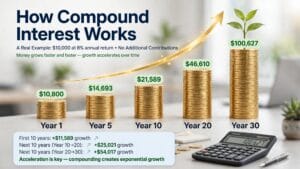
Let’s say you invest $10,000 at an 8% average annual return and never add another dollar:

  • Year 1: $10,000 → $10,800
  • Year 5: $10,000 → $14,693
  • Year 10: $10,000 → $21,589
  • Year 20: $10,000 → $46,610
  • Year 30: $10,000 → $100,627

Notice something important: your money didn’t just grow steadily — it grew faster and faster over time. That acceleration is the entire point of understanding how compound interest works. The first 10 years added about $11,589 in growth; the next 10 years alone added roughly $25,000 more, without you contributing a single additional dollar.

Want to see this play out with your own numbers? Try our free Compound Interest Calculator to visualize how your specific investment could grow over time.

how compound interest works building wealth

Why Starting Early Matters So Much

This is where understanding how compound interest works becomes genuinely life-changing. Consider two people:

  • Person A invests $200/month starting at age 25, then stops entirely at age 35 (10 years of contributions, then nothing more)
  • Person B waits until age 35 to start, then invests $200/month consistently until age 65 (30 years of contributions)

Assuming an 8% average annual return, Person A — who contributed for only 10 years and stopped — often ends up with a larger balance at age 65 than Person B, who contributed three times longer but started a decade later. This isn’t a trick; it’s simply the mathematical reality of how compound interest works. Time in the market matters more than the amount contributed in many scenarios.

The Rule of 72: A Quick Mental Shortcut

One of the simplest ways to estimate how compound interest works for your own money is the Rule of 72. Divide 72 by your expected annual return rate, and the result is roughly how many years it takes for your money to double.

  • At 6% return: 72 ÷ 6 = 12 years to double
  • At 8% return: 72 ÷ 8 = 9 years to double
  • At 10% return: 72 ÷ 10 = 7.2 years to double

This mental math makes it easy to quickly estimate long-term growth without needing a calculator for every scenario.

how compound interest works building wealth

How to Put Compound Interest to Work for You

1. Start as Early as Possible

Even small amounts invested in your 20s can outperform larger amounts invested later, purely due to the extra time compounding has to work.

2. Contribute Consistently

Regular contributions — even modest ones — add fuel to the compounding process every single month, rather than relying on a single lump sum.

3. Reinvest Dividends and Earnings

Automatically reinvesting any dividends or interest earned, rather than cashing them out, keeps the compounding cycle uninterrupted and growing.

4. Avoid Withdrawing Early

Every withdrawal doesn’t just remove that specific amount — it removes all the future compound growth that money would have generated if left invested.

5. Be Patient Through Market Volatility

Compound growth isn’t a straight line — it includes down years along the way. Understanding how compound interest works over decades, not days, helps investors stay the course during inevitable market dips.

how compound interest works building wealth

Compound Interest and Retirement Planning

Retirement accounts are one of the clearest real-world examples of compound interest in action. According to guidance from the U.S. Securities and Exchange Commission’s Investor.gov, understanding compounding is essential to making informed long-term investment decisions, particularly for retirement savings that span multiple decades.

If you’re mapping out your own retirement timeline, our guide on how much to save for retirement pairs directly with the concepts covered here.

Common Misconceptions About Compound Interest

  • “It only matters for large amounts.” Even small, consistent contributions benefit significantly from compounding over long timelines.
  • “A few years late won’t matter much.” As shown in the earlier example, even a 5-10 year delay can meaningfully reduce long-term outcomes.
  • “Higher returns always mean more compounding benefit.” Consistency and time invested often matter more than chasing slightly higher returns with more risk.
  • “Compounding only applies to investments.” It applies equally to savings accounts, debt, and any situation where interest is calculated on a growing balance.

how compound interest works building wealth

Final Thoughts

Understanding how compound interest works isn’t just an academic exercise — it’s the foundation of nearly every long-term wealth-building strategy. The math rewards two things above all else: starting early and staying consistent. Even modest contributions, given enough time, can grow into substantial wealth simply by letting compounding do the work.

Ready to see your own numbers in action? Try our free Compound Interest Calculator and discover exactly how your money could grow over time.