
Albert Einstein reportedly called compound interest the eighth wonder of the world — and once you understand how compound interest works, it’s easy to see why. It’s the single most powerful force behind long-term wealth building, yet most people never learn how to actually use it to their advantage. This guide breaks down exactly how compound interest works, with real numbers, and why starting early matters more than almost anything else in investing.
Simple Interest vs. Compound Interest
To understand how compound interest works, it helps to first understand what it’s different from: simple interest, which is calculated only on your original amount, every time.
For example, $1,000 earning 8% simple interest annually earns exactly $80 every year, forever — because it’s always calculated on the same original $1,000.
Compound interest, on the other hand, is calculated on your original amount plus all the interest you’ve already earned. So instead of always earning interest on $1,000, you eventually earn interest on $1,080, then $1,166, then $1,260, and so on — the base amount keeps growing, and so does the interest earned on it.

How Compound Interest Works: A Real Example
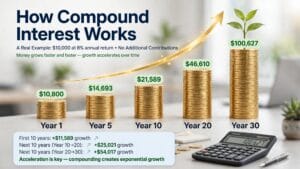
Let’s say you invest $10,000 at an 8% average annual return and never add another dollar:
- Year 1: $10,000 → $10,800
- Year 5: $10,000 → $14,693
- Year 10: $10,000 → $21,589
- Year 20: $10,000 → $46,610
- Year 30: $10,000 → $100,627
Notice something important: your money didn’t just grow steadily — it grew faster and faster over time. That acceleration is the entire point of understanding how compound interest works. The first 10 years added about $11,589 in growth; the next 10 years alone added roughly $25,000 more, without you contributing a single additional dollar.
Want to see this play out with your own numbers? Try our free Compound Interest Calculator to visualize how your specific investment could grow over time.
Why Starting Early Matters So Much
This is where understanding how compound interest works becomes genuinely life-changing. Consider two people:
- Person A invests $200/month starting at age 25, then stops entirely at age 35 (10 years of contributions, then nothing more)
- Person B waits until age 35 to start, then invests $200/month consistently until age 65 (30 years of contributions)
Assuming an 8% average annual return, Person A — who contributed for only 10 years and stopped — often ends up with a larger balance at age 65 than Person B, who contributed three times longer but started a decade later. This isn’t a trick; it’s simply the mathematical reality of how compound interest works. Time in the market matters more than the amount contributed in many scenarios.
The Rule of 72: A Quick Mental Shortcut
One of the simplest ways to estimate how compound interest works for your own money is the Rule of 72. Divide 72 by your expected annual return rate, and the result is roughly how many years it takes for your money to double.
- At 6% return: 72 ÷ 6 = 12 years to double
- At 8% return: 72 ÷ 8 = 9 years to double
- At 10% return: 72 ÷ 10 = 7.2 years to double
This mental math makes it easy to quickly estimate long-term growth without needing a calculator for every scenario.

How to Put Compound Interest to Work for You
1. Start as Early as Possible
Even small amounts invested in your 20s can outperform larger amounts invested later, purely due to the extra time compounding has to work.
2. Contribute Consistently
Regular contributions — even modest ones — add fuel to the compounding process every single month, rather than relying on a single lump sum.
3. Reinvest Dividends and Earnings
Automatically reinvesting any dividends or interest earned, rather than cashing them out, keeps the compounding cycle uninterrupted and growing.
4. Avoid Withdrawing Early
Every withdrawal doesn’t just remove that specific amount — it removes all the future compound growth that money would have generated if left invested.
5. Be Patient Through Market Volatility
Compound growth isn’t a straight line — it includes down years along the way. Understanding how compound interest works over decades, not days, helps investors stay the course during inevitable market dips.

Compound Interest and Retirement Planning
Retirement accounts are one of the clearest real-world examples of compound interest in action. According to guidance from the U.S. Securities and Exchange Commission’s Investor.gov, understanding compounding is essential to making informed long-term investment decisions, particularly for retirement savings that span multiple decades.
If you’re mapping out your own retirement timeline, our guide on how much to save for retirement pairs directly with the concepts covered here.
Common Misconceptions About Compound Interest
- “It only matters for large amounts.” Even small, consistent contributions benefit significantly from compounding over long timelines.
- “A few years late won’t matter much.” As shown in the earlier example, even a 5-10 year delay can meaningfully reduce long-term outcomes.
- “Higher returns always mean more compounding benefit.” Consistency and time invested often matter more than chasing slightly higher returns with more risk.
- “Compounding only applies to investments.” It applies equally to savings accounts, debt, and any situation where interest is calculated on a growing balance.

Final Thoughts
Understanding how compound interest works isn’t just an academic exercise — it’s the foundation of nearly every long-term wealth-building strategy. The math rewards two things above all else: starting early and staying consistent. Even modest contributions, given enough time, can grow into substantial wealth simply by letting compounding do the work.
Ready to see your own numbers in action? Try our free Compound Interest Calculator and discover exactly how your money could grow over time.
5 thoughts on “How Compound Interest Works: The Secret to Building Wealth”