If your savings are sitting in a traditional bank account earning close to nothing, moving that money to a high-yield savings account is one of the easiest financial upgrades available — it takes minutes to set up and costs nothing to do. This guide covers 7 things to know before you open one, how they actually work, and how to choose the right account for your situation.
What Is a High-Yield Savings Account?
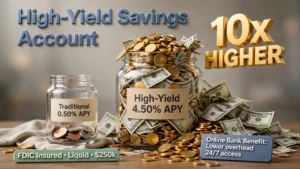
A high-yield savings account is a savings account that pays a significantly higher interest rate than a traditional bank savings account — often many times higher. These accounts are usually offered by online banks, which have lower overhead costs than traditional branch-based banks and pass some of those savings on to customers through better rates.
Your money in a high-yield savings account works the same way as a regular savings account in every other respect: it’s federally insured up to the standard limit, it’s liquid (you can withdraw when needed), and it’s meant for money you want to keep safe rather than invest for growth.
1. The Interest Rate Difference Adds Up More Than You’d Expect
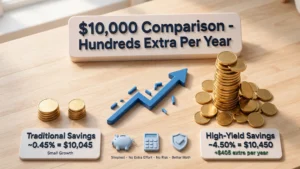
The gap between a traditional savings account and a high-yield savings account can be substantial. On $10,000 in savings, the difference between near-zero interest and a competitive high-yield rate can mean hundreds of dollars a year in extra earnings — money you’d otherwise be leaving on the table for doing nothing differently except choosing where to keep your cash.
This makes a high-yield savings account one of the simplest wins in personal finance: no risk, no extra effort, just better math on money you already have.
2. Rates Are Variable, Not Fixed
Unlike a certificate of deposit, the rate on a high-yield savings account can change over time, usually in response to broader interest rate trends. This means the rate you open an account with isn’t guaranteed to stay the same. It’s worth checking your rate periodically and comparing it against competitors, since some banks are slower to pass on rate increases — or quicker to cut rates — than others.
3. Your Money Is Still Federally Insured
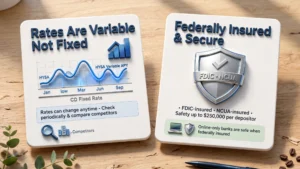
A common concern with online-only banks is safety. As long as the bank is FDIC-insured (or NCUA-insured for credit unions), your deposits are protected up to the standard federal insurance limit, exactly the same protection as a traditional brick-and-mortar bank. Always confirm FDIC or NCUA insurance before opening any account — this information is typically displayed clearly on the bank’s website.
4. It’s the Right Home for Your Emergency Fund
A high-yield savings account is widely considered one of the best places to keep an emergency fund, because it balances two priorities: your money stays fully accessible when you need it, while still earning meaningfully more than it would sitting idle. If you haven’t built your emergency fund yet, see our guide on how much you should save for an emergency fund, or use our free Emergency Fund Calculator to set a target.
Avoid keeping emergency savings in investments like stocks, since the entire purpose of that money is stability, not growth potential that comes with market risk.

5. Watch for Fees and Minimum Balance Requirements
Not all high-yield savings accounts are created equal. Before opening one, check for:
- Monthly maintenance fees — the best accounts typically charge none
- Minimum balance requirements — some accounts reduce your rate or charge fees if your balance drops below a threshold
- Minimum opening deposit — varies significantly between banks, from $0 to several hundred dollars
- Withdrawal limits — some accounts limit the number of free withdrawals per month
A high interest rate doesn’t help much if fees quietly eat into your returns every month.
6. Online Banks Usually Offer Better Rates Than Traditional Banks
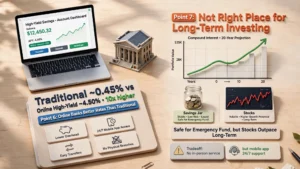
Because online-only banks don’t maintain physical branches, they generally offer more competitive rates on a high-yield savings account than traditional banks with branch networks. The tradeoff is that you won’t have in-person banking access, though most online banks offer strong mobile apps, 24/7 customer support, and easy transfers to and from linked external accounts.
For most people using this account purely for savings — not daily transactions — this tradeoff is minor compared to the rate advantage.
7. It’s Not the Right Place for Long-Term Investing
While a high-yield savings account is excellent for emergency funds and short-term savings goals, it’s not designed to compete with long-term investment growth. Historically, diversified investments have significantly outpaced savings account interest rates over long time periods, though with more volatility and risk. Our guide on how compound interest works explains why the right tool depends on your timeline — savings accounts for money you need soon, investments for money you won’t touch for years.
How to Choose the Right High-Yield Savings Account
Compare Annual Percentage Yield (APY), Not Just Advertised Rates
APY reflects your actual annual return including compounding, making it the most accurate number to compare across different banks rather than a simple interest rate.
Check for FDIC or NCUA Insurance
This should be non-negotiable — never open an account, no matter how attractive the rate, without confirming federal deposit insurance.
Read the Fee Schedule Carefully
Look specifically for monthly fees, minimum balance penalties, and any charges for excessive withdrawals.
Consider How Easily You Can Move Money
Check how long transfers take between the high-yield savings account and your everyday checking account — this matters if you ever need funds quickly in an emergency.
Look at Customer Service Options
Since most high-yield accounts are online-only, confirm the bank offers support channels you’re comfortable with, whether that’s phone, chat, or email.

High-Yield Savings Account vs. Other Savings Options
| Account Type | Liquidity | Typical Return |
|---|---|---|
| Traditional savings account | High | Very low |
| High-yield savings account | High | Moderate, variable |
| Certificate of deposit (CD) | Low (until maturity) | Fixed, often slightly higher |
| Index fund investments | Moderate | Higher long-term, with risk |
How Much Should You Keep in a High-Yield Savings Account?
As a general guideline, this account type works best for money you’ll need within the next few years — your emergency fund, short-term savings goals, or sinking funds for known upcoming expenses. Our guide on sinking fund examples covers common categories people save for this way.
Money you won’t need for 5-10+ years is generally better suited for long-term investment accounts, where growth potential outweighs the value of daily liquidity.
Common Mistakes to Avoid
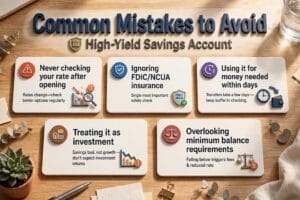
- Never checking your rate after opening the account. Rates change, and staying on top of them ensures you’re not missing out on better options elsewhere.
- Ignoring FDIC or NCUA insurance status. This is the single most important safety check before depositing any money.
- Using it for money needed within days. Transfers between banks can take a few business days, so keep a small buffer in your regular checking account for immediate needs.
- Treating it as an investment account. It’s a savings tool, not a growth tool — don’t expect investment-level returns.
- Overlooking minimum balance requirements. Falling below the threshold can trigger fees or a reduced rate on some accounts.
For general guidance on choosing safe savings products, the Consumer Financial Protection Bureau offers additional consumer resources on comparing account types and understanding your rights as a depositor.
Final Thoughts
A high-yield savings account is one of the simplest, lowest-risk upgrades you can make to your finances — better returns on money you were already saving, with no added risk or effort beyond choosing the right bank. It’s particularly well suited for emergency funds and short-term goals where safety and accessibility matter more than growth potential.
Ready to see how much your emergency fund should be before you decide where to park it? Try our free Emergency Fund Calculator and set a clear savings target today.
This article is for educational purposes only and is not personal financial advice.