
One of the most common financial questions people ask is how much to save for retirement — and the honest answer is that it depends on your age, income, lifestyle goals, and when you started saving. This guide breaks down savings targets by age, explains the most common rules of thumb, and gives you a realistic path forward whether you’re just starting or feel behind schedule.
Why There’s No Single “Magic Number”
You’ve probably seen headlines claiming you need exactly $1 million or $2 million to retire comfortably. In reality, how much to save for retirement depends heavily on your expected expenses, where you plan to live, healthcare needs, and whether you’ll have other income sources like a pension or rental income. Rather than chasing one specific number, it’s more useful to track your progress against your current income at different life stages.

Retirement Savings Targets by Age
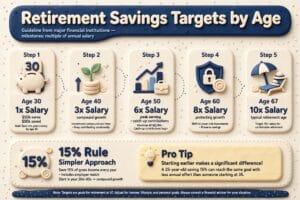
A widely used guideline from major financial institutions suggests these savings milestones, expressed as a multiple of your annual salary:
By Age 30: 1x Your Annual Salary
If you earn $50,000, aim to have roughly $50,000 saved across retirement accounts by 30. This is an ambitious target for many, and falling short here isn’t a crisis — it’s simply a starting point to work toward.
By Age 40: 3x Your Annual Salary
By your 40s, compound growth should be doing more of the heavy lifting, assuming consistent contributions throughout your 30s.
By Age 50: 6x Your Annual Salary
This is often when people hit their peak earning years, making it a good time to maximize contributions, especially with catch-up contribution options available in many retirement accounts starting at age 50.
By Age 60: 8x Your Annual Salary
As retirement approaches, the focus shifts from aggressive growth toward protecting what you’ve built while still growing steadily.
By Age 67 (Typical Retirement Age): 10x Your Annual Salary
This target is designed to support a retirement lifestyle similar to your working years, combined with other income sources like Social Security.
These are general guidelines, not strict rules — someone with lower expenses or additional income sources may need less, while someone planning an expensive retirement lifestyle may need more.
The 15% Rule: A Simpler Approach
If tracking savings multiples feels overwhelming, a simpler rule many financial planners recommend is saving 15% of your gross income for retirement every year, starting in your 20s or 30s and continuing consistently through your career. This includes any employer match you receive, not just your own contributions.
Starting earlier makes a significant difference due to compound growth. Want to see how consistent contributions compound over decades? Try our free Investment Growth Calculator to visualize your own numbers.
What If You’re Behind on Retirement Savings?
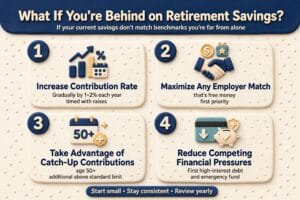
If your current savings don’t match these benchmarks, you’re far from alone — many people fall behind due to debt, lower-earning years, or simply starting late. Here’s how to catch up:
1. Increase Your Contribution Rate Gradually
Rather than jumping straight to 15%, increase your contribution rate by 1-2% each year, especially timed with raises, so the change is barely noticeable in your take-home pay.
2. Maximize Any Employer Match
If your employer offers a retirement plan match and you’re not contributing enough to get the full match, that’s leaving free money on the table — this should be the first priority before any other savings goal.
3. Take Advantage of Catch-Up Contributions
Once you reach age 50, most retirement accounts allow additional “catch-up” contributions above the standard limit, specifically designed to help people who started saving later accelerate their progress.
4. Reduce Competing Financial Pressures First
High-interest debt and a lack of emergency savings often prevent people from saving adequately for retirement. Building a small emergency fund and tackling high-interest debt can free up more room for consistent retirement contributions. Our Emergency Fund Calculator and debt payoff guide can help with both.
Where Should You Actually Save for Retirement?
The right accounts depend on your situation, but a common priority order is:
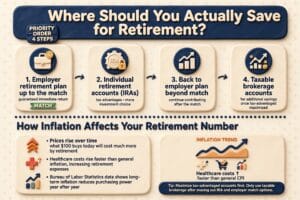
- Employer retirement plan up to the match — this is guaranteed, immediate return that shouldn’t be skipped
- Individual retirement accounts (IRAs) — offering tax advantages and more investment choice than many employer plans
- Back to your employer plan beyond the match — if you still have room to save more after maxing an IRA
- Taxable brokerage accounts — for additional savings once tax-advantaged options are maximized
How Inflation Affects Your Retirement Number
When calculating how much to save for retirement, it’s easy to underestimate the impact of inflation over a multi-decade timeline. Prices that feel manageable today will be significantly higher by the time you retire, especially for healthcare costs, which tend to rise faster than general inflation. According to data from the Bureau of Labor Statistics, long-term inflation trends reinforce why retirement projections should assume rising costs, not today’s prices, when planning decades ahead.
Common Retirement Savings Mistakes to Avoid
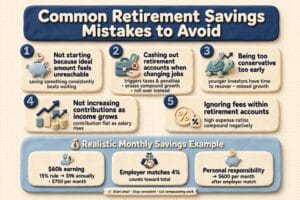
- Not starting because the “ideal” amount feels unreachable. Saving something consistently beats waiting until you can save the “right” amount.
- Cashing out retirement accounts when changing jobs. This triggers taxes and penalties while erasing years of compound growth — rolling over to a new account preserves your progress instead.
- Being too conservative too early. Younger investors with decades until retirement generally have time to recover from market volatility, making overly cautious allocations a missed growth opportunity.
- Not increasing contributions as income grows. Keeping your contribution percentage flat as your salary rises means your retirement savings rate effectively shrinks over time relative to your lifestyle.
- Ignoring fees within retirement accounts. High expense ratios compound negatively over decades just as much as returns compound positively.
A Realistic Monthly Savings Example
To make this more concrete: someone earning $60,000 a year aiming for the 15% rule would need to save $9,000 annually, or $750 per month, across all retirement accounts combined — including any employer match. If their employer matches 4%, that reduces their personal contribution responsibility to around $600 per month, illustrating why maximizing employer matches matters so much.
Final Thoughts
There’s no universal answer to how much to save for retirement that fits everyone perfectly, but the age-based benchmarks and the 15% rule give you a realistic framework to measure your progress against. If you’re behind, focus on gradual increases, employer matches, and catch-up contributions rather than trying to close the gap all at once.
The most important factor isn’t hitting an exact number by an exact age — it’s building the consistent habit of saving something every month and increasing it over time. Ready to see how your own contributions could grow? Try our free Investment Growth Calculator and map out your retirement savings trajectory.
1 thought on “How Much to Save for Retirement: A Guide by Age in 2026”