
When it comes to paying off debt, the debt snowball vs avalanche debate is one of the most common questions people face once they decide to get serious about becoming debt-free. Both methods work — thousands of people have paid off debt using each one — but they work in very different ways, and picking the wrong one for your personality can mean giving up before you finish.
This guide breaks down exactly how each method works, compares the real math behind debt snowball vs avalanche, and helps you decide which approach fits how you actually think about money.
What Is the Debt Snowball Method?
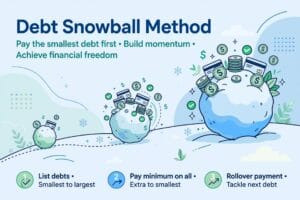
The debt snowball method, popularized by financial expert Dave Ramsey, focuses on psychology over math. Here’s how it works:
- List all your debts from smallest balance to largest, ignoring interest rates.
- Make minimum payments on everything except the smallest debt.
- Throw every extra dollar you can at that smallest debt until it’s paid off.
- Once it’s gone, roll that entire payment amount into the next-smallest debt.
- Repeat until every debt is paid off.
The core idea behind the debt snowball is momentum. Paying off a full debt — even a small one — creates a quick win that builds motivation to keep going, which is often more valuable than saving a few extra dollars in interest.
What Is the Debt Avalanche Method?
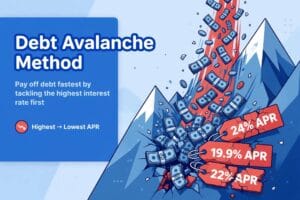
The debt avalanche method takes the opposite approach, prioritizing interest rate over balance size:
- List all your debts from highest interest rate to lowest, ignoring the balance.
- Make minimum payments on everything except the highest-interest debt.
- Put every extra dollar toward that highest-interest debt until it’s gone.
- Move to the next-highest interest rate debt and repeat.

Mathematically, the debt avalanche method is more efficient — you pay less total interest over the life of your debt payoff journey because you’re eliminating your most expensive debt first.
Debt Snowball vs Avalanche: The Real Math
To understand the practical difference in the debt snowball vs avalanche debate, let’s look at an example. Imagine three debts:
- Credit Card A: $1,500 balance at 24% interest
- Credit Card B: $4,000 balance at 19% interest
- Personal Loan: $8,000 balance at 12% interest
With the snowball method, you’d pay off Credit Card A first (smallest balance), then Credit Card B, then the Personal Loan — even though Credit Card A doesn’t have the highest interest rate.
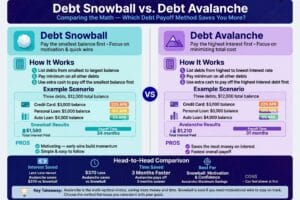
With the avalanche method, you’d pay off Credit Card A first too — in this case, it happens to have both the smallest balance and the highest interest rate. But if Credit Card A had a lower interest rate than Credit Card B, avalanche would tell you to attack Credit Card B first instead, saving more in interest even though its balance is larger.
In cases where your smallest-balance debt and your highest-interest debt aren’t the same account, avalanche will almost always save you more money in total interest paid — sometimes by hundreds or even thousands of dollars depending on your balances and rates.
Want to see exactly how fast you could be debt-free with your specific numbers? Try our free Debt Payoff Calculator to compare timelines side by side.
Debt Snowball vs Avalanche: Pros and Cons
Debt Snowball: Pros
- Fast early wins build motivation and momentum
- Simpler to stay consistent with, especially for beginners
- Reduces the number of monthly payments you’re juggling sooner
Debt Snowball: Cons
- You may pay more in total interest over time
- High-interest debt keeps accumulating charges while you focus on smaller balances
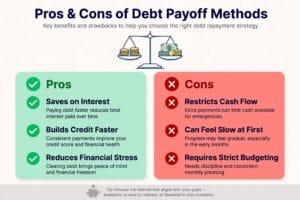
Debt Avalanche: Pros
- Saves the most money in total interest paid
- Mathematically the most efficient path to debt freedom
- Often results in a faster overall payoff timeline
Debt Avalanche: Cons
- Can feel slow and discouraging if your highest-interest debt also has a large balance
- Requires more discipline since early “wins” may take longer to achieve
Which Method Should You Choose?
The honest answer in the debt snowball vs avalanche debate is: the best method is the one you’ll actually stick with. A mathematically perfect plan you abandon after two months is worse than a slightly less efficient plan you follow through to completion.
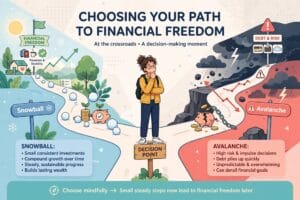
Choose the Snowball Method If:
- You’ve struggled to stay motivated with past debt payoff attempts
- You need quick wins to stay engaged with the process
- Your debts don’t vary dramatically in interest rate
Choose the Avalanche Method If:
- You’re motivated by numbers and long-term savings, not quick wins
- One or more of your debts has a significantly higher interest rate than the others
- You’re disciplined enough to stay consistent without frequent milestones
A Hybrid Approach: The Best of Both Worlds
You don’t have to choose strictly one method. Some people start with the snowball method to build early momentum by knocking out one or two small debts, then switch to the avalanche method once they’ve built the habit of consistently paying extra toward debt. This hybrid approach captures the psychological benefit of the snowball’s quick wins while still prioritizing high-interest debt sooner rather than later.
Steps to Start Paying Off Debt Today, Regardless of Method

1. List Every Debt You Have
Write down every debt — balance, minimum payment, and interest rate — in one place. You can’t apply either the debt snowball or avalanche method without a full, honest picture.
2. Build a Small Emergency Fund First
Before aggressively paying down debt, most financial experts recommend having at least $500-$1,000 set aside. Without this buffer, a single unexpected expense often becomes new debt on a credit card, undoing your progress. Our Emergency Fund Calculator can help you determine a starting target.
3. Free Up Extra Payment Money
Review your budget for anywhere you can redirect money toward debt payoff — even $50-$100 extra per month accelerates either method significantly. Our Budget Calculator can help identify where that extra money might come from.
4. Automate Minimum Payments
Set up automatic minimum payments on all debts so you never miss one, which protects your credit score. Then manually direct any extra payment toward your target debt each month based on your chosen method.
5. Track Your Progress Visually
Whether it’s a simple spreadsheet, an app, or a printed debt payoff chart, seeing your progress — however you’re measuring it — reinforces the habit and keeps you moving forward during the months when progress feels slow.
Common Mistakes in Both Methods
- Taking on new debt while paying off old debt. This undoes progress from either method and is one of the most common reasons debt payoff plans fail.
- Not adjusting the plan as your situation changes. A raise, a new expense, or a bonus should be factored back into your payoff strategy.
- Ignoring high-interest debt for too long with the snowball method. If your highest-interest debt also has a large balance, consider switching toward avalanche sooner rather than later.
- Underestimating how much interest compounds. According to the Consumer Financial Protection Bureau, minimum payments alone can keep you in debt for decades on high-interest balances.
Final Thoughts
The debt snowball vs avalanche decision ultimately comes down to knowing yourself. If you need momentum and quick wins to stay motivated, the snowball method will likely get you further than a mathematically perfect plan you abandon out of frustration. If you’re driven by efficiency and want to minimize total interest paid, the avalanche method is the smarter long-term choice.
Whichever method you choose, the most important factor is consistency — extra payments applied month after month, regardless of which debt they’re targeting first. Ready to map out your own payoff timeline? Try our free Debt Payoff Calculator and see exactly how fast you could be debt-free.
2 thoughts on “7 Proven Ways to Pay Off Debt Faster: Snowball vs Avalanche”