
Investing for beginners can feel confusing, but the core idea is simple: you put money into assets such as stocks, bonds, or funds so it has the chance to grow over time. You do not need to be rich, and you do not need to pick winning stocks. For most people, the best plan is to cover the basics, open the right account, choose a low-cost diversified fund, and invest regularly for many years.
This guide to investing for beginners walks you through the whole process in plain English. You will learn what investing is, how to start in seven steps, which accounts and investments beginners commonly use, how fees and risk work, and which mistakes to avoid. All growth examples are hypothetical, and investing always involves risk, including the possible loss of money.
Investing for Beginners: What Is Investing?
Investing means using your money to buy something that may increase in value or produce income. Common examples include shares of companies (stocks), loans to governments or companies (bonds), and funds that hold many of these together.
The difference between investing and saving is risk and time. Savings sit in a safe account and earn modest interest, which makes them good for short-term goals and emergencies. Investments can grow faster over long periods, but their value goes up and down, which makes them better for goals that are many years away.

Why Start Investing for Beginners Early?
The biggest advantage in investing for beginners is time. When your investments earn returns, those returns can earn returns too, which is called compound growth. The longer your money stays invested, the more this effect can help.
That is why starting with a small amount today often beats waiting to start with a large amount later. If you want to see how steady contributions might grow, try our free Investment Growth Calculator.
Investing for Beginners: A Quick Checklist Before You Start
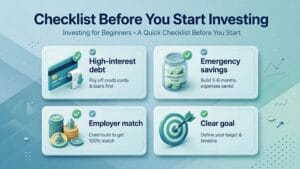
Investing works best when your foundation is stable. Check these four things first:
- High-interest debt. Paying off a credit card with a high interest rate often beats investing, because the interest you avoid can be larger than what you might earn. See our plan on how to get out of debt.
- Emergency savings. Keep a cushion so you never have to sell investments at a bad time. Our guide to sinking fund vs emergency fund explains how to organize your savings.
- An employer match. If your employer matches retirement contributions, that is extra money you should usually capture first.
- A clear goal. Know what the money is for and when you will need it.
Investing for Beginners in 7 Simple Steps
Follow these seven steps in order. Most beginners can complete the setup in a single afternoon.
Step 1: Set Your Goals and Time Horizon
Write down what you are investing for, such as retirement, a home, or long-term wealth, and when you will need the money. Many people use five years as a rough guide: money you may need sooner is usually better kept in savings, while money for later goals can handle market ups and downs.
Step 2: Decide How Much You Can Invest
Start with an amount you can keep up, even if it is small. A budget makes investing for beginners much easier, and our guide to the 50/30/20 rule shows where investing fits. For a full overview, read our guide on how to budget.
Step 3: Choose the Right Account
Your account affects taxes and access to your money. Here are the most common options:
| Account | How It Works | Good For |
|---|---|---|
| Workplace plan (such as a 401(k)) | Contributions come from your paycheck, and some employers add a match | Retirement, especially if there is a match |
| Traditional IRA | An individual retirement account with potential tax benefits on contributions | Retirement savings outside work |
| Roth IRA | Contributions are made with after-tax money, and qualified withdrawals can be tax-free | Long-term retirement savings |
| Taxable brokerage account | A flexible account with no special tax advantages | Goals other than retirement |
Retirement accounts have rules about contributions, income, and withdrawals, and those rules change over time. Check the current details on the IRS website, or ask a qualified tax professional.
Step 4: Learn the Basic Types of Investments
You do not need to master every product. Understanding these basics is enough to start:
| Investment | What It Is | General Risk Level |
|---|---|---|
| Stocks | Shares of ownership in a company | Higher, with larger ups and downs |
| Bonds | Loans to a government or company that pay interest | Usually lower than stocks, but not risk-free |
| Mutual funds | Pooled money invested in many assets, priced once a day | Depends on what the fund holds |
| ETFs | Funds that trade on an exchange like a stock | Depends on what the fund holds |
| Index funds | Funds that track a market index at low cost | Follows the market they track |
| Target-date funds | Funds that adjust their mix as a goal date gets closer | Becomes more conservative over time |
If you are comparing fund types, read our guide on ETF vs mutual fund to see how they differ on fees, taxes, and trading.
Step 5: Pick Low-Cost, Diversified Investments
For investing for beginners, a broad index fund is a common starting point, because it spreads your money across many companies and usually has low fees. Diversification means you do not rely on any single company, which lowers the risk that one bad result damages your whole portfolio.
Step 6: Invest Regularly and Automate It
The easiest habit in investing for beginners is automation. Set up automatic monthly contributions, so investing happens without effort. Putting in the same amount on a schedule is called dollar-cost averaging, and our guide to dollar-cost averaging explains how it works and its limits.
Step 7: Review Once or Twice a Year
Check that your goals, amounts, and investments still match, then leave your plan alone. Frequent checking and changing usually leads to emotional decisions, which can hurt long-term results.
Investing for Beginners: How Much Should You Invest?
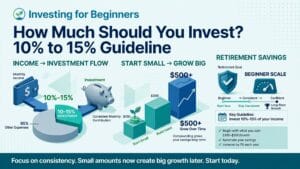
There is no single right number, because it depends on your income, debts, and goals. A common guideline for retirement is to save around 10% to 15% of your income, including any employer match, but treat this as a starting point rather than a rule. If that feels like too much, begin with a smaller amount and raise it when your income grows.
If you are starting with a small amount, our guides on how to invest $100 and how to invest $500 show how to begin at different levels.
Investing for Beginners: How Risk and Diversification Work
All investing involves risk, and higher potential returns usually come with larger swings in value. Understanding risk is a key part of investing for beginners, because it helps you stay calm when markets fall.
- Risk tolerance. How large a drop in value you can handle without panicking and selling.
- Time horizon. The longer you can leave money invested, the more time it has to recover from downturns.
- Diversification. Spreading money across many investments so one failure does not ruin your plan.
Diversification does not remove risk or guarantee a profit, but it can reduce the damage from any single investment.
How Fees Affect Your Returns
Fees quietly reduce your returns every year, so they matter a lot over decades. The main cost is the expense ratio, an annual percentage charged by a fund. Here is what different expense ratios cost each year on a $10,000 balance:
| Expense Ratio | Yearly Cost on $10,000 |
|---|---|
| 0.05% | $5 |
| 0.50% | $50 |
| 1.00% | $100 |
The gap grows as your balance grows, so comparing costs is one of the easiest wins in investing for beginners and one of the simplest ways to improve your results. Also check for trading commissions and account fees before you invest.
What Could Regular Investing Grow Into?
Here is a hypothetical example, assuming an average return of 7% a year, compounded monthly. This return is only an assumption for illustration, real returns change every year, and your investments can lose value:
| Years | Total You Contribute at $200 a Month | Estimated Value |
|---|---|---|
| 10 years | $24,000 | About $34,600 |
| 20 years | $48,000 | About $104,200 |
| 30 years | $72,000 | About $244,000 |
The lesson in investing for beginners is that consistency and time usually matter more than the size of any single deposit.
Investing for Beginners: Simple Terms You Should Know
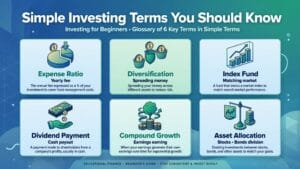
- Expense ratio: the yearly fee a fund charges, shown as a percentage.
- Diversification: spreading money across many investments to reduce risk.
- Index fund: a fund that tries to match the performance of a market index.
- Dividend: a payment some companies make to their shareholders.
- Compound growth: earnings that begin to earn their own earnings over time.
- Asset allocation: how your money is divided between stocks, bonds, and other assets.
Common Mistakes in Investing for Beginners
- Waiting for the perfect moment. Time in the market usually matters more than timing the market.
- Investing money you need soon. Short-term bills belong in savings.
- Putting everything in one stock. A single company carries far more risk than a diversified fund.
- Ignoring fees. A higher expense ratio reduces returns every year.
- Chasing hype. Be cautious with anyone promising quick or guaranteed returns.
- Panic selling. Selling after a drop can lock in losses and miss the recovery.
- Investing while carrying expensive debt. High interest can outweigh what investments might earn.
Tips for Investing for Beginners
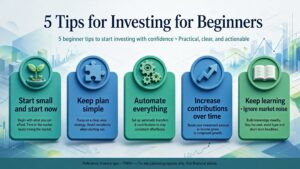
- Start small and start now. A habit started today beats a perfect plan started next year.
- Keep your plan simple. One or two diversified funds are enough for many beginners.
- Automate everything. Automatic transfers remove the need for willpower.
- Increase contributions over time. Raise them whenever your income grows.
- Keep learning. Read one trusted guide a month, and ignore daily market noise.
For free, plain-language education, the U.S. Securities and Exchange Commission runs Investor.gov, and you can check the background of a broker or advisor with FINRA.
Where to Go Next
If you want to go deeper, these guides build on what you learned here:
- How to start investing with little money
- How to invest $100
- How to invest $500
- ETF vs mutual fund
- Dollar-cost averaging explained
Frequently Asked Questions About Investing for Beginners
What is the best way to start investing for beginners?
For many people, the best way is to cover high-interest debt and build a small emergency fund, open a retirement or brokerage account, choose a low-cost diversified fund, and invest a set amount every month.
How much money do I need to start investing?
Not much. Many brokers have no account minimum, and fractional shares let you start with small amounts such as $25 or $100. The habit matters more than the starting amount.
Is investing safe for beginners?
All investing involves risk, including the possible loss of money. Diversified, low-cost funds and a long time horizon can reduce risk, but they cannot remove it.
Should I invest or pay off debt first?
If your debt carries a high interest rate, paying it down often comes first, because avoiding interest has no market risk. For low-interest debt, investing alongside payments may make sense.
What should a beginner invest in?
Many beginners start with a broad index fund or ETF, because it is diversified and usually low cost. The right choice depends on your goals, time horizon, and comfort with risk.
How often should beginners check their investments?
Once or twice a year is enough for most long-term investors. Checking every day often leads to emotional decisions.
Can I start investing with $100?
Yes. Many beginners start with $100 or less, using fractional shares or a low-minimum fund. Our guide on how to invest $100 explains the steps.
Final Thoughts
Investing for beginners does not have to be complicated. Cover your basics, choose an account, pick a low-cost diversified fund, automate your contributions, and give your money time to grow. You will make mistakes along the way, and that is normal, but a simple plan that you follow consistently is better than a complex plan you abandon.
Ready to take the first step? Try our free Investment Growth Calculator to see how your contributions could grow, and start with our guide on how to start investing with little money.
This article is for educational purposes only and is not financial or investment advice. All investing involves risk, including the possible loss of money, and past performance does not guarantee future results. Consider speaking with a qualified professional about your specific situation.