
If you’re looking for how to save money fast — not vague long-term advice — you’re in the right place. Maybe you’re building an emergency fund, paying off debt, or saving for something specific with a deadline. Whatever the reason, this guide covers 12 practical, proven tips that show you exactly how to save money fast, starting today.
These aren’t the tired “stop buying coffee” tips you’ve heard a hundred times. They’re organized by how quickly they produce results, so you can start with the fastest wins first.
Quick Wins: Save Money Fast in the Next 24 Hours

1. Audit and Cancel Unused Subscriptions
Go through your bank and credit card statements from the last two months and list every recurring charge — streaming services, apps, memberships. Most people are shocked to find $50-$150 a month in subscriptions they barely use. Canceling even three or four of them is instant, ongoing savings with zero lifestyle sacrifice.
2. Call Your Providers and Negotiate
Internet, phone, and insurance providers often have retention discounts they don’t advertise. A single 15-minute call asking “is there a lower rate available” or mentioning a competitor’s price can save $20-$50 a month — savings that repeat every single month going forward.
3. Switch to a High-Yield Savings Account
If your savings are sitting in a traditional bank account earning close to 0% interest, moving that money to a high-yield savings account is a five-minute task that puts your existing savings to work harder immediately, with zero additional effort required going forward.
4. Use the 48-Hour Rule on Non-Essential Purchases
Before buying anything non-essential over $50, wait 48 hours. This single habit eliminates a huge percentage of impulse purchases — you’ll be amazed how often the urge to buy disappears once the initial impulse fades.
Fast Results: Save Money Fast Within a Week

5. Meal Plan and Batch Cook
Groceries and takeout combined are often one of the biggest controllable expenses in any budget. Planning meals for the week and batch cooking on one day typically cuts food spending by 20-30% almost immediately, while also saving time during busy weekdays.
6. Switch to Generic or Store Brands
For most household items — medications, pantry staples, cleaning supplies — store brands are nearly identical to name brands at 20-40% lower cost. This is one of the easiest ways to save money fast without changing your actual shopping habits or routine.
7. Review and Adjust Your Insurance
Shop your car and home insurance rates against 2-3 competitors. Rates change frequently, and loyalty rarely gets rewarded — many people save several hundred dollars a year simply by re-shopping policies they’ve had for years without checking.
8. Sell Items You No Longer Use
Unused electronics, clothes, furniture, and equipment sitting around your home can be converted to cash within days through online marketplaces. This isn’t a long-term strategy, but it’s one of the fastest ways to generate an immediate cash boost toward a savings goal.
Not sure where your money is actually going each month? Use our free Budget Calculator to see your full spending breakdown in seconds.
Sustainable Habits: Save Money Fast and Keep It That Way

9. Automate Your Savings
Set up an automatic transfer to savings the day you get paid, before you have a chance to spend it. This single change — removing the decision entirely — is one of the most reliable ways to save money fast and consistently, month after month.
10. Use a Sinking Fund for Irregular Expenses
A huge amount of “emergency” spending is actually predictable — car maintenance, holiday gifts, annual fees. Setting aside small amounts monthly for these known future costs prevents them from wrecking your savings progress later. Learn more in our guide on what a sinking fund is and see 50 real sinking fund examples to get started.
11. Try a No-Spend Challenge
Pick a set period — a week or a full month — and commit to spending only on true essentials: housing, utilities, groceries, and existing bills. No-spend challenges reset spending habits quickly and often reveal exactly how much unnecessary spending has crept into your routine.
12. Track Every Dollar for 30 Days
Simply writing down or logging every purchase for a month — without judgment or restriction — makes most people spend less automatically. Awareness alone is one of the most underrated ways to save money fast, because it’s hard to overspend on something you’re actively watching.
How Much Can You Realistically Save?
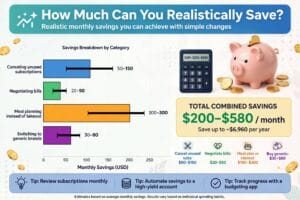
Combining even a handful of these tips typically produces noticeable results within 30 days. As a rough example:
- Canceling unused subscriptions: $50-$150/month
- Negotiating bills: $20-$50/month
- Meal planning instead of takeout: $100-$300/month
- Switching to generic brands: $30-$80/month
Combined, that’s potentially $200-$580 in monthly savings from changes that take less than a few hours total to implement — without touching your income at all.
How to Save Money Fast and Make It Last: What to Do Next
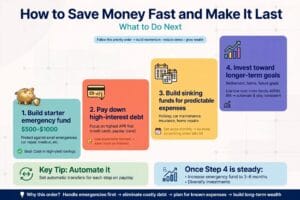
Once you start seeing real results, it’s important to direct that extra money intentionally rather than letting it quietly disappear back into spending. Consider this priority order:
- Build a starter emergency fund ($500-$1,000) if you don’t have one yet. Our Emergency Fund Calculator can help you set a target.
- Pay down high-interest debt — every dollar saved here is guaranteed “return” equal to your interest rate.
- Build sinking funds for predictable upcoming expenses so you never have to scramble again.
- Invest the rest toward longer-term goals once your short-term foundation is solid.
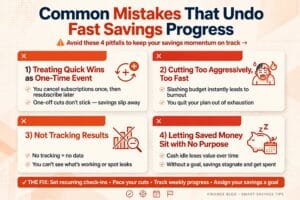
Common Mistakes That Undo Fast Savings Progress
- Treating quick wins as a one-time event. Canceling a subscription once doesn’t help if you resubscribe to something else a month later. Make these audits a recurring quarterly habit.
- Cutting too aggressively, too fast. Extreme restriction often backfires into burnout spending. Sustainable savings beats an unsustainable sprint.
- Not tracking the results. Without measuring your progress, it’s easy to lose motivation. According to research highlighted by the Consumer Financial Protection Bureau, automating savings significantly increases the odds of hitting savings goals compared to manual saving alone.
- Letting saved money sit with no purpose. Money saved without a clear destination (debt, emergency fund, goal) tends to get spent eventually. Assign every saved dollar a job.
Final Thoughts
Learning how to save money fast isn’t about extreme sacrifice — it’s about identifying the highest-impact changes first (subscriptions, negotiating bills, automating savings) and building sustainable habits second (meal planning, tracking spending, sinking funds). If you’re serious about how to save money fast, start with two or three tips from this list today, and layer in more as they become habits.
Ready to see exactly where your money is going? Try our free Budget Calculator and get a personalized breakdown of your spending in seconds — no sign-up required.