
If you are searching for how to get out of debt, you have already done the hardest part: you are facing the problem instead of ignoring it. Debt can feel heavy, but it responds to a clear plan. In this guide you will learn how to get out of debt step by step, from listing what you owe to choosing a payoff method, lowering your interest, and making sure the debt does not come back.
Whether you are dealing with credit card debt, a personal loan, a car loan, or a mix of everything, the process of how to get out of debt is the same. You need to see the full picture, free up extra money, attack your balances in a smart order, and build habits that protect you afterward. Let’s walk through it together.
How to Get Out of Debt: The 8-Step Plan at a Glance
- List every debt you owe
- Build a budget that finds extra money
- Start a small emergency fund
- Choose a debt payoff method
- Lower your interest costs
- Increase your income
- Automate and track your progress
- Stop adding new debt
Why Getting Out of Debt Feels So Hard
Understanding how to get out of debt starts with understanding why debt is hard to escape. Interest works against you every single month, so a large part of each payment can go to the lender instead of to your balance. Minimum payments are often set low, which keeps the balance alive for years. On top of that, debt brings stress, and stress makes it harder to plan calmly. The good news is that a written plan removes much of that pressure, because you always know what to do next.
Step 1: List Every Debt You Owe
The first step in how to get out of debt is knowing exactly what you are up against. Many people avoid this because it feels uncomfortable, but a debt payoff plan cannot work without real numbers. Write down every debt in a spreadsheet or notebook, including credit cards, store cards, student loans, car loans, personal loans, and any money you owe to family or friends.
For each debt, record these details:
- Lender name and type of debt
- Current balance
- Interest rate (APR)
- Minimum monthly payment
- Due date
If you are not sure about a balance or an account you forgot about, you can request your free credit reports from AnnualCreditReport.com, the official site for free reports in the United States. Reviewing them helps you catch every open account.
Not all debt is equally urgent. High-interest debt such as credit cards and payday loans usually deserves attention first, while lower-interest debt such as a mortgage or some student loans can often be handled with regular payments. Sorting your list this way makes the rest of the plan much clearer.
Once you have the list, add up your total monthly debt payments and divide that number by your gross monthly income. This gives you your debt-to-income ratio (DTI). A lower DTI means debt takes up a smaller share of your income, and it is a useful number to track as you pay off debt over time.

Step 2: Build a Budget That Finds Extra Money
A budget is the engine of any plan for how to get out of debt, because you cannot pay off debt faster without extra cash flow. Track your income and spending for a month, then separate your expenses into needs, wants, and debt payments. Popular frameworks like the 50/30/20 rule can be a helpful starting point, but when you are working on a debt payoff plan you may temporarily shift more of the “wants” portion toward debt.
Look for quick wins: unused subscriptions, frequent takeout, bank fees, or insurance you have not shopped around for in years. Even a modest amount redirected every month adds up, because every extra dollar sent to debt reduces the interest you pay later. You can use our free Budget Calculator to see where your money goes and how much you can realistically put toward debt each month.

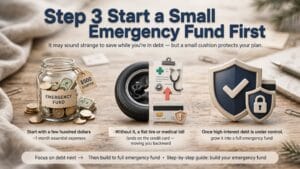
Step 3: Start a Small Emergency Fund First
It may sound strange to save while you are in debt, but a small cushion protects your plan for how to get out of debt. Without one, a flat tire or a medical bill goes straight onto a credit card, and you end up moving backward. Many people start with a small starter fund, such as a few hundred dollars or roughly one month of essential expenses, and then focus on debt.
Once your high-interest balances are under control, you can grow that cushion into a full emergency fund. Our guide to building an emergency fund explains how to do it step by step.
Step 4: Choose a Debt Payoff Method
This is the heart of how to get out of debt faster. Two popular strategies work well, and the best one is the one you will actually stick with.
The Debt Snowball Method
With the snowball method, you pay the minimum on every debt and put all extra money toward the smallest balance first. When it is gone, you roll that payment into the next smallest balance. The quick wins build motivation, which is why many people find it easier to stay consistent.
The Debt Avalanche Method
With the avalanche method, you pay the minimum on everything and send extra money to the debt with the highest interest rate first. This usually costs less in total interest, but it can take longer to see the first debt disappear.
A Simple Example
Imagine three debts (illustrative numbers only): a $800 loan at 8%, a $1,200 credit card at 19%, and a $4,500 credit card at 27%. The snowball order would be the $800 loan, then the $1,200 card, then the $4,500 card. The avalanche order would be the 27% card, then the 19% card, then the 8% loan. Neither is wrong. If you want to compare both approaches in detail, read our guide on debt snowball vs debt avalanche, or test your own numbers in the Debt Payoff Calculator.

Step 5: Lower Your Interest Costs
If you want to know how to get out of debt faster, lowering your interest rate is one of the most powerful moves. High interest is what keeps credit card debt hanging around for years, and reducing your rate means more of each payment goes to the balance instead of to interest. Here are the main options to consider:
- Call your lender and ask for a lower rate. It does not always work, but a short phone call costs nothing, especially if you have a history of on-time payments.
- Balance transfer card. Some cards offer a low or 0% introductory rate for a limited time. Check the transfer fee and the rate after the promotional period ends, and only use this if you can realistically pay the balance down in time.
- Debt consolidation loan. A personal loan with a fixed rate can replace several high-interest balances with one payment. It only helps if the new rate is lower and you do not run the cards back up.
- Nonprofit credit counseling. A reputable nonprofit agency can review your finances and may offer a debt management plan. The National Foundation for Credit Counseling is one place to find certified counselors.
Be cautious with companies that promise to erase your debt quickly or charge large upfront fees. The Consumer Financial Protection Bureau publishes free guides on debt, credit, and how to spot debt relief scams. Whichever option you choose, compare the total cost, not only the monthly payment. A lower monthly payment stretched over a longer period can cost more overall.

Step 6: Increase Your Income
Cutting expenses has a limit, but income can grow, and this is often what separates a slow plan from a fast one when you are working out how to get out of debt on any income. Even a small side income dedicated entirely to debt can speed up your debt payoff plan. Options include freelancing, selling items you no longer use, taking extra shifts, doing seasonal work, or asking for a raise if you have taken on more responsibility. Treat this extra income as a debt-only fund so it does not get absorbed into everyday spending.
Step 7: Automate and Track Your Progress
Consistency matters most when you are learning how to get out of debt. Set up automatic payments for at least the minimums so you never miss a due date, and schedule your extra payment right after payday. Then track your progress monthly: total debt, number of debts left, and your debt-to-income ratio. Seeing the total fall is a powerful motivator. Many people mark each paid-off debt on a chart or checklist to celebrate the milestone.
Step 8: Stop Adding New Debt
A payoff plan only works if you stop borrowing while you pay. Consider pausing new credit card spending, using cash or a debit card for everyday purchases, and waiting 24 to 48 hours before non-essential purchases. If you rely on credit for emergencies, that is another reason a starter emergency fund matters. Over time, building a habit of saving for planned expenses, such as with a sinking fund, helps you avoid borrowing for predictable costs.
Common Mistakes When Learning How to Get Out of Debt
- Paying only the minimum. Minimum payments are designed to keep you in debt longer, and most of the payment can go toward interest.
- Not having a written plan. Good intentions are not a debt payoff plan. Put the order and amounts on paper.
- Closing accounts without thinking. Closing old cards can affect your credit utilization and credit history, so check the impact first.
- Using consolidation without changing habits. If the cards fill up again, you end up with more debt than before.
- Giving up after a slip. One unplanned expense does not ruin the plan. Adjust and keep going.

How to Get Out of Debt on a Low Income
Many people assume that how to get out of debt is only a question for high earners, but a low income does not make it impossible. It usually means the timeline is longer and every decision matters more. Start with a bare-bones budget that covers essentials only, then look for one realistic way to add income, even a few extra hours a month. Ask lenders about hardship programs or lower rates, and consider nonprofit credit counseling for free guidance. Small, steady extra payments work better than big plans you cannot keep up, because the goal is progress you can repeat every month.
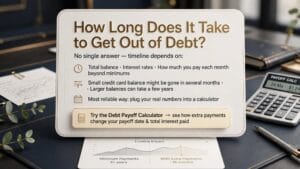
How Long Does It Take to Get Out of Debt?
There is no single answer, because the timeline depends on your total balance, your interest rates, and how much you can pay each month beyond the minimums. A small credit card balance might be gone in several months, while larger balances can take a few years. The most reliable way to estimate your own date is to plug your real numbers into a calculator. Try our Debt Payoff Calculator to see how extra payments change your payoff date and the total interest you pay.
Frequently Asked Questions About Getting Out of Debt
What is the first step in how to get out of debt?
The first step is to list every debt with its balance, interest rate, and minimum payment. You cannot build a payoff plan until you can see the full picture in one place.
What is the fastest way to get out of debt?
The fastest approach is usually to combine a tight budget, extra income, and a focused payoff method. Sending every spare dollar to one target debt while paying minimums on the rest, and lowering your interest where possible, shortens the timeline the most.
Should I pay off debt or save money first?
For most people, a balanced approach works best: build a small starter emergency fund first so surprise costs do not become new debt, then focus on paying off high-interest debt, then grow your savings.
Is debt snowball or avalanche better?
Avalanche usually saves more on interest, while snowball can provide faster motivation. The better method is the one you can follow consistently until the debt is gone.
How do I get out of credit card debt?
List each card with its balance and APR, stop adding new charges, choose snowball or avalanche, and consider lowering your interest through a rate negotiation, balance transfer, or consolidation loan if it fits your situation.
Can I get out of debt on a low income?
Yes, although it may take longer. Focus on the essentials: a bare-bones budget, one small extra income source, interest reduction where possible, and steady progress. Even small, consistent extra payments make a real difference over time.
Final Thoughts
Knowing how to get out of debt is not about a secret trick. It is about seeing your numbers clearly, creating room in your budget, choosing a payoff method, and staying consistent until the last balance is gone. Start with Step 1 today: list your debts and total them. Then use the Debt Payoff Calculator to turn your plan into a real timeline.
This article is for educational purposes only and is not financial advice. Consider speaking with a qualified professional about your specific situation.