
If your paycheck seems to disappear before the month ends, the 50/30/20 rule may be the simplest fix you will find. It is one of the most popular budgeting methods in personal finance because it replaces long lists of categories and complicated spreadsheets with just three numbers. In this guide you will learn exactly what the 50/30/20 rule is, how to calculate it step by step, what counts as a need, a want, or savings, and how to adjust it when your life does not fit the standard formula.
Whether you are budgeting for the first time or have tried and quit before, the 50/30/20 rule gives you a clear starting point without forcing you to track every single dollar. Let’s break it down in plain English.
What Is the 50/30/20 Rule?
The 50/30/20 rule is a simple budgeting framework that splits your after-tax income into three groups: 50% for needs, 30% for wants, and 20% for savings and debt repayment. It was popularized by Senator Elizabeth Warren and her daughter Amelia Warren Tyagi in their book All Your Worth: The Ultimate Lifetime Money Plan, and it has stayed popular for one reason: it is easy to remember and easy to apply.
- 50% for needs: the essentials you must pay to live and work, such as housing, utilities, groceries, and transportation.
- 30% for wants: everything that improves your life but is not essential, such as dining out, hobbies, and entertainment.
- 20% for savings and debt repayment: money that builds your future, including emergency savings, retirement contributions, and extra debt payments.
The idea behind the 50/30/20 rule is balance. Instead of cutting all enjoyment from your budget or ignoring your future, you give every part of your life a fair share. That balance is what makes this method easier to stick with than strict budgets that feel like punishment.

How to Calculate the 50/30/20 Rule
To use the 50/30/20 rule, you start with your after-tax income, also called take-home pay. This is the amount that actually lands in your bank account after taxes and payroll deductions. If your income changes from month to month, use a conservative average of the last three to six months instead.
Then multiply that number by 0.50, 0.30, and 0.20. The results are your monthly spending limits for each group. Here is an example based on $4,000 of monthly take-home pay:
| Category | Percentage | Monthly Amount |
|---|---|---|
| Needs | 50% | $2,000 |
| Wants | 30% | $1,200 |
| Savings and debt repayment | 20% | $800 |
In this example, the 50/30/20 rule tells you to keep needs at or below $2,000, limit wants to $1,200, and move $800 into savings or extra debt payments every month. The percentages stay the same at any income level, so only the dollar amounts change.
What Counts as a Need, a Want, or Savings?
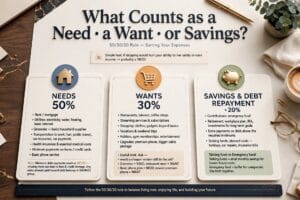
The hardest part of the 50/30/20 rule is sorting your expenses into the right group. A simple test helps: if skipping it would hurt your ability to live safely or earn income, it is probably a need.
Needs (50%)
- Rent or mortgage payment
- Utilities such as electricity, water, heating, and basic internet
- Groceries and basic household supplies
- Transportation to work, including fuel, public transit, car insurance, and car payments
- Health insurance and essential medical costs
- Minimum payments on loans and credit cards
- Basic phone service
Notice that minimum debt payments count as needs, because missing them leads to fees and credit damage. Any extra amount you pay toward debt belongs in the savings group instead.
Wants (30%)
- Restaurants, takeout, and coffee shops
- Streaming services and subscriptions
- Shopping for clothes and gadgets beyond the basics
- Vacations and weekend trips
- Hobbies, gym memberships, and entertainment
- Upgrades such as a premium phone or a bigger cable package
A useful trick is to ask whether a cheaper version would still do the job. Groceries are a need, but a restaurant meal is a want. A phone plan is a need, but the newest premium phone is a want.
Savings and Debt Repayment (20%)
- Contributions to your emergency fund
- Retirement savings, such as a workplace plan or an IRA
- Investments for long-term goals
- Extra payments on debt above the required minimums
- Sinking funds for planned costs such as holidays, car repairs, or insurance bills
Sinking funds, which are small monthly savings for known future costs, fit well in this group. Our guide to sinking fund vs emergency fund explains how to use both together.
How to Start Using the 50/30/20 Rule Step by Step
You do not need special software to begin. Follow these six steps and you will have a working budget in less than an hour.
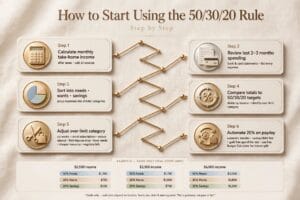
Step 1: Calculate your monthly take-home income. Use the amount that reaches your bank account after taxes. If you have more than one source of income, add them together.
Step 2: Review the last two or three months of spending. Open your bank and card statements and list every expense. This shows what you really spend, not what you think you spend.
Step 3: Sort each expense into needs, wants, or savings. Use the lists above. When an item could fit two groups, choose the stricter one.
Step 4: Compare your totals with the 50/30/20 targets. Add up each group and divide it by your income. You will quickly see which category is too high.
Step 5: Adjust the category that is over its limit. Most people find the extra money in wants first, such as subscriptions, takeout, and impulse shopping. You can also lower needs by shopping for cheaper insurance or negotiating a bill.
Step 6: Automate your 20% on payday. Set up an automatic transfer to savings or debt payments the day your paycheck arrives. When saving happens first, you spend the rest without guilt. To make the math easy, try our free Budget Calculator, which shows your 50/30/20 split instantly.
50/30/20 Rule Examples at Different Incomes
The 50/30/20 rule works the same way at any income level. These examples show how the dollar amounts change:
| Monthly Take-Home Pay | Needs (50%) | Wants (30%) | Savings and Debt (20%) |
|---|---|---|---|
| $2,500 | $1,250 | $750 | $500 |
| $3,500 | $1,750 | $1,050 | $700 |
| $6,000 | $3,000 | $1,800 | $1,200 |
These numbers are only a guide. Your real costs depend heavily on where you live, your family size, and your debts, so treat the percentages as a starting point rather than a pass or fail test.
What If Your Needs Cost More Than 50%?
For many people, especially in expensive cities, housing alone can swallow half of their income. If that sounds familiar, the 50/30/20 rule is not broken, and neither are you. It is a guideline, not a law, and you can adapt it to your situation:
- 60/20/20: needs get a larger share, wants shrink, and you still save 20%.
- 70/20/10: a tight-income version that protects a small amount of savings while you work on raising income or lowering costs.
- 50/20/30: a debt-focused version where you shift part of your wants budget toward paying off high-interest balances faster.
The goal is to keep the habit of dividing your income on purpose. Even if you start with a 70/20/10 split, you can slowly move closer to the 50/30/20 rule as your income grows or your expenses fall.
Using the 50/30/20 Rule to Pay Off Debt
The 20% portion of the 50/30/20 rule is your debt-fighting budget. After you cover minimum payments in your needs category, send everything in this group above those minimums to the debt you want to eliminate first. If you want a complete plan for doing that, read our step-by-step guide on how to get out of debt.
If your debt is large or expensive, it is reasonable to temporarily pull a little from your wants category as well. A short period of tighter spending can shorten your payoff timeline and reduce the total interest you pay. Once the debt is gone, you can redirect that same money to savings and investing.
Using the 50/30/20 Rule to Build Savings
If you have little or no savings, a smart way to use the 50/30/20 rule is to split the 20% into two parts. First build a starter emergency fund, then add retirement and other long-term goals. A common starting target is one month of essential expenses, which you can grow over time.
Keep your emergency money in an easy-to-access account that is insured. You can check whether a bank is covered by deposit insurance on the FDIC website. For a full walkthrough, see our guide to building an emergency fund.

Pros and Cons of the 50/30/20 Rule
Pros
- Simple: three categories are easy to remember and track.
- Flexible: you decide exactly how to spend within each group.
- Balanced: it protects both your present enjoyment and your future security.
- Beginner friendly: you do not need detailed categories or special software.
- Scales with income: the percentages work whether you earn a little or a lot.
Cons
- Not ideal for high living costs: needs can exceed 50% in expensive areas.
- Not ideal for very low incomes: there may be little room for wants or savings.
- Too general for some goals: if you are paying off large debt or saving aggressively, you may need a more customized plan.
- Depends on honest sorting: calling every purchase a need makes the budget meaningless.
Common Mistakes When Using the 50/30/20 Rule
- Using gross income instead of take-home pay. Percentages based on pre-tax income will overstate what you can actually spend.
- Calling wants “needs.” A premium cable package or a top-tier phone plan is a want, even if it feels necessary.
- Forgetting irregular expenses. Annual insurance, holiday gifts, and car repairs can break a budget if you do not plan for them.
- Skipping the 20%. Saving whatever is left over rarely works. Pay yourself first.
- Quitting after one bad month. One overspent month is a data point, not a failure. Adjust and keep going.

Tips to Make the 50/30/20 Rule Work for You
- Review your budget monthly. Prices, income, and goals change, and your budget should change with them.
- Use separate accounts. A dedicated savings account makes it harder to spend your 20% by accident.
- Lower your biggest needs first. Cutting rent, insurance, or car costs has a bigger effect than skipping small treats.
- Keep a little fun in the plan. A realistic wants category helps you stay consistent.
- Use free, trusted tools. The Consumer Financial Protection Bureau offers free guides on budgeting and managing money.
Frequently Asked Questions About the 50/30/20 Rule
What is the 50/30/20 rule in simple terms?
It is a budgeting method that divides your take-home pay into 50% for needs, 30% for wants, and 20% for savings and debt repayment. It gives you a simple structure without tracking dozens of categories.
Should the 50/30/20 rule use gross or net income?
Use net income, which is your pay after taxes and deductions. That is the money you can actually spend and save each month.
Is the 50/30/20 rule realistic?
It can be, but it depends on your income and cost of living. If your needs exceed 50%, use a modified split such as 60/20/20 and work toward the standard version over time.
Where do debt payments go in the 50/30/20 rule?
Minimum payments belong in needs because they are required. Any extra payments above the minimum belong in the 20% savings and debt category.
Can I change the percentages in the 50/30/20 rule?
Yes. The percentages are a guideline, and many people adjust them to fit high rent, large debts, or aggressive savings goals. The key is to keep a clear plan for every dollar.
Is the 50/30/20 rule good for beginners?
Yes, it is one of the best budgeting methods for beginners because it is simple, flexible, and easy to start in an hour or less.
Final Thoughts
The 50/30/20 rule will not solve every money problem, but it gives you something many budgets lack: a clear, balanced structure you can actually follow. Start by calculating your take-home pay, sorting your last two months of spending, and moving your 20% into savings or debt payments on payday. Then fine-tune the percentages until they fit your real life.
Ready to put your numbers to work? Try our free Budget Calculator to see your personal 50/30/20 split in seconds, and check back for more simple guides on budgeting, saving, and investing.
This article is for educational purposes only and is not financial advice. Consider speaking with a qualified professional about your specific situation.