
If you are starting to invest, one question comes up almost immediately: ETF vs mutual fund, which one is better? Both let you own hundreds or even thousands of stocks and bonds in a single purchase, and both can help you build wealth without picking individual companies. But they work differently when it comes to fees, taxes, trading, and minimum investments, and those differences can quietly add up over many years.
In this guide you will learn exactly how the ETF vs mutual fund choice works, how the two compare side by side, and how to decide which one fits your goals, your account type, and your budget. No jargon, just clear answers.
What Is an ETF?
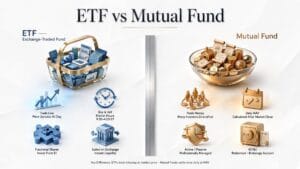
An ETF, short for exchange-traded fund, is a basket of investments that trades on a stock exchange just like a single company’s stock. When you buy one share of an ETF, you own a small slice of everything inside the basket. Many ETFs simply track an index, such as a broad stock market index, which means they aim to match the market rather than beat it.
Because ETFs trade on an exchange, their price changes throughout the trading day. You can buy or sell them whenever the market is open, using a brokerage account. Many brokers also let you buy fractional shares, so you can start with a small dollar amount instead of the full price of one share.
What Is a Mutual Fund?
A mutual fund also pools money from many investors to buy a diversified mix of stocks, bonds, or other assets. The difference is how you buy and sell it. Mutual fund shares are not traded on an exchange during the day. Instead, orders are processed once per day at the fund’s net asset value (NAV), which is calculated after the market closes.
Mutual funds can be actively managed, where a professional tries to beat the market, or passively managed, where the fund tracks an index. You can buy them through a brokerage, directly from the fund company, or through a workplace retirement plan such as a 401(k), where they are often the main option. Understanding these basics makes the ETF vs mutual fund comparison much easier.
ETF vs Mutual Fund: Key Differences at a Glance
Here is a quick side-by-side view of the ETF vs mutual fund comparison before we go deeper into each point:
| Feature | ETF | Mutual Fund |
|---|---|---|
| How it trades | On an exchange all day | Once per day at NAV |
| Typical fees | Often very low for index ETFs | Varies, can be higher for active funds |
| Minimum to start | Price of one share (or less with fractional shares) | Sometimes a minimum such as $1,000 or more |
| Tax efficiency | Often more tax efficient | May pay out more taxable gains |
| Automatic investing | Depends on your broker | Usually easy to set up |
| Management style | Mostly passive, some active | Both active and passive |
The table gives you the big picture of the ETF vs mutual fund comparison, but the details behind each row matter. Let’s look at them one by one.
ETF vs Mutual Fund: Fees and Costs
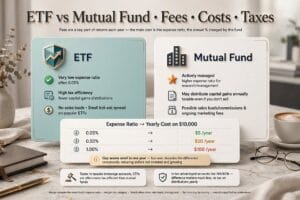
Fees are one of the most important parts of the ETF vs mutual fund decision, because they come out of your returns every single year. The main cost is the expense ratio, an annual percentage charged by the fund. An expense ratio of 0.05% means you pay about $0.50 per year for every $1,000 invested.
Index ETFs and index mutual funds can both have very low expense ratios. Actively managed mutual funds usually cost more, because you are paying for research and a management team. Here is how much different expense ratios cost each year on a $10,000 investment:
| Expense Ratio | Yearly Cost on $10,000 |
|---|---|
| 0.05% | $5 |
| 0.50% | $50 |
| 1.00% | $100 |
That gap may look small in one year, but over decades the difference compounds, because those dollars are not invested and growing. When comparing an ETF vs mutual fund, always compare the expense ratio of the exact funds you are considering, not just the category.
Also watch for other costs. Some mutual funds charge a sales load, which is a commission when you buy or sell, and some charge ongoing marketing fees. Many investors prefer no-load funds to avoid these charges. ETFs do not have sales loads, but they have a small trading cost called the bid-ask spread, which is usually tiny for large, popular ETFs.
ETF vs Mutual Fund: Taxes
In a regular taxable brokerage account, taxes can be another deciding factor in the ETF vs mutual fund choice. ETFs are often more tax efficient because of how they are built and traded, which usually means fewer taxable capital gains payouts to shareholders. Mutual funds, especially actively managed ones, may distribute capital gains at the end of the year, and you may owe tax on them even if you did not sell any shares.
Inside a tax-advantaged account such as an IRA or a 401(k), this difference matters much less, because you are not taxed on distributions each year. Tax rules vary by country and situation, so check the rules that apply to you or speak with a qualified tax professional before deciding.
ETF vs Mutual Fund: Trading and Flexibility
This is where the ETF vs mutual fund difference is easiest to see. With an ETF, you can place an order at any time during market hours and know the price you are getting. You can also use tools such as limit orders. With a mutual fund, you place an order and receive the price calculated at the end of the day.
For a long-term investor, this difference rarely matters. If you plan to hold for years, whether you buy at 10 a.m. or at the end of the day makes almost no difference. Frequent trading is usually a mistake for beginners, so do not treat ETF flexibility as a reason to trade more often.
ETF vs Mutual Fund: Minimum Investment
Some mutual funds require a minimum initial investment, which can range from a few hundred to a few thousand dollars. That can be a barrier if you are starting small. ETFs have no required minimum beyond the price of a share, and many brokers now offer fractional shares, so you can invest a small amount such as $25 or $50.
That said, many brokers also offer mutual funds with no minimum or very low minimums, so check the details of your platform. If you are just getting started with a small budget, our guide on how to start investing with little money walks through the first steps.
ETF vs Mutual Fund: Active vs Passive Management
Another part of the ETF vs mutual fund question is management style. A passive fund tracks an index and tries to match its performance at low cost. An active fund has a manager who tries to beat the index by choosing investments, and usually charges higher fees for that effort.
Most ETFs are passive, while mutual funds include both types. However, active ETFs and index mutual funds both exist, so do not assume the label tells you the strategy. Always read the fund’s description to see whether it tracks an index and what it charges. Research from many sources has shown that many active funds struggle to beat their benchmark after fees over long periods, which is why low-cost index funds are popular with beginners.
ETF vs Mutual Fund: Which Is Better for Beginners?
There is no single winner in the ETF vs mutual fund debate, because the better choice depends on how and where you invest. For many beginners, a low-cost, broadly diversified index fund is the most important part. Whether that fund is an ETF or a mutual fund matters less than its fees and how easily you can keep investing in it.
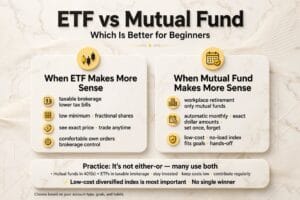
When an ETF Makes More Sense
- You invest in a taxable brokerage account and want potentially lower tax bills.
- You want a low minimum and the option to buy fractional shares.
- You prefer to see the exact price you pay when you place an order.
- You are comfortable placing your own orders through a broker.
When a Mutual Fund Makes More Sense
- Your workplace retirement plan only offers mutual funds.
- You want simple, automatic monthly investments in exact dollar amounts.
- You prefer to set up a plan once and not think about trading.
- You found a low-cost, no-load index mutual fund that fits your goals.
In practice, the ETF vs mutual fund question is not either-or, because many investors use both. For example, you might hold mutual funds inside a 401(k) and ETFs in a taxable brokerage account. What matters most is staying invested, keeping costs low, and contributing regularly.
How to Choose Between an ETF and a Mutual Fund
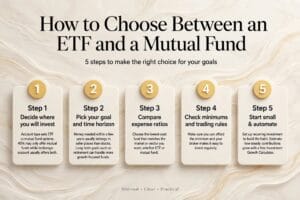
If you are still unsure about the ETF vs mutual fund choice, follow these simple steps:
Step 1: Decide where you will invest. Your account type sets your ETF vs mutual fund options. A 401(k) may only offer mutual funds, while a brokerage account usually offers both.
Step 2: Pick your goal and time horizon. Money you need within a few years usually belongs in safer places than stocks. Long-term goals, such as retirement, can handle more growth-focused funds.
Step 3: Compare expense ratios. Choose the lowest-cost fund that matches the market or sector you want, whether it is an ETF or a mutual fund.
Step 4: Check minimums and trading rules. Make sure you can afford the minimum and that your broker makes it easy to invest regularly.
Step 5: Start with a small amount and automate. Set up a recurring investment so you build the habit. You can estimate how steady contributions grow with our free Investment Growth Calculator.
Common Mistakes in the ETF vs Mutual Fund Decision
- Choosing based on the label alone. An ETF is not automatically better than a mutual fund, or the other way around. Compare costs and holdings.
- Ignoring fees. A higher expense ratio quietly reduces your returns every year.
- Trading too often. The ability to trade ETFs all day does not mean you should.
- Buying funds that overlap. Owning several funds that hold the same companies does not add real diversification.
- Investing money you may need soon. Investments can lose value, so keep emergency savings separate, as explained in our guide to the 50/30/20 rule.
- Investing while carrying expensive debt. High-interest debt can cost more than investments typically earn, so see our plan for how to get out of debt first.
Where to Learn More Before You Invest
Before you settle the ETF vs mutual fund question and buy any fund, read its prospectus and fee table, which explain the costs, risks, and strategy. The U.S. Securities and Exchange Commission offers free, plain-language guides at Investor.gov, including information on funds and fees. You can also check a broker or advisor’s background with FINRA.
Frequently Asked Questions About ETF vs Mutual Fund
What is the main difference in an ETF vs mutual fund?
The main difference is how they trade. ETFs trade on an exchange throughout the day at changing prices, while mutual funds are priced and traded once per day after the market closes.
Is an ETF vs mutual fund better for beginners?
Neither is automatically better. A low-cost, diversified index fund is the key. Beginners often like ETFs for low minimums and mutual funds for easy automatic investing, so choose the one that fits your account and habits.
Are ETFs cheaper than mutual funds?
Often, but not always. Index ETFs and index mutual funds can both have very low expense ratios, while actively managed mutual funds usually cost more. Compare the specific funds you are considering.
Which is more tax efficient in the ETF vs mutual fund comparison?
ETFs are generally more tax efficient in taxable accounts because they tend to pay out fewer capital gains. In retirement accounts such as an IRA or 401(k), the difference matters much less.
Can I own both ETFs and mutual funds?
Yes. Many investors hold mutual funds in a workplace retirement plan and ETFs in a brokerage account. Just make sure your funds do not overlap too much.
How much money do I need to start investing in an ETF or mutual fund?
It depends on the fund and the broker. Some mutual funds require a minimum of $1,000 or more, while ETFs can be bought for the price of one share, and fractional shares let you start with even less.
Final Thoughts
The ETF vs mutual fund decision is smaller than it looks. Both are good tools for building long-term wealth, and what matters most is low fees, broad diversification, and the habit of investing regularly. Start by checking which options your account offers, compare expense ratios, and begin with an amount you are comfortable with.
Ready to see what steady investing can do? Try our free Investment Growth Calculator to estimate how your contributions could grow over time, and explore our other beginner guides to keep building your plan.
This article is for educational purposes only and is not financial or investment advice. All investing involves risk, including the possible loss of money. Consider speaking with a qualified professional about your specific situation.