
If you’re new to investing, index funds for beginners is probably the single most important phrase to understand before you buy anything else. Index funds are the foundation most successful long-term investors build on — simple, low-cost, and proven over decades. This guide explains exactly what they are, why they work, and how to buy your first one, even with no prior investing experience.
What Is an Index Fund?
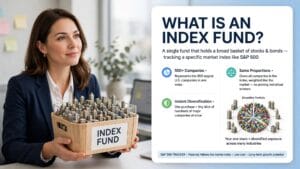
An index fund is a type of investment that holds a broad basket of stocks or bonds designed to track a specific market index — like the S&P 500, which represents 500 of the largest U.S. companies. Instead of trying to pick individual winning stocks, an index fund simply owns all of them (or a representative sample) in the same proportions as the index it tracks.
When you buy one share of an S&P 500 index fund, you’re effectively buying a tiny slice of hundreds of major companies at once — instant diversification in a single purchase.
Why Index Funds for Beginners Makes So Much Sense
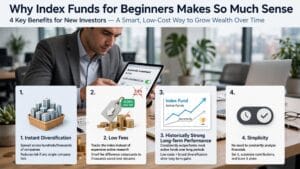
1. Instant Diversification
Rather than researching and picking individual stocks — a task even professional fund managers frequently struggle to do successfully over the long term — index funds spread your investment across hundreds or thousands of companies automatically, reducing the risk of any single company’s failure sinking your entire investment.
2. Low Fees
Because index funds simply track a market index rather than requiring active research and stock-picking, they typically have significantly lower fees than actively managed funds. Over decades, this fee difference compounds into a substantial amount of money saved — or lost, if you choose a high-fee alternative instead.
3. Historically Strong Long-Term Performance
Broad market index funds have historically outperformed the majority of actively managed funds over long time periods, largely due to their low costs and broad diversification. This doesn’t mean they never decline — they absolutely do during market downturns — but over multi-decade timelines, they’ve been a reliable wealth-building tool.
4. Simplicity
For index funds for beginners specifically, simplicity matters enormously. You don’t need to analyze company financials, follow market news constantly, or make frequent trading decisions — you can set up automatic contributions and largely leave the fund alone for years.
Types of Index Funds to Know
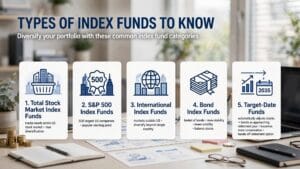
Total Stock Market Index Funds
Track nearly the entire U.S. stock market, offering maximum diversification across companies of all sizes.
S&P 500 Index Funds
Track the 500 largest U.S. companies — a popular starting point due to its long track record and broad exposure to major businesses.
International Index Funds
Track markets outside the U.S., helping diversify beyond a single country’s economic performance.
Bond Index Funds
Track a broad basket of bonds rather than stocks, generally offering more stability and lower volatility, often used to balance out stock holdings.
Target-Date Funds
A specific type of fund that automatically adjusts its mix of stocks and bonds as you approach a target retirement year, becoming more conservative over time — a popular hands-off option within retirement accounts.
Index Funds vs. Individual Stocks
A common question when learning about index funds for beginners is why not just buy individual stocks instead. The honest answer: picking individual stocks that consistently outperform the market requires significant research, time, and often luck — and even professional fund managers frequently underperform simple index funds over long periods.
Index funds trade the potential for extraordinary individual stock gains for consistent, diversified, lower-risk growth — a trade-off that suits the vast majority of long-term investors, especially beginners.
How to Buy Your First Index Fund: Step by Step
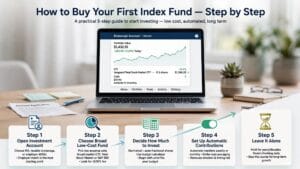
Step 1: Open an Investment Account
Depending on your goals, this might be an employer retirement plan, an IRA, or a standard taxable brokerage account. If your employer offers a retirement plan with a match, that’s typically the best starting point.
Step 2: Choose a Broad, Low-Cost Fund
Look for funds with low expense ratios and broad market exposure — a total stock market or S&P 500 index fund is a reasonable, well-established starting point for most beginners.
Step 3: Decide How Much to Invest
Start with an amount that fits your budget, even if it’s small. Many platforms now allow fractional shares, meaning you don’t need hundreds of dollars to get started. Our free Budget Calculator can help you find room in your monthly budget for consistent investing.
Step 4: Set Up Automatic Contributions
Automating your investments removes the temptation to time the market and ensures consistent progress, a strategy known as dollar-cost averaging.
Step 5: Leave It Alone
This is the hardest step for many beginners — resisting the urge to check daily or react to short-term market news. Index funds are designed to be held for years or decades, not traded frequently.
How Much Can You Expect to Earn?
Historically, broad U.S. stock market index funds have returned an average of roughly 7-10% annually over long time periods, though any individual year can vary significantly — including negative years. Want to see how consistent contributions to an index fund could grow over time? Try our free Investment Growth Calculator to visualize your own numbers, and read more about how compound interest works to understand why time matters so much.
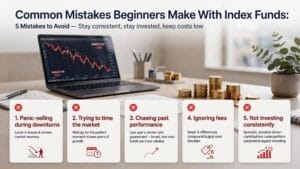
Common Mistakes Beginners Make With Index Funds
- Panic-selling during market downturns. This locks in losses and misses the recovery that historically follows most downturns.
- Trying to time the market. Waiting for the “perfect” moment to invest often means missing years of potential growth while waiting on the sidelines.
- Chasing past performance. A fund that performed well last year isn’t guaranteed to repeat that performance — broad, low-cost funds remain a more reliable long-term strategy than chasing trends.
- Ignoring fees. Even small percentage differences in fees compound significantly over decades of investing.
- Not investing consistently. Sporadic, emotion-driven investing tends to underperform simple, automated, regular contributions.
Are Index Funds Right for Everyone?
Index funds for beginners work particularly well for people who want a straightforward, low-maintenance investing approach without constantly monitoring individual stocks. According to guidance from the U.S. Securities and Exchange Commission’s Investor.gov, understanding fund fees, diversification, and long-term risk tolerance are all essential parts of choosing investments that match your personal financial goals.
That said, before investing aggressively, make sure you have a starter emergency fund in place — our Emergency Fund Calculator can help you determine a target so you’re not forced to sell investments during a personal financial emergency.
Final Thoughts
For most people starting their investing journey, index funds for beginners isn’t just a beginner strategy — it’s the same core approach many experienced, long-term investors continue to rely on throughout their entire investing lives. Broad diversification, low fees, and consistent contributions over time have proven to be one of the most reliable paths to building long-term wealth.
Ready to see how your own investing plan could grow? Try our free Investment Growth Calculator and map out your path forward.
1 thought on “Index Funds for Beginners: The Simple Guide to Getting Started”