
Choosing between a Roth IRA vs traditional IRA is one of the most common decisions new investors face, and it’s a decision that can meaningfully affect how much you keep in retirement. Both accounts offer valuable tax advantages, but they work in opposite ways — understanding the Roth IRA vs traditional IRA difference now can save or cost you significant money over decades of investing.
This guide breaks down exactly how each account works, walks through the Roth IRA vs traditional IRA tax rules, and helps you decide which one fits your specific situation.
Roth IRA vs Traditional IRA: The Core Difference
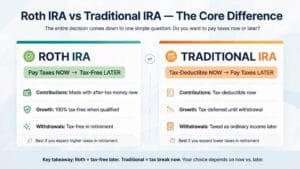
The entire Roth IRA vs traditional IRA decision comes down to one simple question: do you want to pay taxes now, or later?
- Traditional IRA: Contributions are typically tax-deductible now, but withdrawals in retirement are taxed as ordinary income.
- Roth IRA: Contributions are made with after-tax money now, but qualified withdrawals in retirement — including all growth — are completely tax-free.
Everything else in the Roth IRA vs traditional IRA comparison flows from this single distinction.
How a Traditional IRA Works
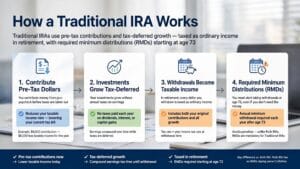
When comparing Roth IRA vs traditional IRA mechanics, the traditional IRA is the more familiar structure to most people. You contribute pre-tax dollars, meaning your taxable income for the year is reduced by your contribution amount, potentially lowering your current tax bill.
Your investments then grow tax-deferred — you don’t pay taxes on dividends, interest, or capital gains each year. However, when you withdraw money in retirement, every dollar is taxed as ordinary income, including your original contributions and all the growth that accumulated over time.
Traditional IRAs also require you to begin taking required minimum distributions (RMDs) starting at a certain age, whether you need the money or not — a rule that doesn’t apply to Roth IRAs during the original owner’s lifetime.
How a Roth IRA Works
The Roth IRA flips the traditional IRA structure. You contribute after-tax dollars — meaning you don’t get an upfront tax deduction — but your investments grow completely tax-free, and qualified withdrawals in retirement are also entirely tax-free, including all the growth your investments accumulated over decades.
This is the central appeal in the Roth IRA vs traditional IRA debate for younger investors: if you expect your tax rate to be similar or higher in retirement than it is now, paying taxes today at a known rate, rather than an unknown future rate, can work significantly in your favor.
Roth IRA vs Traditional IRA: A Side-by-Side Comparison
| Feature | Traditional IRA | Roth IRA |
|---|---|---|
| Tax on contributions | Often deductible now | Paid now, no deduction |
| Tax on withdrawals | Taxed as income | Tax-free if qualified |
| Required minimum distributions | Yes, at a set age | No, during owner’s lifetime |
| Income limits to contribute | None for contributions | Yes, phases out at higher incomes |
| Early withdrawal flexibility | Penalties generally apply | Contributions can be withdrawn penalty-free |
Roth IRA vs Traditional IRA: Which Is Better for Young Investors?
For many people early in their careers, the Roth IRA vs traditional IRA decision often favors the Roth. Early-career earners are frequently in a lower tax bracket now than they expect to be later in their careers, making it advantageous to pay taxes at today’s lower rate rather than deferring taxes to a future year when income — and potentially tax rates — may be higher.
Additionally, decades of tax-free growth inside a Roth IRA can be extremely valuable. As explained in our guide on how compound interest works, the earlier money is invested, the more time it has to grow — and with a Roth IRA, all of that growth is eventually withdrawn completely tax-free.

Roth IRA vs Traditional IRA: When Traditional Might Make More Sense
The traditional IRA side of the Roth IRA vs traditional IRA decision tends to make more sense for:
- Higher earners currently in a high tax bracket who expect their tax rate to be lower in retirement
- People who want to lower their current taxable income for an immediate tax benefit
- Investors close to retirement who won’t benefit as much from decades of tax-free compound growth
- People who exceed Roth IRA income limits and don’t want to pursue a backdoor Roth conversion strategy
Can You Have Both a Roth IRA and a Traditional IRA?
Yes — the Roth IRA vs traditional IRA choice doesn’t have to be all-or-nothing. Many investors contribute to both account types, a strategy sometimes called “tax diversification.” This provides flexibility in retirement, allowing withdrawals from whichever account makes more sense tax-wise in a given year, rather than being locked into one tax treatment for all retirement income.
Keep in mind that combined annual contribution limits across both a Roth and traditional IRA are shared, not doubled — contributing to both simply splits your total allowed contribution between the two accounts rather than allowing extra total contributions.

Income Limits: A Key Roth IRA vs Traditional IRA Difference
One important distinction in the Roth IRA vs traditional IRA comparison is that Roth IRAs have income limits — once your income exceeds a certain threshold, your ability to contribute directly phases out and eventually disappears entirely. Traditional IRAs don’t have income limits on contributions, though the tax deductibility of those contributions can be limited if you or a spouse have access to a workplace retirement plan.
High earners who exceed Roth IRA income limits sometimes use a “backdoor Roth” strategy — contributing to a traditional IRA and then converting it to a Roth — though this involves tax considerations that are worth researching carefully or discussing with a tax professional.
Early Withdrawal Rules: Roth IRA vs Traditional IRA
This is an underrated part of the Roth IRA vs traditional IRA comparison. With a Roth IRA, you can withdraw your original contributions (not earnings) at any time, for any reason, without taxes or penalties, since you already paid taxes on that money. This provides more flexibility in emergencies compared to a traditional IRA, where early withdrawals of any amount are generally subject to both income tax and an additional penalty.
That said, an IRA — Roth or traditional — should never replace a proper emergency fund. Use our free Emergency Fund Calculator to build a cash cushion first, so retirement accounts stay invested and untouched.

How to Decide: Roth IRA vs Traditional IRA Questions to Ask Yourself
- Do I expect to be in a higher or lower tax bracket in retirement? Higher favors Roth; lower favors traditional.
- Do I need the tax deduction right now? If reducing this year’s taxable income is a priority, traditional may be more appealing.
- How many years until retirement? More years favors Roth, due to more time for tax-free compound growth.
- Am I above the Roth income limit? If so, a traditional IRA or backdoor Roth strategy may be necessary.

A Practical Example
Imagine two 25-year-olds, both contributing $6,000 a year for 40 years at an 8% average annual return, ending with roughly $1.5 million each before taxes are considered.
- Traditional IRA investor: Withdraws funds in retirement and pays income tax on the full amount at whatever their retirement tax rate happens to be.
- Roth IRA investor: Withdraws the same amount completely tax-free, having already paid taxes on contributions decades earlier at a potentially much lower rate.
Depending on future tax rates, this difference in the Roth IRA vs traditional IRA outcome can represent hundreds of thousands of dollars in retirement — illustrating why this decision deserves careful thought rather than a random choice.
Common Mistakes in the Roth IRA vs Traditional IRA Decision
- Choosing based on which one a friend or family member uses, rather than your own income, tax bracket, and retirement timeline.
- Ignoring required minimum distributions on traditional IRAs, which can create unexpected tax bills later in retirement if not planned for.
- Assuming you’re locked into one choice forever. Contribution strategies can shift over time as income and tax situations change.
- Not contributing at all while deciding. Time lost while overthinking the Roth IRA vs traditional IRA decision often costs more than simply choosing one and starting.
For official contribution limits and eligibility rules, which change periodically, the IRS’s official IRA guidance is the most reliable source to confirm current numbers.

Final Thoughts: Roth IRA vs Traditional IRA
There’s no universally “correct” answer in the Roth IRA vs traditional IRA debate — the right choice depends on your current tax bracket, expected future income, and how many years you have until retirement. Younger investors in lower tax brackets often lean toward Roth IRAs for decades of tax-free growth, while higher earners closer to retirement may benefit more from a traditional IRA’s upfront tax deduction.
Whichever you choose, the most important step is simply starting. Ready to see how consistent contributions could grow inside either account? Try our free Investment Growth Calculator and visualize your own long-term numbers.
1 thought on “7 Key Differences: Roth IRA vs Traditional IRA Explained”