
If you’ve been researching ways to save smarter, you’ve probably run into both terms and wondered about sinking fund vs emergency fund — what’s the actual difference, and do you need both? The short answer is yes, you need both, and they serve completely different purposes. This guide breaks down the 5 key differences, when to use each one, and how to set both up correctly.
Quick Definitions Before We Compare
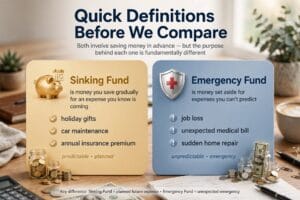
A sinking fund is money you save gradually for an expense you know is coming — holiday gifts, car maintenance, an annual insurance premium. An emergency fund is money set aside for expenses you can’t predict — a job loss, an unexpected medical bill, a sudden home repair. Both involve saving money in advance, but the purpose behind each one is fundamentally different.
Sinking Fund vs Emergency Fund: 5 Key Differences
1. Predictability of the Expense
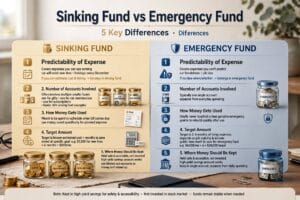
This is the core difference in the sinking fund vs emergency fund comparison. A sinking fund covers expenses you can see coming — you know your car will eventually need new tires, or that the holidays happen every December. An emergency fund covers the expenses you can’t predict at all — you don’t know when your car will break down unexpectedly or when you might lose your job.
If you can reasonably estimate the cost and timing, it belongs in a sinking fund. If you have no idea when or whether it will happen, it belongs in your emergency fund.
2. Number of Accounts Involved
An emergency fund is typically one single account, kept separate from your everyday spending money. A sinking fund strategy, on the other hand, often involves multiple smaller funds — one for holiday gifts, one for car maintenance, one for annual subscriptions, and so on. Our guide on 50 sinking fund examples covers the most common categories people save for separately.
3. How the Money Gets Used
Your emergency fund should ideally never get touched unless a genuine emergency occurs — and when it is used, the goal is to rebuild it as quickly as possible afterward. A sinking fund, by contrast, is meant to be spent on schedule. When your car insurance bill comes due, you’re supposed to use the money you saved specifically for that purpose — that’s the fund doing exactly what it was designed to do.
4. Target Amount
Emergency fund targets are typically based on a multiple of your monthly expenses — commonly three to six months’ worth, depending on your job stability and income type. Our guide on how much you should save for an emergency fund breaks this down in detail. A sinking fund target is simply the known or estimated cost of the specific upcoming expense, divided by the number of months you have to save for it.
5. Where the Money Should Be Kept
Both should be kept somewhere safe and accessible — not invested in the stock market, where the value could drop right when you need it. A high-yield savings account works well for both, though many people prefer a single account for their emergency fund and either a separate account or clearly labeled sub-accounts for multiple sinking funds, so the money doesn’t get mixed up.
Side-by-Side Comparison
| Feature | Sinking Fund | Emergency Fund |
|---|---|---|
| Purpose | Known, planned expenses | Unknown, unplanned expenses |
| Number of accounts | Often several, by category | Usually one |
| Meant to be spent? | Yes, on schedule | Only in true emergencies |
| Typical target | Cost of the specific expense | 3-6 months of expenses |
Why You Need Both, Not Just One
Some people try to simplify their savings by keeping just one general fund for everything — but this usually backfires. Without separating a sinking fund from an emergency fund, planned expenses quietly eat into money meant for real emergencies, leaving you underprepared when something unexpected actually happens. Our guide on what a sinking fund is explains this in more depth, including why combining the two categories is one of the most common budgeting mistakes.
Think of it this way: your emergency fund protects you from financial shock, while a sinking fund protects you from financial surprise. Both prevent debt — they just prevent different kinds of debt.

How to Set Up Both the Right Way
Step 1: Build Your Emergency Fund First
Most financial experts recommend prioritizing at least a starter emergency fund — $500 to $1,000 — before focusing heavily on sinking funds, since an emergency fund protects you from the most disruptive, unpredictable expenses first.
Step 2: Identify Your Top 3-5 Predictable Expenses
Rather than trying to create a sinking fund for every possible category at once, start with the ones most likely to catch you off guard — holiday spending, car maintenance, or an annual bill you’ve forgotten about before.
Step 3: Calculate Monthly Contributions for Each
Divide the expected cost by the number of months until you need it. If holiday gifts cost $600 and you start saving in January, that’s $50 a month set aside specifically for that purpose.
Step 4: Keep the Funds Clearly Separated
Whether through separate accounts or clearly labeled sub-accounts, make sure your sinking fund money and emergency fund money never blend together, so you always know exactly what each dollar is for.
Step 5: Automate Both
Set up automatic transfers for your emergency fund and each active sinking fund on payday, so consistent saving happens without requiring a decision every month. Our free Budget Calculator can help you find room for both in your monthly budget.

Real-Life Example: Sinking Fund vs Emergency Fund in Action
Imagine your car breaks down unexpectedly — a $900 repair. If you have an emergency fund, that cost gets covered without stress or new debt. Now imagine a few months later, your annual car insurance premium of $1,200 comes due. If you’ve been contributing $100 a month to a car-related sinking fund, that bill is also already covered — without touching your emergency fund at all.
This is exactly why the sinking fund vs emergency fund distinction matters in practice: one protects you from the unexpected repair, the other protects you from the bill you knew was coming all along.
Common Mistakes People Make
- Using the emergency fund for predictable expenses. This leaves you exposed when a real emergency eventually happens.
- Never restarting a sinking fund after spending it. Once the holiday gift fund is used in December, contributions should resume immediately for next year.
- Trying to build both at full speed simultaneously with limited income. It’s usually fine to prioritize a starter emergency fund first, then build sinking funds gradually.
- Keeping everything in one undefined “savings” account. Without separation, it becomes nearly impossible to know whether you’re actually prepared for either type of expense.
For additional guidance on building healthy savings habits, the Consumer Financial Protection Bureau offers resources on automating savings effectively.

Final Thoughts
The sinking fund vs emergency fund comparison isn’t really an either-or decision — both play distinct, complementary roles in a solid financial plan. Your emergency fund protects you from the unpredictable, while sinking funds protect you from being caught off guard by the predictable. Together, they prevent nearly every common reason people turn to debt.
Ready to start building both? Use our free Emergency Fund Calculator and Sinking Fund Planner to set clear targets for each one today.
This article is for educational purposes only and is not personal financial advice.