
How much should you save for an emergency fund? The short answer is three to six months of essential expenses — but the right number for you depends on your job stability, income type, and family situation. This guide breaks down exactly how to calculate your target, where to keep the money, and how to build it faster than you might think.

An emergency fund is the financial buffer between a surprise expense and a crisis. Without one, a broken car, a medical bill, or a sudden job loss often gets paid for with high-interest credit card debt — turning a temporary setback into a long-term financial problem. That’s exactly why knowing how much you should save for an emergency fund matters so much before an emergency actually happens.
Why an Emergency Fund Comes Before Everything Else
Before aggressively investing or paying down low-interest debt, most financial experts recommend building at least a small emergency fund first. Here’s why:
- It prevents new debt. Without cash reserves, unexpected costs usually go on a credit card, often at 20%+ interest.
- It protects your other financial goals. Without a buffer, you may be forced to pull money out of investments at the worst possible time, or stop contributing to retirement accounts.
- It reduces financial stress. Studies consistently link having even a small emergency cushion to lower financial anxiety, regardless of overall income level.

How Much Should You Save for an Emergency Fund?
The standard guideline for how much you should save for an emergency fund is three to six months of essential expenses — not your full income, but the amount you’d need to cover rent, utilities, groceries, insurance, and minimum debt payments if your income stopped.

Where you fall in that range depends on a few factors:
Save Closer to 3 Months If:
- You have a stable job in an in-demand field
- You have a second income earner in your household
- You have other liquid assets you could access if needed
Save Closer to 6 Months (or More) If:
- You’re self-employed or work on commission
- You’re the sole income earner in your household
- You work in a volatile or seasonal industry
- You have dependents relying on your income
Still not sure how much you should save for an emergency fund based on your own numbers? Use our free Emergency Fund Calculator to plug in your monthly expenses and instantly see your personalized target range.
How to Calculate How Much You Should Save for an Emergency Fund
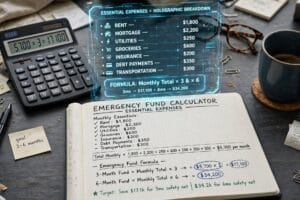
Add up only your essential monthly expenses — the ones that don’t stop if your income does:
- Rent or mortgage payment
- Utilities (electric, water, gas, internet)
- Groceries
- Insurance premiums
- Minimum debt payments
- Transportation costs
Multiply that monthly total by three (minimum target) and by six (fuller target) to get your range. For example, if your essential expenses total $2,500/month, your target is between $7,500 and $15,000.
That number can feel intimidating — which is exactly why the next section matters more than the target itself.
Start Smaller: The $1,000 Starter Fund
If three to six months feels impossibly far away, don’t let that stop you from starting. Many financial plans recommend building a smaller “starter” fund of $500–$1,000 first, before tackling high-interest debt or the full three-to-six-month goal — you don’t need the full amount of how much you should save for an emergency fund on day one.
This smaller cushion won’t cover a job loss, but it will absorb most common surprises — a car repair, a vet bill, a broken appliance — without derailing your budget or forcing you into debt. Reaching this first milestone also builds momentum and confidence for the bigger goal ahead.
Where to Keep Your Emergency Fund
Once you’ve figured out how much you should save for an emergency fund, the next question is where to keep it. Your emergency fund needs to be accessible quickly, without penalty, but ideally still earning some interest. Good options include:
- High-yield savings account: Offers better interest than a traditional savings account while remaining fully liquid.
- Money market account: Similar liquidity to a savings account, sometimes with check-writing privileges.

Avoid keeping your emergency fund in the stock market or any investment that can lose value — the entire purpose of this money is stability, not growth. Also avoid keeping it in your everyday checking account, where it’s too easy to accidentally spend.
How to Build Your Emergency Fund Faster
1. Automate a Fixed Transfer

Set up an automatic transfer to your emergency savings account on payday, even if it’s small. Consistency matters more than the amount — $50 a month becomes $600 in a year without you having to think about it.
2. Save Windfalls Before You Spend Them
Tax refunds, work bonuses, and cash gifts are ideal emergency fund boosters because they weren’t part of your regular budget to begin with — you won’t “miss” money you never planned on.
3. Use a Sinking Fund Approach for Predictable Costs
Separating your emergency fund from planned irregular expenses — like car maintenance or holiday gifts — keeps your true emergency cushion intact. Learn more in our guide on what a sinking fund is and how it complements your emergency savings.
4. Temporarily Redirect “Extra” Spending
Pause one or two discretionary subscriptions or dining-out budget lines for a few months and redirect that money straight into your emergency fund until you hit your first milestone.
When It’s Okay to Use Your Emergency Fund
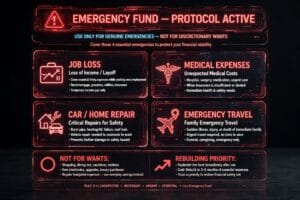
An emergency fund should only be used for genuine emergencies — not planned expenses or wants. Appropriate uses include:
- Job loss or a significant reduction in income
- Unexpected medical or dental expenses
- Essential car or home repairs
- Emergency travel (such as a family medical crisis)
If you do dip into it, treat rebuilding it as a top financial priority — pause other savings goals temporarily if needed until it’s restored.

Common Mistakes to Avoid
- Investing it for higher returns: This defeats the purpose — emergency funds need to be stable and accessible, not growing at the mercy of market swings.
- Combining it with other savings goals: Mixing your emergency fund with vacation or gift savings makes it too easy to “borrow” from it for non-emergencies.
- Waiting until you hit the full target to start: Even $500 in savings puts you ahead of a large percentage of households with zero emergency savings, according to Federal Reserve survey data on household financial resilience.
Final Thoughts: How Much Should You Save for an Emergency Fund?
To recap: how much should you save for an emergency fund? Start with a goal of $500–$1,000, then build toward three to six months of essential expenses as your income and stability allow. The exact number matters less than the habit of saving consistently — even small, automatic contributions add up faster than most people expect.
Ready to find your personalized target? Try our free Emergency Fund Calculator and see exactly how much cushion you need based on your own monthly expenses.