
If you are wondering how to invest $100, the good news is that you can start today. You do not need thousands of dollars or a financial advisor. With a free or low-cost brokerage account, fractional shares, and a diversified fund, $100 is enough to become an investor and start building a habit that can grow over many years.
In this guide you will learn how to invest $100 step by step, which options beginners often use, what to check before you start, and what $100 could grow into over time. All growth examples are hypothetical, and investing always involves risk, so you will also see what can go wrong.
Is $100 Enough? How to Invest $100 as a Beginner
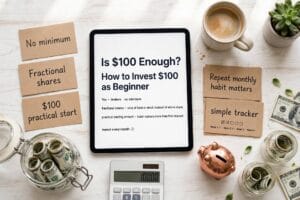
Yes. Many brokers now let you open an account with no minimum, and many allow fractional shares, which means you can buy a small slice of a fund or stock instead of a whole share. That makes $100 a practical starting amount, and it makes learning how to invest $100 a realistic goal.
It is important to be realistic, though. A single $100 investment will not make you rich. The real power comes from repeating it every month, because the habit matters more than the first deposit. If you want a broader overview, read our guide on how to start investing with little money.
Before You Start: A Checklist for How to Invest $100
Investing makes the most sense when your basics are covered. Before you invest, check these three things:
- High-interest debt. If you carry credit card debt at a high rate, paying it down often beats investing, because the interest you avoid can be larger than what you might earn. See our plan on how to get out of debt.
- A small cushion. Keep emergency savings so you never have to sell investments at a bad time. Our guide to sinking fund vs emergency fund explains how to separate your savings.
- Money you will not need soon. Money for bills in the next few years is usually better kept out of the stock market, because prices can fall.
If your employer offers a retirement plan match, that is often worth capturing before anything else, because it is extra money added to your account.
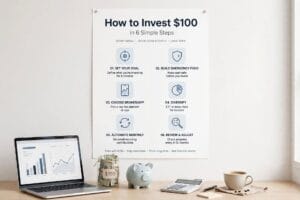
How to Invest $100 in 6 Simple Steps
Follow these six steps in order. Most people can finish them in less than an hour.
Step 1: Decide What the Money Is For
Your goal decides how to invest $100 and where the money should go. Retirement and other goals more than five years away can handle the ups and downs of the market. Goals that are closer, such as a vacation next year, are usually better suited to savings.
Step 2: Choose an Account Type
The account you open affects taxes and access to your money. The most common options for beginners are:
- A taxable brokerage account. Flexible, and you can withdraw anytime, but gains may be taxed.
- A retirement account such as an IRA. Offers tax advantages, but has rules about contributions and withdrawals.
If you are not sure which fits you, check the rules for each type or speak with a qualified tax professional.
Step 3: Open the Account
Choose a well-known, regulated broker, then complete the online application. You will need to confirm your identity, and you can usually link a bank account to transfer money. You can check the background of a broker with FINRA.
Step 4: Pick a Diversified Investment
Knowing how to invest $100 wisely starts with diversification. For a first $100, most beginners choose a broad index fund or ETF. These hold hundreds or thousands of companies, so your money is spread out instead of resting on one business. If you are not sure whether to choose an ETF or a mutual fund, read our comparison of ETF vs mutual fund.
Step 5: Place Your Order
Transfer your $100, search for the fund, and enter the dollar amount if your broker supports fractional shares. Review the order carefully before you confirm. If you are buying a whole share instead, check that the share price fits within $100.
Step 6: Automate and Repeat
Set up an automatic monthly investment, even if it is the same $100. This approach is called dollar-cost averaging, and our guide to dollar-cost averaging explains how it works and why many beginners like it.
How to Invest $100: Options Compared
Here are the most common places beginners use when they learn how to invest $100:
| Option | How It Works | Good For | Main Consideration |
|---|---|---|---|
| Index ETF | A basket of many investments that trades like a stock | Low-cost diversification | You place the orders yourself |
| Index mutual fund | A pooled fund priced once per day | Automatic monthly investing | Some funds have minimums |
| Fractional shares | A small slice of a single company | Owning a piece of a company you know | Concentrated in one business |
| Robo-advisor | An automated service that builds a portfolio for you | Hands-off investing | Check the management fee |
| Savings account | Earns interest, not invested in markets | Short-term goals | Interest rates change |
For long-term goals, a diversified index fund is a common starting point because it keeps costs low and spreads risk. Whatever you choose, make sure you understand what you are buying.
What Could $100 Grow Into?
Here is a hypothetical example, assuming an average return of 7% a year. This return is only an assumption for illustration, real returns vary every year, and your investments can lose value:
| Years | One-Time $100 | $100 a Month | Total You Contribute Monthly |
|---|---|---|---|
| 10 years | About $197 | About $17,300 | $12,000 |
| 20 years | About $387 | About $52,100 | $24,000 |
| 30 years | About $761 | About $122,000 | $36,000 |
The lesson is clear: a one-time $100 grows slowly, but $100 invested every month can grow into a meaningful amount because your earnings start earning too. You can test your own numbers in our free Investment Growth Calculator.
How Fees Affect a $100 Investment
When you think about how to invest $100, costs matter even on small amounts, because they come out of your returns every year. The main cost is the expense ratio, an annual percentage charged by a fund. On a $100 balance, a 0.05% expense ratio costs about five cents a year, while a 1% expense ratio costs about one dollar a year. That difference seems tiny now, but it grows as your balance grows.
Also check whether your broker charges trading commissions or account fees. Many brokers offer commission-free trading for common funds, but you should always confirm before you invest.
Risks to Understand Before You Decide How to Invest $100
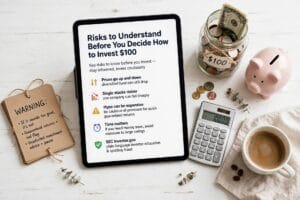
All investing involves risk, including the possible loss of money. Keep these points in mind:
- Prices go up and down. A diversified fund can still drop in value during a downturn.
- Single stocks are riskier. One company can fall sharply, which is why diversified funds are popular with beginners.
- Hype can be expensive. Be cautious with anyone promising quick or guaranteed returns.
- Time matters. Money you may need soon should not be exposed to large short-term swings.
The U.S. Securities and Exchange Commission offers free, plain-language investor education at Investor.gov, including guidance on spotting fraud.
How to Invest $100 With Fractional Shares or a Robo-Advisor
Two beginner-friendly tools make small amounts easier to invest. Fractional shares let you buy a slice of a fund or company for an exact dollar amount, such as $100, instead of the full share price. A robo-advisor is an automated service that builds and manages a diversified portfolio for you based on a few questions about your goals.
Both can be a good way to learn how to invest $100 without picking investments yourself. With either one, compare fees first, make sure you understand how the account works, and start with an amount you are comfortable with.
What to Do After You Invest Your First $100
Once your first $100 is invested, the hardest step is behind you. Here is what to do next:
- Do not panic if the balance drops. Short-term moves are normal, and checking every day makes them feel worse.
- Keep investing on schedule. Put in the same amount every month, whatever the market does.
- Increase gradually. Move from $100 toward larger amounts as your income allows, using the same steps.
- Review once or twice a year. Check that your goals and investments still match, then leave it alone.
How to Invest $100 Without Hurting Your Budget
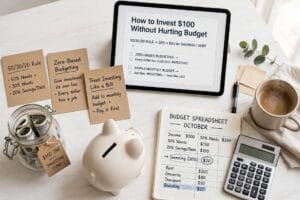
You do not need extra income to learn how to invest $100. You need a plan. Here is how it fits with popular budgeting methods:
- 50/30/20 rule. Investing belongs in the 20% savings and debt category. See our guide to the 50/30/20 rule.
- Zero-based budgeting. Give your investment its own line, so every dollar has a job.
- Simple monthly budget. Add a line called “investing” and treat it like a bill. For the full picture, read our guide on how to budget.
Common Mistakes When Learning How to Invest $100
These mistakes are easy to avoid once you understand how to invest $100 the simple way:
- Waiting for the perfect moment. Time in the market usually matters more than timing the market.
- Putting all $100 into one stock. A single company is much riskier than a diversified fund.
- Ignoring fees. Always check the expense ratio and any account fees.
- Investing money you need soon. Keep short-term money in savings.
- Checking your balance every day. Frequent checking often leads to emotional decisions.
- Stopping after one bad month. Consistency is what builds results.
Tips for How to Invest $100 and Make It Count
- Start now, even small. A habit started today beats a perfect plan started next year.
- Increase the amount over time. Raise your monthly investment when your income grows.
- Reinvest your earnings. Letting dividends buy more shares helps compounding.
- Learn as you go. Read one beginner guide a month, and keep your plan simple.

Frequently Asked Questions About How to Invest $100
What is the best way to invest $100?
For many beginners, the best way to approach how to invest $100 is a low-cost, diversified index fund or ETF, bought through a brokerage account and repeated every month. The best choice depends on your goals, time frame, and comfort with risk.
Can I invest $100 with no experience?
Yes. A broad index fund requires no stock-picking skill, and many brokers offer simple tools for beginners. Start small, learn as you go, and avoid investments you do not understand.
Should I invest $100 or save it?
It depends on the goal. Money you need within a few years usually belongs in savings. Money for long-term goals such as retirement can be invested, as long as you have emergency savings first.
How much can $100 grow in a year?
There is no guaranteed number, because returns change every year and can be negative. Over long periods, the amount you add regularly usually matters more than the first $100.
Can I invest $100 a month?
Yes. Investing $100 every month is a common strategy. Setting up an automatic transfer makes it easier to stay consistent.
Do I need a lot of money to start investing?
No. Many brokers have no account minimum, and fractional shares let you invest small amounts. The most important part is to start with an amount you can keep up.
Final Thoughts
Knowing how to invest $100 is really about starting small and staying consistent. Make sure your basics are covered, open an account, choose a diversified low-cost fund, and set up an automatic monthly investment. The first $100 is only the beginning. The habit is what builds results over many years.
Ready to see what steady investing could look like? Try our free Investment Growth Calculator to estimate how your monthly contributions could grow, and read our guide on how to start investing with little money for the next steps.
This article is for educational purposes only and is not financial or investment advice. All investing involves risk, including the possible loss of money, and past performance does not guarantee future results. Consider speaking with a qualified professional about your specific situation.