
Want to invest daily but not sure where to begin? The idea is simple: instead of waiting until you have a large lump sum, you commit a small amount — even $5 a day — and put it to work consistently. This guide explains how to invest daily with little money, what the habit really does for your wealth (and what it doesn’t), and the exact steps to set it up this week.
The habit of choosing to invest daily matters more than the size of any single deposit. Small amounts repeated over years can grow into serious money, and you don’t need a high salary to get started.

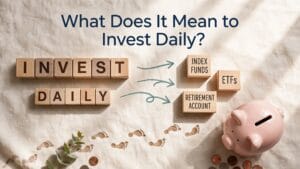
What Does It Mean to Invest Daily?
To invest daily means setting aside a small, fixed amount of money every day — or building a daily habit of contributing — and putting it into assets such as index funds, ETFs, or a retirement account. Some people literally invest daily through apps that round up their purchases. Others save a daily amount and invest it weekly or monthly. Both approaches serve the same goal: making investing automatic, small, and consistent.
Think of it as the investing version of a daily walk. You won’t see dramatic results after one day, but people who invest daily for years often end up far ahead of those who wait for the “perfect” moment.
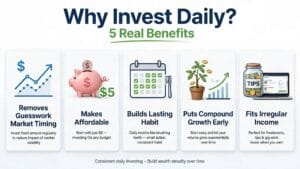
Why Invest Daily? 5 Real Benefits
1. It Removes the Guesswork of Market Timing
When you invest daily, you buy at many different prices — some high, some low. This approach is called dollar-cost averaging. It means you never bet everything on a single day, and over time it smooths out your average purchase price.
2. It Makes Investing Affordable
You don’t need $1,000 to start. If you can start with just a few dollars a day, the barrier to entry nearly disappears. Many platforms now offer fractional shares, so $5 can buy a slice of a broad index fund.
3. It Builds a Lasting Habit
Behavior matters more than talent in investing. When you invest daily, investing stops being a big decision and becomes routine, like brushing your teeth. Routines survive bad moods, scary headlines, and busy weeks.
4. It Puts Compound Growth to Work Early
The earlier each dollar is invested, the longer it can compound. Our guide on how compound interest works shows why starting early matters so much, and choosing to invest daily is one of the easiest ways to start early.
5. It Fits Irregular Income
If your income arrives in small pieces — freelance work, tips, gig income — a daily habit lets you invest daily from whatever you earn instead of waiting for a large lump sum.
Is It Better to Invest Daily or Monthly? An Honest Answer
Here is what many articles skip: investing every day is not magically more profitable than investing weekly or monthly. Research published by large investment firms has found that how much you invest and how long you stay invested matter far more than contribution frequency. The real advantage when you invest daily is behavioral — it keeps you consistent.
So if your platform only allows weekly or monthly automatic investments, that is perfectly fine. You can still invest daily in spirit by moving a set amount into a separate savings pot each day and investing the total on a schedule. The goal is consistency, not a specific frequency.
What Could You Build If You Invest Daily?
The table below shows what different daily amounts could grow into, assuming a 7% average annual return with monthly compounding. These are illustrations, not promises — real returns vary every year, and markets can and do fall.
| Daily Amount | About Per Month | After 10 Years | After 20 Years |
|---|---|---|---|
| $5 | $150 | ~$26,000 | ~$78,000 |
| $10 | $300 | ~$52,000 | ~$156,000 |
| $20 | $600 | ~$104,000 | ~$313,000 |
Notice the pattern: when you invest daily for 20 years, most of the final balance comes from growth rather than deposits. Someone who puts in $5 a day contributes roughly $36,000 over 20 years, yet the illustration shows a balance near $78,000. Want to test your own numbers? Try our free Investment Growth Calculator.
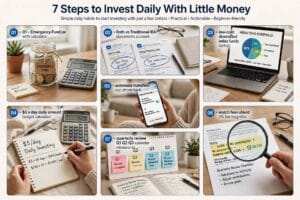
7 Steps to Invest Daily With Little Money
Step 1: Build a Starter Emergency Fund
Before you invest daily, keep a small cash cushion so an unexpected bill doesn’t force you to sell investments at a bad time. Use our free Emergency Fund Calculator to set a target, or read our guide on how much you should save for an emergency fund.
Step 2: Pick the Right Account
Where you invest daily affects your taxes. A retirement account often comes first, especially if your employer matches contributions. Our comparison of Roth IRA vs traditional IRA explains the difference, and a regular brokerage account works well for goals outside retirement.
Step 3: Choose Low-Cost, Diversified Investments
The simplest way to invest daily without stress is a broad, low-cost index fund. You get instant diversification and don’t need to pick winners. If funds are new to you, start with our guide to index funds for beginners.
Step 4: Decide Your Daily Amount
Start with an amount that never strains your budget. Our free Budget Calculator can show what you can comfortably put aside each day after essentials. A common starting point is $5 a day, which you can raise whenever your income grows.
Step 5: Automate Everything
Set up automatic transfers on payday, or recurring purchases where your platform allows. If you want to invest daily but your platform offers only weekly or monthly schedules, automate the closest option. Automation removes willpower from the equation.
Step 6: Watch Out for Fees
This step matters most when you invest tiny amounts each day. A flat fee per trade can eat a large share of a $5 purchase. Choose platforms with no per-trade commissions, low fund expense ratios, and no monthly fees that outweigh your contributions.
Step 7: Review Quarterly, Not Daily
The irony of this approach is that you should not check your balance every day. Review your investments every three months, rebalance if needed, and increase your daily amount whenever your income rises.
How to Find Your Daily Amount in Your Budget
Not sure where $5 or $10 a day will come from? Most budgets have more room than people expect. Here are practical places to look:
- Unused subscriptions: Two or three forgotten subscriptions can equal $30 or more each month.
- Food spending: Meal planning and fewer takeout orders often free up $100 or more monthly.
- Bills you can negotiate: A single call to your internet or phone provider can lower a recurring bill.
- Windfalls: Tax refunds, bonuses, and gifts can fund several months of contributions at once.
- Extra income: Even a small side gig can cover your daily amount entirely.
For more ideas, see our guides on how to save money fast and side hustle ideas to make extra money.
Best Places to Invest Daily
The right place depends on your goals, but the main options are:
- Employer retirement plan: Often the best first stop, especially when your employer matches contributions.
- Individual retirement account (IRA): Offers tax advantages and more investment choices than many workplace plans.
- Brokerage account with fractional shares: Flexible and well suited to goals outside retirement.
- Micro-investing apps: Convenient for small amounts, but compare fees carefully before committing.
Whichever you choose, read the fee schedule before you commit. The SEC’s Investor.gov offers a beginner-friendly overview of investing basics and how to compare providers.

Common Mistakes When You Invest Daily
- Ignoring fees. Small accounts suffer most from flat charges, so always check costs first.
- Checking the balance constantly. Daily price swings are noise, and reacting to them often leads to selling at the wrong time.
- Investing money you will need soon. Cash for rent, bills, or a purchase within a few years does not belong in the market.
- Skipping the emergency fund. Without one, a surprise expense can force you to sell your investments.
- Chasing whatever is trending. Buying hot stocks or coins is speculation, not a long-term plan.
- Stopping when markets fall. People who keep going through downturns buy more shares at lower prices.
Should You Invest Daily If You Have Debt?
It depends on the interest rate. If you carry high-interest credit card debt, paying it off usually beats any investment return you can reasonably expect, so pause before you invest daily. Our guides on debt snowball vs avalanche and how to pay off student loans faster can help you choose a payoff plan.
If your debt has a low interest rate, doing both — paying it down while investing a small amount — is often reasonable.
How to Invest Daily Like a Pro
Professionals rely on rules, not hunches. Stay diversified, keep costs low, ignore short-term noise, and stay invested for the long term. Our guide on how to invest like a pro covers 10 of these rules in detail, and they apply just as well to small daily amounts.
Frequently Asked Questions
Can I really start with $1 a day?
Yes, if your platform supports fractional shares and doesn’t charge per-trade fees. $1 a day is roughly $30 a month. It’s a fine way to build the habit, and you can raise the amount as your budget allows.
Is it safe to invest daily?
All investing carries risk. A diversified fund reduces the risk of a single company failing, but its value can still fall, sometimes sharply. Only invest money you won’t need for several years.
How long until I see results?
Think in years, not weeks. Meaningful growth usually takes five to ten years or more, and no timeline is guaranteed.
Do I pay taxes on my investments?
It depends on the account. Retirement accounts have special tax rules, while dividends and gains in taxable accounts can be taxed. The IRS guidance on investment income is a good starting point, and a tax professional can answer questions specific to you.
Final Thoughts: Start to Invest Daily Today
You don’t need a fortune to begin. You need a small amount, a low-cost fund, and the discipline to keep going. For many people, the best time to invest daily is once a starter emergency fund is in place, high-interest debt is under control, and platform fees are low.
Ready to see what your daily amount could become? Try our free Investment Growth Calculator, then decide your number, automate it, and invest daily for a full year before judging the results.
This article is for educational purposes only and is not personal financial advice. All investing involves risk, including the possible loss of principal.