
Learning how to budget on $3,000 a month can feel stressful when rent, groceries, and bills seem to use up every dollar. The good news is that $3,000 a month is workable with the right plan, especially if you decide where each dollar goes before the month starts. In this guide you will see two realistic example budgets, a step-by-step method, and practical tips to save money even on a tight income.
Everything below assumes $3,000 is your take-home pay, which means the amount that reaches your bank account after taxes and deductions. If your number is different, you can copy the same structure and change the amounts. The method to budget on $3,000 a month is the same method that works at any income.
Is $3,000 a Month Enough?
Whether $3,000 a month is enough depends mostly on where you live and who depends on your income. A single person in a low-cost area can often cover essentials and still save. A family in an expensive city may find it very tight.
That is why the first step to budget on $3,000 a month is to be honest about your biggest cost, which is usually housing. Once you know your rent or mortgage payment, the rest of the plan becomes much easier to build.
How to Budget on $3,000 a Month in 5 Steps
Follow these five steps to build your first plan. Most people finish it in about an hour.
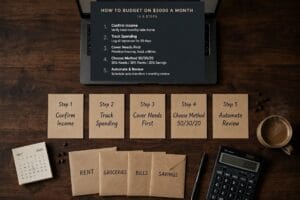
Step 1: Confirm Your Take-Home Income
The foundation of any plan to budget on $3,000 a month is knowing the real number. Check your bank deposits for the last two or three months. If your income is steady, use that number. If it changes, use the lowest month so your plan never promises money you do not have.
Step 2: Track Where Your Money Goes
Review your last two months of bank and card statements and write down every expense. Many people are surprised by small recurring costs such as subscriptions, delivery fees, and impulse purchases. This step shows the real starting point for how you budget on $3,000 a month.
Step 3: Cover Your Needs First
List your essentials: housing, utilities, groceries, transportation, insurance, and minimum debt payments. These come before everything else, because missing them causes real problems such as late fees and credit damage.
Step 4: Choose a Simple Method
The easiest way to budget on $3,000 a month is the 50/30/20 rule, which puts 50% toward needs, 30% toward wants, and 20% toward savings and debt. If those percentages do not fit your costs, adjust them. Our complete guide to the 50/30/20 rule shows how to do that. If you want more control, try zero-based budgeting, where every dollar gets an exact job.
Step 5: Automate and Review Monthly
Set up automatic transfers to savings on payday and automatic payments for fixed bills. Then spend ten minutes each month comparing your plan with what actually happened, and adjust the numbers. Automation is what keeps your plan to budget on $3,000 a month running without daily effort.
Budget on $3,000 a Month: 50/30/20 Example
Here is a sample budget that applies the 50/30/20 rule to $3,000. The amounts are examples, so adjust them to match your own costs:
| Category | Monthly Amount |
|---|---|
| Housing (rent or mortgage) | $850 |
| Utilities and internet | $150 |
| Groceries | $300 |
| Transportation | $150 |
| Insurance and health | $50 |
| Needs total (50%) | $1,500 |
| Dining out | $150 |
| Entertainment and subscriptions | $100 |
| Shopping | $150 |
| Personal care | $100 |
| Fun and travel fund | $150 |
| Gifts | $50 |
| Miscellaneous buffer | $200 |
| Wants total (30%) | $900 |
| Emergency fund | $250 |
| Retirement savings | $100 |
| Extra debt payment | $150 |
| Sinking funds | $100 |
| Savings and debt total (20%) | $600 |
This version works best if your housing costs are around $850 or less. A flexible wants category makes it easier to budget on $3,000 a month without feeling deprived. If your rent is higher, use the next example.
Budget on $3,000 a Month in a High-Cost Area
In expensive cities, needs often use far more than 50% of income. This second example shows a realistic 70/15/15 split for someone with higher rent:
| Category | Monthly Amount |
|---|---|
| Housing (rent or mortgage) | $1,200 |
| Utilities and internet | $150 |
| Groceries | $350 |
| Transportation | $200 |
| Insurance and health | $100 |
| Minimum debt payments | $100 |
| Needs total (70%) | $2,100 |
| Dining out | $100 |
| Subscriptions | $60 |
| Shopping | $100 |
| Personal care | $70 |
| Miscellaneous buffer | $120 |
| Wants total (15%) | $450 |
| Emergency fund | $200 |
| Retirement savings | $100 |
| Sinking funds | $100 |
| Extra debt payment | $50 |
| Savings and debt total (15%) | $450 |
Even with higher rent, this plan keeps a little fun in the budget and still saves $450 a month. The key to budget on $3,000 a month in a costly area is protecting your savings first and trimming wants instead of skipping savings completely.
How Much Should You Save on $3,000 a Month?
A common goal is to save 20% of your take-home pay, but your best number depends on your costs. If 20% is not realistic yet, start smaller and raise it over time. Here is what different savings rates look like when you budget on $3,000 a month:
| Savings Rate | Saved Each Month | Saved Each Year |
|---|---|---|
| 10% | $300 | $3,600 |
| 15% | $450 | $5,400 |
| 20% | $600 | $7,200 |
The most important part is consistency. Saving $300 every single month beats saving $600 for two months and then quitting.
Turn Your Monthly Budget Into Weekly Limits
A monthly number can feel abstract, so many people break flexible categories into weekly limits. Using the first example above, the weekly amounts look like this:
| Category | Monthly Amount | About Per Week |
|---|---|---|
| Groceries | $300 | $69 |
| Dining out | $150 | $35 |
| Transportation | $150 | $35 |
| Shopping | $150 | $35 |
Check your spending once a week. If you are ahead in one category, you can move a little money to another one on purpose instead of overspending by accident.
How to Budget on $3,000 a Month as a Couple or Family
If your $3,000 supports more than one person, the same steps apply, but the categories change. Here is what to focus on:
- Agree on the plan together. A shared budget is much easier to follow when everyone helped build it.
- Add family costs as separate lines. Childcare, school costs, and children’s clothing need their own categories.
- Raise your emergency fund goal. More people depending on your income means a bigger cushion helps more.
- Give each adult a small personal allowance. A little guilt-free money prevents resentment and secret spending.

How to Budget on $3,000 a Month by Lowering Your Biggest Costs
When you need to stretch $3,000, the biggest savings usually come from a few large categories rather than from small treats.
Housing
Housing is the biggest lever. Lowering it even by $100 does more than cutting many small treats.
- A common guideline is to keep housing near 30% of income, which is about $900 on $3,000.
- Consider a roommate, a smaller place, or a cheaper neighborhood if rent takes more than 40%.
- Ask your landlord or provider about lower rates when you renew.
Transportation
- Driving an older, paid-off car is often the biggest transportation saving.
- Shop for car insurance every year, because prices vary a lot between companies.
- Combine trips and use public transit when it is practical.
Food
- Plan meals for the week and shop with a list.
- Cook at home most days and keep restaurants for special occasions.
- Buy store brands and use sales for items you use often.
What to Prioritize When You Budget on $3,000 a Month
With a limited income, the order of your money moves matters. When you budget on $3,000 a month, follow this simple priority list:
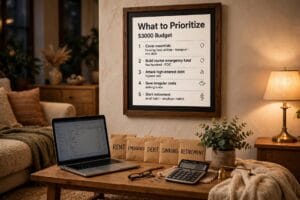
- Cover essentials. Housing, food, utilities, transportation, and minimum debt payments.
- Build a starter emergency fund. Even a few hundred dollars protects you from small surprises. Keep it in an easy-to-access account that is insured, and check coverage on the FDIC website.
- Attack high-interest debt. Send extra money to the debt with the highest interest rate. Our guide on how to get out of debt explains the full plan.
- Save for irregular costs. Use sinking funds for car repairs, gifts, and annual bills. See our guide on what is a sinking fund to get started.
- Start retirement savings. Even a small amount each month builds the habit, and an employer match is worth capturing if you have one.
Ways to Increase Your Income When You Budget on $3,000 a Month
If your budget is still tight after trimming expenses, a little extra income can make a big difference on $3,000 a month. Even $200 more each month adds $2,400 a year. Ideas to consider:
- Ask for a raise or extra hours. Prepare a short list of what you have accomplished.
- Take on freelance or gig work. Pick something that uses a skill you already have.
- Sell items you no longer use. This can create a one-time boost for your emergency fund.
- Use extra income wisely. Decide in advance that extra money goes to savings or debt, not to new spending.
Common Mistakes When You Budget on $3,000 a Month
These small errors cause most budgets to fail in the first few months:
- Using gross income. Always plan with take-home pay, or your numbers will be too high.
- Skipping irregular expenses. Annual insurance, car repairs, and gifts can ruin a plan that does not include them.
- Making the budget too strict. A plan with no room for fun is hard to keep. Include a realistic amount for wants.
- Not tracking spending. A budget only works if you compare it with real spending each month.
- Giving up after one bad month. One overspent month is information, not failure. Adjust and continue.
- Forgetting to review. Prices and income change, so your plan should change too.

Tools to Help You Budget on $3,000 a Month
You do not need expensive software. A notebook, a spreadsheet, or a free app is enough. Our Budget Calculator shows your 50/30/20 split instantly from your income and expenses, which makes a good starting point. For a wider look at all methods, read our complete guide on how to budget.
The Consumer Financial Protection Bureau also publishes free budgeting worksheets at consumerfinance.gov.
Frequently Asked Questions About How to Budget on $3,000 a Month
How should I budget on $3,000 a month?
Start with your take-home pay, cover needs first, then split the rest between wants and savings. A common starting point is the 50/30/20 rule, which you can adjust if your rent or other costs are high.
How do I budget on $3,000 a month for a family?
Start with essentials, add family costs such as childcare as their own categories, and keep a larger emergency fund goal. A shared plan that both adults helped build is easier to follow.
How much rent can I afford on $3,000 a month?
A common guideline is to keep housing near 30% of income, which is about $900. Many people in expensive areas spend more, but going far above that makes saving much harder.
Can I save money on $3,000 a month?
Yes. Even small amounts matter. In the examples above, you can save between $450 and $600 a month, depending on your housing costs and other expenses.
Is $3,000 a month a good income?
It depends on where you live and your household size. It can be comfortable in a low-cost area for one person, and very tight for a family in an expensive city.
What is the best budget method for $3,000 a month?
The 50/30/20 rule is a good first choice because it is simple. If it feels too loose, zero-based budgeting gives you more control by assigning every dollar a job.
How do I budget on $3,000 a month with debt?
Cover essentials and minimum payments first, build a small emergency fund, and send every extra dollar to your highest-interest debt. A written plan makes this much easier.
Final Thoughts
You can budget on $3,000 a month without feeling deprived. Start with your take-home pay, cover your needs, protect a little savings, and review your plan every month. The first version will never be perfect, and that is completely normal, because each month teaches you something new about your spending.
Ready to see your own numbers? A calculator makes it easier to budget on $3,000 a month with confidence. Try our free Budget Calculator to get your personal split in seconds, and explore our other guides to keep building a stronger financial plan.
This article is for educational purposes only and is not financial advice. Costs vary by location and household. Consider speaking with a qualified professional about your specific situation.