
Zero-based budgeting is a simple idea with a powerful result: every dollar you earn gets a job before the month begins. Instead of spending first and wondering where your money went, you plan each dollar on purpose, until your income minus your planned spending, saving, and debt payments equals exactly zero.
In this guide you will learn what zero-based budgeting is, how it works step by step, how it compares with the 50/30/20 rule, and how to use it even if your income changes every month. You will also see a full example budget with real numbers that you can copy and adjust.
What Is Zero-Based Budgeting?
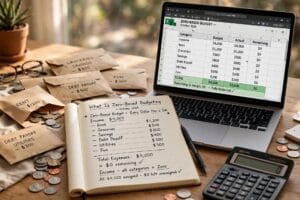
Zero-based budgeting is a method where you assign every dollar of your income to a specific category, such as rent, groceries, savings, or debt payoff. When you subtract all of those planned amounts from your income, the result is zero.
That does not mean you spend everything or end the month with an empty bank account. Savings and extra debt payments count as spending categories, so money you move into an emergency fund or toward a loan still has a job. The goal of zero-based budgeting is that no dollar is left unassigned, because unassigned money tends to disappear on small, forgettable purchases.
How Zero-Based Budgeting Works
The formula behind zero-based budgeting is easy to remember:
Income – Planned Expenses, Savings, and Debt Payments = $0
You start with the income you expect for the month, list every category you need to fund, and keep adjusting the numbers until nothing is left over. If you have $200 unassigned, you give it a job, such as a sinking fund, extra debt payment, or fun money. If you planned too much, you trim a category until the math balances.
Because you build the plan before the month starts, zero-based budgeting makes spending decisions in advance. When you are standing in a store, the decision has already been made.
Zero-Based Budgeting Example on $4,000
Here is how zero-based budgeting looks for someone who takes home $4,000 a month. The amounts are examples, so adjust them to match your own costs:
| Category | Monthly Amount |
|---|---|
| Housing | $1,100 |
| Utilities and internet | $180 |
| Groceries | $400 |
| Transportation | $250 |
| Insurance and health | $150 |
| Minimum debt payments | $120 |
| Dining out | $200 |
| Entertainment and subscriptions | $120 |
| Personal care | $80 |
| Shopping | $150 |
| Gifts | $50 |
| Emergency fund | $400 |
| Retirement savings | $300 |
| Extra debt payment | $300 |
| Sinking funds | $200 |
| Total planned | $4,000 |
| Left unassigned | $0 |
Notice that savings and debt payoff are part of the plan, not what is left over. This is the heart of zero-based budgeting: you pay your goals first, then you spend the rest on purpose.
How to Start Zero-Based Budgeting in 6 Steps
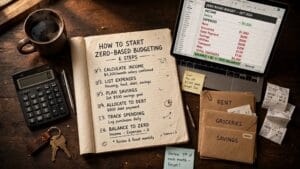
You can set up your first zero-based budget in about an hour. Follow these six steps.
Step 1: Calculate Your Monthly Income
Add up your take-home pay for the month, which is the money that reaches your account after taxes and deductions. If your income changes, use the lowest amount you can expect.
Step 2: List Every Expense
Write down every cost you expect, starting with fixed bills such as rent, insurance, and loan payments. Then add variable expenses such as groceries, fuel, and dining out. Your last two or three months of bank statements make this step much easier.
Step 3: Add Savings and Debt Goals
Add lines for the goals that matter to you, such as an emergency fund, retirement, a vacation, or extra payments on a credit card. These count as expenses in zero-based budgeting, so they get funded before you spend on wants.
Step 4: Balance the Budget to Zero
Subtract your total planned amounts from your income. If money is left over, give it a job. If the total is higher than your income, trim the flexible categories until the result is zero.
Step 5: Track Your Spending During the Month
Record what you spend and compare it with each category’s limit. When a category runs out, you either stop spending in it or move money from another category on purpose. This tracking step is what makes zero-based budgeting work in real life.
Step 6: Review and Reset Next Month
At the end of the month, see where your plan matched reality and where it did not, then build next month’s budget from zero. Each month you learn more, so your numbers become more accurate over time.
Zero-Based Budgeting vs the 50/30/20 Rule
Both methods are popular, but they work differently. Here is a quick comparison:
| Feature | Zero-Based Budgeting | 50/30/20 Rule |
|---|---|---|
| Structure | Every dollar assigned to a category | Three broad groups with set percentages |
| Level of detail | High | Low |
| Time needed | More, especially at first | Less |
| Flexibility | Fully customizable | Percentages guide you |
| Best for | People who want full control | Beginners who want simplicity |
If detailed planning feels like too much, start with our guide to the 50/30/20 rule. You can also combine them: use the percentages as a guide, then assign exact amounts to each category in the style of zero-based budgeting. For a wider look at all the methods, read our complete guide on how to budget.
Pros and Cons of This Method
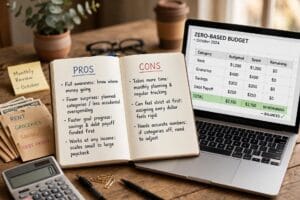
Pros
- Full awareness. You always know where your money is going.
- Fewer surprises. Planned categories leave less room for accidental overspending.
- Faster goal progress. Savings and debt payoff are funded first, not last.
- Works at any income. The method scales from a small paycheck to a large one.
Cons
- Takes more time. It needs a monthly planning session and regular tracking.
- Can feel strict at first. Assigning every dollar may feel rigid until it becomes a habit.
- Needs accurate numbers. If your categories are far off, you will need to adjust during the month.
How to Use This Method With an Irregular Income
If you are paid on commission or work as a freelancer, zero-based budgeting can still work with a few changes:
- Budget from your lowest typical month. Cover essentials and savings first with that amount.
- Use a priority list. Decide in advance where extra income goes once the basics are covered.
- Budget only the money you already have. Plan with last month’s income so you are never counting on money that has not arrived yet.
- Keep a bigger emergency cushion. It smooths out the months when income is low.
Planning for Irregular Expenses
Many zero-based budgets break because of expenses that do not happen every month, such as car repairs, holiday gifts, and annual insurance. The fix is to give those future costs a monthly category. A sinking fund is a small amount you save each month for a known future cost. If you are new to the idea, start with our guide on what is a sinking fund, then see the most common sinking fund categories to decide which ones you need.
Who Is Zero-Based Budgeting Best For?
Zero-based budgeting is a strong fit if one or more of these sound like you:
- You feel like your money disappears and you cannot explain where it goes.
- You are paying off debt and want every extra dollar to count.
- You have a specific goal, such as a down payment or an emergency fund, and want to reach it faster.
- You enjoy planning and seeing exactly how your money is organized.
If you prefer something lighter, that is perfectly fine. A simpler method you actually follow will always beat a detailed plan you abandon.
A Simple Monthly Routine to Keep Your Plan on Track
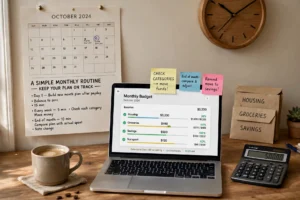
A budget works best when it becomes a short, repeatable routine instead of a big project. Here is a routine that takes less than half an hour per month:
- Day 1 (15 minutes): Build the new month’s plan right after payday and balance it to zero.
- Every week (5 minutes): Check each category and move money if one is running low.
- End of the month (10 minutes): Compare the plan with what you actually spent, and note what to change next time.
After two or three months, you will know your real numbers well enough that the planning step becomes quick and almost automatic.
Best Tools for Zero-Based Budgeting
You do not need expensive software for zero-based budgeting. Pick the tool that you will keep using:
- Pen and paper. Simple and effective for planning each month.
- A spreadsheet. Flexible, free, and easy to customize with your own categories.
- A budgeting app. Many apps are built around assigning every dollar and tracking spending automatically.
- A free calculator. Our Budget Calculator helps you see where your income goes before you build your detailed plan.
The Consumer Financial Protection Bureau also offers free budgeting worksheets and guides at consumerfinance.gov.
Using Your Plan to Pay Off Debt and Build Savings
One of the biggest strengths of zero-based budgeting is how it speeds up your goals. When you plan every dollar, you can see exactly how much extra you can send to debt each month. For a full plan, see our step-by-step guide on how to get out of debt.
It also helps you build an emergency fund faster. Keep that money in an easy-to-access account that is insured, and you can check bank insurance coverage on the FDIC website.

Common Mistakes to Avoid
- Thinking zero means spending everything. Savings and debt payments are categories too.
- Making categories too tight. A budget with no flexibility breaks quickly. Add a small buffer or fun category.
- Forgetting irregular expenses. Annual bills and repairs can ruin a plan if they are not funded monthly.
- Not tracking during the month. A plan only works if you compare it with real spending.
- Quitting after one bad month. Adjust the numbers and try again, because the plan gets more accurate each month.
- Using gross income. Always plan with take-home pay.
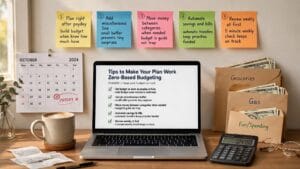
Tips to Make Your Plan Work
- Plan right after payday. Build the budget when you know exactly how much you have.
- Add a miscellaneous line. A small buffer prevents tiny surprises from breaking your plan.
- Move money between categories when needed. The budget is a guide, not a trap.
- Automate savings and bills. Automatic transfers keep your priorities funded.
- Review weekly at first. A five-minute weekly check keeps you on track.
Frequently Asked Questions About Zero-Based Budgeting
What is zero-based budgeting in simple terms?
It is a budgeting method where you assign every dollar of your income to a category, so your income minus your planned spending, saving, and debt payments equals zero.
Does this method mean I have to spend all my money?
No. Savings and extra debt payments count as spending categories. The goal is to give every dollar a purpose, not to spend it all.
Is zero-based budgeting good for beginners?
Yes, although it takes more time than simpler methods. Many beginners start with the 50/30/20 rule and move to zero-based budgeting once they are comfortable tracking their spending.
How do I budget this way with an irregular income?
Plan from your lowest expected income, fund essentials and savings first, and decide in advance where extra income will go when you earn more.
What is the difference between zero-based budgeting and the 50/30/20 rule?
The 50/30/20 rule divides income into three broad percentage groups. Zero-based budgeting assigns exact amounts to every individual category until nothing is left unassigned.
How often should I make a new plan?
Create a new plan every month, and review it weekly in the beginning. Adjust it any time your income or expenses change.
Final Thoughts
Zero-based budgeting will not make every month perfect, but it gives you something many budgets lack: control. When every dollar has a job, your goals are funded first and your spending feels intentional instead of accidental. Start with your take-home pay, list your categories, balance the plan to zero, and review it every month.
Ready to see where your money goes? Try our free Budget Calculator to get a quick picture of your numbers, then build your first zero-based budget with the steps above.
This article is for educational purposes only and is not financial advice. Consider speaking with a qualified professional about your specific situation.