How to Improve Your Credit Score: 9 Proven Steps in 2026

Learning how to improve your credit score can save you thousands of dollars over your lifetime — better rates on mortgages, car loans, credit cards, and even lower insurance premiums in many states. The good news is that improving your credit score doesn’t require complicated tricks, just consistent habits applied over time. This guide covers 9 proven steps to help you raise your score, starting today.

How Your Credit Score Is Calculated

Before diving into how to improve your credit score, it helps to understand what actually determines it. The most widely used scoring model weighs five factors:

  • Payment history (35%): Whether you pay bills on time
  • Credit utilization (30%): How much of your available credit you’re using
  • Length of credit history (15%): How long your accounts have been open
  • Credit mix (10%): The variety of credit types you have
  • New credit (10%): How many new accounts or inquiries you’ve had recently

Knowing these weights helps explain why some actions move your score faster than others — and why there’s no single “trick” that fixes everything overnight.

how to improve your credit score steps

Step 1: Pay Every Bill on Time, Every Time

Since payment history is the single biggest factor, this is the most important habit for anyone learning how to improve your credit score. Even one 30-day late payment can significantly drop your score and stay on your report for years.

Set up autopay for at least the minimum payment on every account, so a missed payment never happens due to forgetfulness. If you’re worried about overdrafting, set a calendar reminder a few days before each due date as a backup.

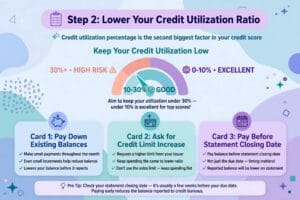
Step 2: Lower Your Credit Utilization Ratio

Credit utilization — the percentage of your available credit you’re currently using — is the second biggest factor. As a general rule, keeping utilization under 30% is good, and under 10% is considered excellent for anyone focused on how to improve their credit score quickly.

Ways to lower utilization:

  • Pay down existing balances, even in small increments throughout the month
  • Ask for a credit limit increase on an existing card (without using the extra limit)
  • Pay your balance before the statement closing date, not just the due date
how to improve your credit score steps

Step 3: Don’t Close Old Credit Cards

It might feel responsible to close a credit card you no longer use, but doing so can actually hurt your score in two ways: it reduces your total available credit (raising your utilization ratio) and shortens your average account age. Unless the card has a high annual fee that isn’t worth it, keeping old accounts open — even with occasional small purchases — generally helps your score.

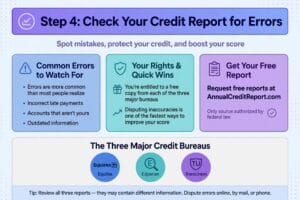
Step 4: Check Your Credit Report for Errors

Errors on credit reports are more common than most people realize — incorrect late payments, accounts that aren’t yours, or outdated information. You’re entitled to a free copy of your credit report from each of the three major bureaus, and disputing inaccuracies is one of the fastest ways to improve your credit score when an error is dragging it down unfairly.

You can request your free reports at AnnualCreditReport.com, the only source authorized by federal law for free credit reports.
how to improve your credit score steps

Step 5: Become an Authorized User on a Trusted Account

If a family member has a credit card with a long history and low utilization, asking to be added as an authorized user can boost your score, since that account’s positive history may be reflected on your report. This works especially well for people with thin or new credit files.

Step 6: Diversify Your Credit Mix (Carefully)

Having a mix of credit types — a credit card, an installment loan, maybe a car loan — can help your score slightly, since it shows you can manage different kinds of credit responsibly. That said, this is a smaller factor, and opening new accounts purely to “diversify” often does more harm than good in the short term. Let this happen naturally rather than forcing it.

Step 7: Limit New Credit Applications

Every time you apply for new credit, a hard inquiry appears on your report, which can cause a small, temporary dip in your score. Multiple applications in a short period can compound this effect and signal risk to lenders. If you’re focused on how to improve your credit score before a major purchase like a mortgage, avoid opening new accounts in the months leading up to your application.

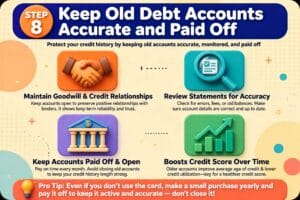
Step 8: Keep Old Debt Accounts Accurate and Paid Off

If you have older debts — collections, charged-off accounts — verify they’re being reported accurately and, where possible, work toward paying them off or negotiating settlements. Even paid collections can remain on your report for years, but a paid status looks better to lenders than an unpaid one, and some newer scoring models weigh paid collections less heavily.
how to improve your credit score steps

Step 9: Be Patient and Consistent

Unlike some financial goals, improving your credit score doesn’t happen overnight. Significant improvement typically takes a few months of consistent positive behavior, and rebuilding from serious negative marks (like a missed payment or collection) can take longer. The habits that improve your score are the same ones that build strong financial health overall — on-time payments, low utilization, and patience.

While you’re building better credit habits, it’s also worth building a cash cushion so you’re less reliant on credit for emergencies. Our free Emergency Fund Calculator can help you set a savings target.

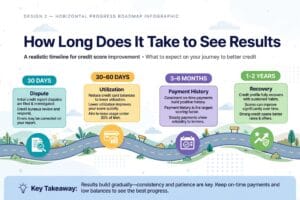
How Long Does It Take to See Results?

Timelines vary based on your starting point:

  • Lowering utilization: Can show results within 1-2 billing cycles (30-60 days)
  • Disputing an error: Typically resolved within 30 days, with score updates shortly after
  • Building payment history: Meaningful improvement usually takes 3-6 months of consistent on-time payments
  • Recovering from major negative marks: Can take 1-2 years for significant score recovery, though the impact lessens over time
how to improve your credit score steps

Common Mistakes That Hurt Your Credit Score

  • Maxing out credit cards, even temporarily. High utilization at any point in the billing cycle can be reported and affect your score, even if you pay it off in full each month.
  • Co-signing loans without understanding the risk. A co-signed loan affects your credit just as much as it affects the primary borrower’s.
  • Ignoring small, forgotten bills. A single missed medical or utility bill sent to collections can significantly impact your score.
  • Closing your oldest credit card. This shortens your credit history length and raises utilization at the same time — a double negative.
  • Applying for too many cards at once when chasing sign-up bonuses, which can trigger multiple hard inquiries in a short window.

Building Credit From Scratch

If you’re starting with no credit history at all, a few beginner-friendly options can help:

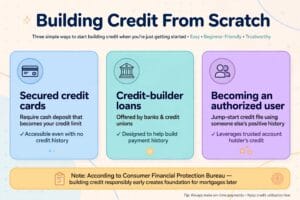
  • Secured credit cards: Require a cash deposit that becomes your credit limit, making them accessible even with no credit history.
  • Credit-builder loans: Offered by some banks and credit unions specifically designed to help build payment history.
  • Becoming an authorized user: As mentioned earlier, this can jump-start a credit file using someone else’s positive history.

According to the Consumer Financial Protection Bureau, building credit responsibly early on creates a foundation that pays off significantly when applying for larger loans like mortgages later in life.
how to improve your credit score steps

Final Thoughts

Knowing how to improve your credit score comes down to a handful of consistent habits: pay on time, keep utilization low, avoid unnecessary new credit, and be patient. There’s no shortcut that replaces time and consistency, but the steps in this guide will move your score in the right direction faster than most people realize.

As your credit improves, pairing it with a solid financial foundation matters just as much. Check out our guide on how to create a budget that actually works to make sure your overall financial plan supports your credit goals long-term.

How to Save Money Fast: 12 Proven Tips That Actually Work

If you’re looking for how to save money fast — not vague long-term advice — you’re in the right place. Maybe you’re building an emergency fund, paying off debt, or saving for something specific with a deadline. Whatever the reason, this guide covers 12 practical, proven tips that show you exactly how to save money fast, starting today.

These aren’t the tired “stop buying coffee” tips you’ve heard a hundred times. They’re organized by how quickly they produce results, so you can start with the fastest wins first.

Quick Wins: Save Money Fast in the Next 24 Hours

how to save money fast tips

1. Audit and Cancel Unused Subscriptions

Go through your bank and credit card statements from the last two months and list every recurring charge — streaming services, apps, memberships. Most people are shocked to find $50-$150 a month in subscriptions they barely use. Canceling even three or four of them is instant, ongoing savings with zero lifestyle sacrifice.

2. Call Your Providers and Negotiate

Internet, phone, and insurance providers often have retention discounts they don’t advertise. A single 15-minute call asking “is there a lower rate available” or mentioning a competitor’s price can save $20-$50 a month — savings that repeat every single month going forward.

3. Switch to a High-Yield Savings Account

If your savings are sitting in a traditional bank account earning close to 0% interest, moving that money to a high-yield savings account is a five-minute task that puts your existing savings to work harder immediately, with zero additional effort required going forward.

4. Use the 48-Hour Rule on Non-Essential Purchases

Before buying anything non-essential over $50, wait 48 hours. This single habit eliminates a huge percentage of impulse purchases — you’ll be amazed how often the urge to buy disappears once the initial impulse fades.

Fast Results: Save Money Fast Within a Week

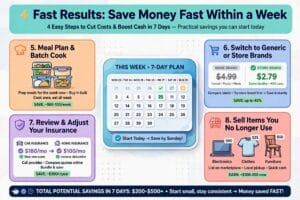
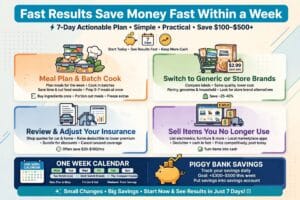
Fast Results: Save Money Fast Within a Week 5. Meal Plan and Batch Cook Groceries and takeout combined are often one of the biggest controllable expenses in any budget. Planning meals for the week and batch cooking on one day typically cuts food spending by 20-30% almost immediately, while also saving time during busy weekdays. 6. Switch to Generic or Store Brands For most household items — medications, pantry staples, cleaning supplies — store brands are nearly identical to name brands at 20-40% lower cost. This is one of the easiest ways to save money fast without changing your actual shopping habits or routine. 7. Review and Adjust Your Insurance Shop your car and home insurance rates against 2-3 competitors. Rates change frequently, and loyalty rarely gets rewarded — many people save several hundred dollars a year simply by re-shopping policies they've had for years without checking. 8. Sell Items You No Longer Use Unused electronics, clothes, furniture, and equipment sitting around your home can be converted to cash within days through online marketplaces. This isn't a long-term strategy, but it's one of the fastest ways to generate an immediate cash boost toward a savings goal. Not sure where your money is actually going each month? Use our free Budget Calculator to see your full spending breakdown in seconds.

5. Meal Plan and Batch Cook

Groceries and takeout combined are often one of the biggest controllable expenses in any budget. Planning meals for the week and batch cooking on one day typically cuts food spending by 20-30% almost immediately, while also saving time during busy weekdays.

6. Switch to Generic or Store Brands

For most household items — medications, pantry staples, cleaning supplies — store brands are nearly identical to name brands at 20-40% lower cost. This is one of the easiest ways to save money fast without changing your actual shopping habits or routine.

7. Review and Adjust Your Insurance

Shop your car and home insurance rates against 2-3 competitors. Rates change frequently, and loyalty rarely gets rewarded — many people save several hundred dollars a year simply by re-shopping policies they’ve had for years without checking.

8. Sell Items You No Longer Use

Unused electronics, clothes, furniture, and equipment sitting around your home can be converted to cash within days through online marketplaces. This isn’t a long-term strategy, but it’s one of the fastest ways to generate an immediate cash boost toward a savings goal.

Not sure where your money is actually going each month? Use our free Budget Calculator to see your full spending breakdown in seconds.

Sustainable Habits: Save Money Fast and Keep It That Way

Fast Results: Save Money Fast Within a Week 5. Meal Plan and Batch Cook Groceries and takeout combined are often one of the biggest controllable expenses in any budget. Planning meals for the week and batch cooking on one day typically cuts food spending by 20-30% almost immediately, while also saving time during busy weekdays. 6. Switch to Generic or Store Brands For most household items — medications, pantry staples, cleaning supplies — store brands are nearly identical to name brands at 20-40% lower cost. This is one of the easiest ways to save money fast without changing your actual shopping habits or routine. 7. Review and Adjust Your Insurance Shop your car and home insurance rates against 2-3 competitors. Rates change frequently, and loyalty rarely gets rewarded — many people save several hundred dollars a year simply by re-shopping policies they've had for years without checking. 8. Sell Items You No Longer Use Unused electronics, clothes, furniture, and equipment sitting around your home can be converted to cash within days through online marketplaces. This isn't a long-term strategy, but it's one of the fastest ways to generate an immediate cash boost toward a savings goal. Not sure where your money is actually going each month? Use our free Budget Calculator to see your full spending breakdown in seconds.

9. Automate Your Savings

Set up an automatic transfer to savings the day you get paid, before you have a chance to spend it. This single change — removing the decision entirely — is one of the most reliable ways to save money fast and consistently, month after month.

10. Use a Sinking Fund for Irregular Expenses

A huge amount of “emergency” spending is actually predictable — car maintenance, holiday gifts, annual fees. Setting aside small amounts monthly for these known future costs prevents them from wrecking your savings progress later. Learn more in our guide on what a sinking fund is and see 50 real sinking fund examples to get started.

11. Try a No-Spend Challenge

Pick a set period — a week or a full month — and commit to spending only on true essentials: housing, utilities, groceries, and existing bills. No-spend challenges reset spending habits quickly and often reveal exactly how much unnecessary spending has crept into your routine.

12. Track Every Dollar for 30 Days

Simply writing down or logging every purchase for a month — without judgment or restriction — makes most people spend less automatically. Awareness alone is one of the most underrated ways to save money fast, because it’s hard to overspend on something you’re actively watching.

How Much Can You Realistically Save?

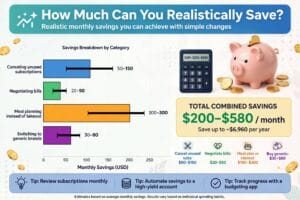
How Much Can You Realistically Save? Combining even a handful of these tips typically produces noticeable results within 30 days. As a rough example: Canceling unused subscriptions: $50-$150/month Negotiating bills: $20-$50/month Meal planning instead of takeout: $100-$300/month Switching to generic brands: $30-$80/month Combined, that's potentially $200-$580 in monthly savings from changes that take less than a few hours total to implement — without touching your income at all.

Combining even a handful of these tips typically produces noticeable results within 30 days. As a rough example:

  • Canceling unused subscriptions: $50-$150/month
  • Negotiating bills: $20-$50/month
  • Meal planning instead of takeout: $100-$300/month
  • Switching to generic brands: $30-$80/month

Combined, that’s potentially $200-$580 in monthly savings from changes that take less than a few hours total to implement — without touching your income at all.

How to Save Money Fast and Make It Last: What to Do Next

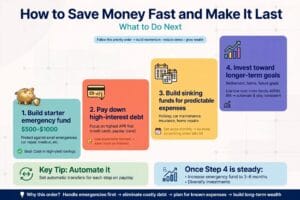
How to Save Money Fast and Make It Last: What to Do Next Once you start seeing real results, it's important to direct that extra money intentionally rather than letting it quietly disappear back into spending. Consider this priority order: Build a starter emergency fund ($500-$1,000) if you don't have one yet. Our Emergency Fund Calculator can help you set a target. Pay down high-interest debt — every dollar saved here is guaranteed "return" equal to your interest rate. Build sinking funds for predictable upcoming expenses so you never have to scramble again. Invest the rest toward longer-term goals once your short-term foundation is solid.

Once you start seeing real results, it’s important to direct that extra money intentionally rather than letting it quietly disappear back into spending. Consider this priority order:

  1. Build a starter emergency fund ($500-$1,000) if you don’t have one yet. Our Emergency Fund Calculator can help you set a target.
  2. Pay down high-interest debt — every dollar saved here is guaranteed “return” equal to your interest rate.
  3. Build sinking funds for predictable upcoming expenses so you never have to scramble again.
  4. Invest the rest toward longer-term goals once your short-term foundation is solid.

Common Mistakes That Undo Fast Savings Progress

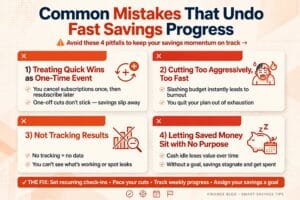
  • Treating quick wins as a one-time event. Canceling a subscription once doesn’t help if you resubscribe to something else a month later. Make these audits a recurring quarterly habit.
  • Cutting too aggressively, too fast. Extreme restriction often backfires into burnout spending. Sustainable savings beats an unsustainable sprint.
  • Not tracking the results. Without measuring your progress, it’s easy to lose motivation. According to research highlighted by the Consumer Financial Protection Bureau, automating savings significantly increases the odds of hitting savings goals compared to manual saving alone.
  • Letting saved money sit with no purpose. Money saved without a clear destination (debt, emergency fund, goal) tends to get spent eventually. Assign every saved dollar a job.

Common Mistakes That Undo Fast Savings Progress Treating quick wins as a one-time event. Canceling a subscription once doesn't help if you resubscribe to something else a month later. Make these audits a recurring quarterly habit. Cutting too aggressively, too fast. Extreme restriction often backfires into burnout spending. Sustainable savings beats an unsustainable sprint. Not tracking the results. Without measuring your progress, it's easy to lose motivation. According to research highlighted by the Consumer Financial Protection Bureau, automating savings significantly increases the odds of hitting savings goals compared to manual saving alone. Letting saved money sit with no purpose. Money saved without a clear destination (debt, emergency fund, goal) tends to get spent eventually. Assign every saved dollar a job.

Final Thoughts

Learning how to save money fast isn’t about extreme sacrifice — it’s about identifying the highest-impact changes first (subscriptions, negotiating bills, automating savings) and building sustainable habits second (meal planning, tracking spending, sinking funds). If you’re serious about how to save money fast, start with two or three tips from this list today, and layer in more as they become habits.

Ready to see exactly where your money is going? Try our free Budget Calculator and get a personalized breakdown of your spending in seconds — no sign-up required.

How Much Should You Save for an Emergency Fund in 2026?

How much should you save for an emergency fund? The short answer is three to six months of essential expenses — but the right number for you depends on your job stability, income type, and family situation. This guide breaks down exactly how to calculate your target, where to keep the money, and how to build it faster than you might think.

how much should you save for an emergency fund

An emergency fund is the financial buffer between a surprise expense and a crisis. Without one, a broken car, a medical bill, or a sudden job loss often gets paid for with high-interest credit card debt — turning a temporary setback into a long-term financial problem. That’s exactly why knowing how much you should save for an emergency fund matters so much before an emergency actually happens.

Why an Emergency Fund Comes Before Everything Else

Before aggressively investing or paying down low-interest debt, most financial experts recommend building at least a small emergency fund first. Here’s why:

  • It prevents new debt. Without cash reserves, unexpected costs usually go on a credit card, often at 20%+ interest.
  • It protects your other financial goals. Without a buffer, you may be forced to pull money out of investments at the worst possible time, or stop contributing to retirement accounts.
  • It reduces financial stress. Studies consistently link having even a small emergency cushion to lower financial anxiety, regardless of overall income level.

how much should you save for an emergency fund

How Much Should You Save for an Emergency Fund?

The standard guideline for how much you should save for an emergency fund is three to six months of essential expenses — not your full income, but the amount you’d need to cover rent, utilities, groceries, insurance, and minimum debt payments if your income stopped.

how much should you save for an emergency fund

Where you fall in that range depends on a few factors:

Save Closer to 3 Months If:

  • You have a stable job in an in-demand field
  • You have a second income earner in your household
  • You have other liquid assets you could access if needed

Save Closer to 6 Months (or More) If:

  • You’re self-employed or work on commission
  • You’re the sole income earner in your household
  • You work in a volatile or seasonal industry
  • You have dependents relying on your income

Still not sure how much you should save for an emergency fund based on your own numbers? Use our free Emergency Fund Calculator to plug in your monthly expenses and instantly see your personalized target range.

How to Calculate How Much You Should Save for an Emergency Fund

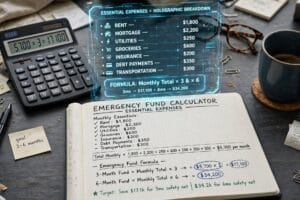
Add up only your essential monthly expenses — the ones that don’t stop if your income does:

  • Rent or mortgage payment
  • Utilities (electric, water, gas, internet)
  • Groceries
  • Insurance premiums
  • Minimum debt payments
  • Transportation costs

Multiply that monthly total by three (minimum target) and by six (fuller target) to get your range. For example, if your essential expenses total $2,500/month, your target is between $7,500 and $15,000.

That number can feel intimidating — which is exactly why the next section matters more than the target itself.

how much should you save for an emergency fund

Start Smaller: The $1,000 Starter Fund

If three to six months feels impossibly far away, don’t let that stop you from starting. Many financial plans recommend building a smaller “starter” fund of $500–$1,000 first, before tackling high-interest debt or the full three-to-six-month goal — you don’t need the full amount of how much you should save for an emergency fund on day one.

This smaller cushion won’t cover a job loss, but it will absorb most common surprises — a car repair, a vet bill, a broken appliance — without derailing your budget or forcing you into debt. Reaching this first milestone also builds momentum and confidence for the bigger goal ahead.

Where to Keep Your Emergency Fund

Once you’ve figured out how much you should save for an emergency fund, the next question is where to keep it. Your emergency fund needs to be accessible quickly, without penalty, but ideally still earning some interest. Good options include:

  • High-yield savings account: Offers better interest than a traditional savings account while remaining fully liquid.
  • Money market account: Similar liquidity to a savings account, sometimes with check-writing privileges.

how much should you save for an emergency fund

Avoid keeping your emergency fund in the stock market or any investment that can lose value — the entire purpose of this money is stability, not growth. Also avoid keeping it in your everyday checking account, where it’s too easy to accidentally spend.

How to Build Your Emergency Fund Faster

1. Automate a Fixed Transfer

how much should you save for an emergency fund

Set up an automatic transfer to your emergency savings account on payday, even if it’s small. Consistency matters more than the amount — $50 a month becomes $600 in a year without you having to think about it.

2. Save Windfalls Before You Spend Them

Tax refunds, work bonuses, and cash gifts are ideal emergency fund boosters because they weren’t part of your regular budget to begin with — you won’t “miss” money you never planned on.

3. Use a Sinking Fund Approach for Predictable Costs

Separating your emergency fund from planned irregular expenses — like car maintenance or holiday gifts — keeps your true emergency cushion intact. Learn more in our guide on what a sinking fund is and how it complements your emergency savings.

4. Temporarily Redirect “Extra” Spending

Pause one or two discretionary subscriptions or dining-out budget lines for a few months and redirect that money straight into your emergency fund until you hit your first milestone.

When It’s Okay to Use Your Emergency Fund

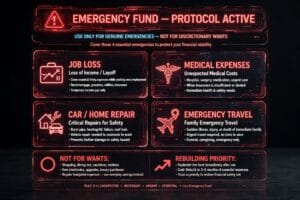
An emergency fund should only be used for genuine emergencies — not planned expenses or wants. Appropriate uses include:

  • Job loss or a significant reduction in income
  • Unexpected medical or dental expenses
  • Essential car or home repairs
  • Emergency travel (such as a family medical crisis)

If you do dip into it, treat rebuilding it as a top financial priority — pause other savings goals temporarily if needed until it’s restored.

how much should you save for an emergency fund

Common Mistakes to Avoid

  • Investing it for higher returns: This defeats the purpose — emergency funds need to be stable and accessible, not growing at the mercy of market swings.
  • Combining it with other savings goals: Mixing your emergency fund with vacation or gift savings makes it too easy to “borrow” from it for non-emergencies.
  • Waiting until you hit the full target to start: Even $500 in savings puts you ahead of a large percentage of households with zero emergency savings, according to Federal Reserve survey data on household financial resilience.

how much should you save for an emergency fund

Final Thoughts: How Much Should You Save for an Emergency Fund?

To recap: how much should you save for an emergency fund? Start with a goal of $500–$1,000, then build toward three to six months of essential expenses as your income and stability allow. The exact number matters less than the habit of saving consistently — even small, automatic contributions add up faster than most people expect.

Ready to find your personalized target? Try our free Emergency Fund Calculator and see exactly how much cushion you need based on your own monthly expenses.

How to Create a Budget That Actually Works: 5-Step Guide

Learning how to create a budget is the single most effective step you can take toward financial control. If you’ve ever reached the end of the month wondering where your paycheck went, you’re not alone — most people who track their spending save more money, not because they earn more, but because they finally see where it’s going.

how to create a budget - step by step guide

A budget isn’t about restriction. It’s about giving every dollar a job before it disappears into random purchases, subscriptions you forgot about, or one too many takeout orders. In this guide, you’ll learn exactly how to create a budget that fits your real life, not someone else’s spreadsheet template.

Why Most Budgets Fail (And How to Avoid It)

Before diving into the steps, it’s worth understanding why so many people give up on budgeting within the first month. The usual culprits are:

  • Being too restrictive. Cutting out every small joy — coffee, takeout, streaming services — makes a budget feel like punishment instead of a plan.
  • Not tracking irregular expenses. Car repairs, annual subscriptions, and holiday gifts blow up “perfect” budgets because they weren’t planned for.
  • Using someone else’s numbers. A budget built around national averages rarely matches your actual cost of living, income, or goals.
  • Giving up after one bad month. A budget is a living plan, not a one-time test you either pass or fail.

The good news: once you build a budget around your actual habits instead of an idealized version of yourself, it becomes far easier to stick with.

Step 1: Calculate Your Real Monthly Income

Start with the number you actually take home, not your gross salary. If your income varies — freelance work, tips, commission — use the average of your last three to six months as a conservative baseline.

how to create a budget - step by step guide


If you have multiple income sources, add them all together:

  • Primary job take-home pay
  • Side hustle or freelance income
  • Passive income (dividends, rental income, etc.)
  • Any other recurring income

This total is your budgeting baseline — the amount you have to work with each month.

Step 2: List Every Expense (Yes, Every One)

This step is where most people underestimate their spending. Go through your last two to three months of bank and credit card statements and categorize every transaction. Group them into:

  • Fixed expenses: rent or mortgage, insurance, loan payments, subscriptions
  • Variable necessities: groceries, utilities, gas, phone bill
  • Discretionary spending: dining out, entertainment, shopping, hobbies
  • Irregular expenses: car maintenance, gifts, annual memberships, medical costs

how to create a budget - step by step guide

That last category is the one people forget most often — and it’s usually the reason a budget falls apart three months in. A simple fix is to average irregular costs over 12 months and set aside a small amount for them every month. This is exactly what a sinking fund is designed to solve.

Step 3: Choose a Budgeting Method That Fits Your Life

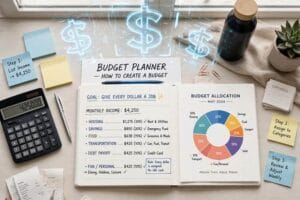
There’s no single “correct” way to create a budget — the best method is the one you’ll actually use. Here are three popular approaches:

The 50/30/20 Rule

Allocate 50% of income to needs, 30% to wants, and 20% to savings and debt repayment. This is a great starting point if you want simplicity without tracking every category in detail.

Zero-Based Budgeting

Every dollar is assigned a job — income minus expenses minus savings should equal zero. This method gives you the most control but requires more upfront planning.

The Pay-Yourself-First Method

Automatically move a set amount into savings the moment you’re paid, then budget the rest for expenses. This works well for people who struggle to save what’s “left over” at the end of the month, because there usually isn’t anything left.

how to create a budget - step by step guide

You can try our free Budget Calculator to instantly see how your income breaks down using the 50/30/20 approach.

Step 4: Build In Room for Real Life

A budget that assumes perfect behavior every single month is a budget destined to fail. Build in a small “miscellaneous” or “fun money” category — even $30–$50 a month — so unplanned small expenses don’t derail your entire plan or make you feel like you failed.

This single change is often the difference between a budget that lasts a few weeks and one that becomes a permanent habit.

Step 5: Review and Adjust Monthly

Your first month’s budget is a draft, not a final answer. At the end of each month, compare what you planned to spend against what you actually spent. Ask yourself:

  • Which categories were consistently over budget?
  • Were there expenses you forgot to include?
  • Did any goals shift — a new expense, a raise, a change in priorities?

Adjust the numbers and try again. After two or three months of this cycle, your budget will reflect your actual life far more accurately than any template ever could.

how to create a budget - step by step guide

Common Budgeting Mistakes to Avoid

  • Forgetting annual expenses: car registration, subscriptions billed yearly, holiday spending.
  • Setting unrealistic savings goals: jumping straight to saving 30% of income when you’re starting from zero often leads to giving up. Start smaller and increase over time.
  • Not having an emergency fund first: without one, a single unexpected expense can undo months of budgeting progress. If you don’t have one yet, our Emergency Fund Calculator can help you figure out a target.
  • Tracking manually forever: spreadsheets work, but automating your tracking (bank apps, budgeting apps) removes the friction that causes most people to quit.

Final Tips on How to Create a Budget That Lasts

A budget isn’t a one-time project — it’s an ongoing conversation with your money. The goal isn’t perfection in month one; it’s building a system flexible enough to survive real life while still moving you toward your goals.

Start simple: calculate your income, track your spending for a month, pick one method, and adjust from there. Small, consistent adjustments beat an ambitious plan you abandon by week two.

how to create a budget - step by step guide

For additional guidance on setting realistic financial goals, the Consumer Financial Protection Bureau offers free, unbiased budgeting worksheets and tools.

Final Thoughts

Now that you know how to create a budget step by step, the hardest part is simply getting started. Ready to see your numbers in action? Try our free Budget Calculator and get your personalized 50/30/20 breakdown in seconds — no sign-up required.

Sinking Fund Categories: 10 Ideas to Start With

Introduction

sinking fund categories

Once you understand what a sinking fund is, the next question is usually: which sinking fund categories should I actually start with? With so many potential expenses to plan for, it’s easy to feel overwhelmed trying to save for everything at once.

This guide walks through 10 practical sinking fund categories, along with a simple framework for prioritizing which ones to start with based on your budget and upcoming expenses.

Quick Recap: What Is a Sinking Fund?

A sinking fund is money set aside gradually, over time, for a specific known future expense — rather than scrambling to cover a large cost all at once. If you’re new to the concept, our guide on What Is a Sinking Fund?https://wealthdailypro.com/what-is-a-sinking-fund/ breaks down exactly how they work and how they differ from an emergency fund.

10 Popular Sinking Fund Categories

1. Holiday and Gift Spending

One of the most common sinking fund categories, since holiday spending tends to arrive at the same time every year but often catches budgets off guard anyway.

2. Car Maintenance and Repairs

sinking fund categories

Setting aside a small amount monthly for routine maintenance, tires, or unexpected repairs can prevent a surprise mechanic bill from disrupting your budget.

3. Annual Insurance Premiums

If your insurance is billed annually rather than monthly, a dedicated sinking fund can turn one large payment into smaller, manageable monthly contributions.

4. Home Repairs and Maintenance

Sinking Fund Categories: 10 Ideas to Start With

From appliance replacements to seasonal maintenance, homeownership comes with predictable — if irregularly timed — expenses that a sinking fund can help smooth out.

5. Vacations and Travel

Sinking Fund Categories: 10 Ideas to Start With

Rather than putting travel expenses on a credit card, a dedicated vacation sinking fund allows you to pay for trips with money you’ve already saved.

6. Back-to-School Expenses

For parents, the start of a school year often brings a cluster of costs — supplies, clothing, and activity fees — that can be planned for well in advance.

7. Medical and Dental Co-Pays

While a true emergency fund covers unexpected medical emergencies, a sinking fund can help cover predictable costs like annual checkups, dental cleanings, or prescription renewals.

8. Pet Care Costs

Routine vet visits, grooming, and pet supplies are ongoing but somewhat predictable costs that many pet owners find easier to manage with a dedicated sinking fund.

9. Wedding or Special Event Costs

Whether it’s your own wedding or attending someone else’s, event-related costs (gifts, travel, attire) can add up quickly without advance planning.

10. Technology Upgrades

Phones, laptops, and other devices eventually need replacing. A technology sinking fund helps you avoid financing a new device or draining other savings when the time comes.

How to Prioritize Your Sinking Fund Categories

Trying to fund all 10 categories at once is rarely realistic, especially when you’re just getting started. Here’s a simple framework for prioritizing: https://www.nerdwallet.com/article/finance/sinking-fund

sinking fund categories

Step 1: Identify What’s Coming Up Soonest

Review the next 6–12 months and note which categories have expenses on the horizon. A vacation planned for next month should likely take priority over a technology upgrade you don’t expect for another two years.

Step 2: Rank by Financial Impact

Consider which categories represent the largest potential expenses relative to your budget. A category like “annual insurance premiums” might warrant earlier prioritization if the lump sum would otherwise strain your finances significantly.

Step 3: Start With 2–3 Categories, Not All 10

Rather than spreading contributions thin across every category, most people find more success starting with two or three sinking funds that address their most pressing or highest-impact upcoming expenses, then adding more categories over time.

Step 4: Adjust as Circumstances Change

Your sinking fund categories aren’t set in stone. As life circumstances shift — a new pet, a change in homeownership status, an upcoming life event — revisit your list and adjust which categories deserve priority.

Example: Prioritizing With a Limited Budget

Suppose you can only allocate $150 per month across sinking funds. Here’s an example of how that might be prioritized:

  • Car maintenance: $50/month (ongoing, unpredictable timing)
  • Holiday gifts: $50/month (known annual expense)
  • Annual insurance premium: $50/month (known amount and date)

As income grows or existing funds reach their goals, additional categories like vacation or technology upgrades could be layered in.

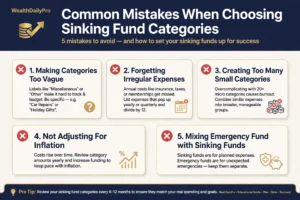
Common Mistakes When Choosing Sinking Fund Categories

Sinking Fund Categories: 10 Ideas to Start With

  • Trying to fund too many categories at once: This often leads to underfunding all of them rather than fully funding a few.
  • Ignoring categories with irregular timing: Costs like car repairs don’t follow a predictable schedule, but that doesn’t mean they shouldn’t have a dedicated fund.
  • Not adjusting contribution amounts over time: As you get closer to a known expense date, you may need to increase contributions to stay on track.
  • Confusing sinking funds with your emergency fund: Sinking fund categories are for known, planned expenses — not for the unexpected emergencies your emergency fund is meant to cover.

Frequently Asked Questions

How many sinking fund categories should I have? There’s no fixed number, but starting with 2–3 of your most pressing or highest-impact categories tends to be more manageable than trying to fund ten categories at once.

Should every sinking fund category get the same amount each month? Not necessarily. Contribution amounts should generally reflect the cost and timeline of each specific expense, meaning some categories may require larger monthly contributions than others.

Can sinking fund categories overlap with a budget category? Yes, and that’s normal. For example, “car maintenance” might appear both as a small monthly budget line and as a sinking fund category for larger, less frequent repairs.

Final Thoughts

Sinking Fund Categories: 10 Ideas to Start With

Choosing the right sinking fund categories comes down to identifying which known expenses are most likely to disrupt your budget if left unplanned. Start small with two or three categories that address your most immediate or highest-impact upcoming costs, and expand from there as your budget allows.


Disclaimer: This article is for general informational and educational purposes only and does not constitute personalized financial advice. Please consult a qualified financial professional before making decisions about your personal finances.