How to Budget: 7 Simple Steps That Really Work (2026)

Learning how to budget is one of the most useful money skills you can build, and it is much easier than most people think. A budget is simply a plan that tells your money where to go before the month begins, instead of wondering where it went when the month ends. In this guide you will learn how to budget in seven simple steps, how to choose a method that fits your life, and how to stick with it.

Whether you earn a high income or a low one, whether your paycheck is steady or irregular, the basics of how to budget stay the same. You will also see a full example budget with real numbers, so you can copy the structure and adjust it to your situation.

What Is a Budget and Why Does It Work?

A budget is a spending and saving plan for a set period, usually one month. It compares the money you expect to earn with the money you expect to spend, so you can make sure your expenses never exceed your income.

The reason budgeting works is simple: you make decisions once, on purpose, instead of making hundreds of small decisions in the moment. When you know how to budget, you can pay bills on time, build savings, reduce debt, and still enjoy spending on things you value.

how to budget for beginners with notebook, calculator and monthly budget plan

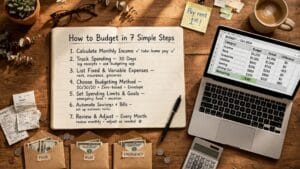
How to Budget in 7 Simple Steps

Follow these seven steps in order. Most people finish the first version of their budget in about an hour.

Step 1: Calculate Your Monthly Income

The first part of how to budget is knowing exactly what you earn. Start with your take-home pay, which is the money that reaches your bank account after taxes and deductions. If you have more than one source of income, add them together.

If your income changes from month to month, use the lowest amount you expect to earn. Budgeting from a conservative number protects you from running short.

Step 2: Track Your Spending for 30 Days

You cannot plan well without knowing where your money goes now. Review your last two or three months of bank and card statements and list every expense. Many people are surprised by how much goes to small, repeated purchases.

This step is the foundation of how to budget accurately, because it shows what you really spend instead of what you think you spend.

Step 3: List Fixed and Variable Expenses

Sort your spending into two groups. Fixed expenses stay roughly the same each month, such as rent, insurance, and loan payments. Variable expenses change, such as groceries, fuel, dining out, and entertainment.

Fixed expenses are harder to change quickly, so most savings come from variable expenses first. Separating these two groups is a key part of how to budget realistically.

Step 4: Choose a Budgeting Method

There is no single best answer to how to budget, only the method you will actually use. Here are three popular options:

Method How It Works Best For
50/30/20 rule 50% needs, 30% wants, 20% savings and debt Beginners who want a simple structure
Zero-based budget Give every dollar a job until income minus expenses equals zero People who want full control
Envelope or cash method Set a spending limit for each category and stop when it runs out People who overspend in certain categories

If you are not sure where to begin, start with the 50/30/20 split. Our complete guide to the 50/30/20 rule explains how to calculate it and how to adjust it.

Step 5: Set Spending Limits and Goals

Now assign a monthly amount to every category: housing, food, transportation, bills, fun, and savings. Then add clear goals, such as an emergency fund, a vacation, or paying off a credit card.

Goals make a budget feel purposeful. When you know how to budget around goals, saving stops feeling like a punishment and starts feeling like progress.

Step 6: Automate Your Savings and Bills

Set up automatic transfers to your savings on payday, and automatic payments for fixed bills. Automation removes the temptation to spend first and save later, and it protects you from late fees.

If you have credit card debt, make sure at least the minimum payment is automated so you never miss a due date. Automation is the easiest part of how to budget consistently.

Step 7: Review and Adjust Every Month

A budget is not a one-time project. Spend ten minutes at the end of each month comparing your plan with what actually happened, then adjust the numbers. Your first budget will never be perfect, and that is completely normal. Regular reviews are what make a budget work in the long run, which is the final lesson in how to budget.
how to budget for beginners with notebook, calculator and monthly budget plan

How to Budget Example: Monthly Plan on $3,500

Here is a sample budget that applies the 50/30/20 rule to $3,500 of monthly take-home pay. The amounts are examples, so adjust them to match your own costs:

Category Monthly Amount
Housing (rent or mortgage) $950
Utilities and internet $150
Groceries $330
Transportation $220
Insurance and health $100
Needs total (50%) $1,750
Dining out $250
Entertainment and subscriptions $150
Shopping $250
Fun and travel fund $200
Personal care and gifts $200
Wants total (30%) $1,050
Emergency fund $250
Retirement savings $200
Extra debt payment $150
Sinking funds $100
Savings and debt total (20%) $700

Notice that every dollar has a job and the totals add up to $3,500. This is the core idea behind how to budget well: your income and your plan always match.

How to Budget on a Low Income

A low income makes budgeting more important, not less. When money is tight, every dollar needs a clear purpose. Here is how to budget when you do not have much room:

  • Cover essentials first. Housing, food, utilities, transportation, and minimum debt payments come before everything else.
  • Use a flexible split. A 70/20/10 or 60/20/20 version of the 50/30/20 rule may fit better than the standard one.
  • Save a small amount every month. Even $10 or $20 builds the habit and creates a cushion.
  • Look for ways to lower your biggest costs. Negotiating a bill or switching a plan often saves more than cutting small treats.
  • Track benefits and discounts you qualify for. Local assistance programs can free up money for essentials.

how to budget for beginners with notebook, calculator and monthly budget plan

How to Budget With an Irregular Income

If you are a freelancer, a gig worker, or paid on commission, your income may change every month. The basics of how to budget still apply, with a few changes:

  • Budget from your lowest typical month. Treat anything above that as extra to save, invest, or use for debt.
  • Pay yourself a fixed salary. Keep income in one account and transfer the same amount to your spending account each month.
  • Build a larger cushion. Irregular earners often need more emergency savings than people with a steady paycheck.
  • Set aside money for taxes. If no tax is withheld from your income, save a portion of every payment.

How to Budget for Irregular Expenses

Many budgets break because of expenses that do not happen every month, such as car repairs, holiday gifts, annual insurance, and travel. The solution is to spread those costs across the year using sinking funds. Planning for them is a key part of how to budget for real life.

A sinking fund is a small amount you save each month for a known future cost. If you are new to the idea, start with our guide on what is a sinking fund, then see the most common sinking fund categories to decide which ones you need.

Tools That Make It Easier to Learn How to Budget

You do not need expensive software to learn how to budget. Choose a tool that matches how you like to work:

  • Pen and paper or a notebook. Simple and effective, especially for the envelope method.
  • A spreadsheet. Flexible and free, and easy to customize with your own categories.
  • A budgeting app. Many apps connect to your accounts and categorize spending automatically.
  • A free calculator. Our Budget Calculator shows your 50/30/20 split instantly from your income and expenses.

The Consumer Financial Protection Bureau also publishes free budgeting worksheets and guides at consumerfinance.gov.

how to budget for beginners with notebook, calculator and monthly budget plan

How to Budget for Savings and Debt

Once your essential bills are covered, your budget should have two priorities: a safety net and debt payoff. Start with a small emergency fund, then grow it over time. Keep emergency savings in an easy-to-access account that is insured, and you can check bank insurance coverage on the FDIC website.

If you have high-interest debt, send every extra dollar to it after your starter emergency fund. Our step-by-step plan on how to get out of debt shows how to do this without losing momentum. Once your debt is under control, you can start investing, and our guide to dollar-cost averaging explains how to invest steadily with small amounts.

Common Mistakes When Learning How to Budget

  • Making the budget too strict. A plan with no room for fun is hard to keep. Include a realistic amount for wants.
  • Forgetting irregular expenses. Annual bills and repairs can wreck a monthly plan if you do not prepare for them.
  • Not tracking spending. A budget only works if you compare it with what you actually spend.
  • Giving up after one bad month. One overspent month is information, not failure. Adjust and continue.
  • Budgeting from gross income. Always use take-home pay, or your plan will promise money you do not have.
  • Never reviewing the budget. Prices and income change, so your plan should change too.

How to Budget Without Giving Up Everything: Tips to Stick to It

  • Pay yourself first. Move savings out of your spending account on payday.
  • Use a separate account for bills. It keeps essential money safe from daily spending.
  • Wait 24 hours before big purchases. This simple pause cuts impulse buying.
  • Celebrate small wins. Reward progress, such as a paid-off card or a full month on budget.
  • Involve your partner or family. A shared plan is easier to follow when everyone agrees on it.

how to budget for beginners with notebook, calculator and monthly budget plan

How Long Does It Take to Learn How to Budget?

Most people build their first working budget in an afternoon, but the habit takes a few months to feel natural. Expect your first two or three months to be a learning period where you adjust categories and limits.

The good news is that how to budget gets easier every month, because you already know your numbers and your patterns. Be patient with yourself, keep tracking, and treat each month as practice.

Frequently Asked Questions About How to Budget

How do I start a budget for the first time?

Calculate your take-home income, track your spending for a month, sort expenses into needs, wants, and savings, and then assign a limit to each category. Review it at the end of every month.

What is the easiest way to budget?

The 50/30/20 rule is one of the easiest ways to budget because it uses only three categories. You spend 50% on needs, 30% on wants, and save or pay off debt with 20%.

How much of my income should I save?

A common guideline is 20% of take-home pay, including debt payments above the minimum. If that is too high right now, start with a smaller amount and increase it over time.

How do I budget when I live paycheck to paycheck?

Start by tracking every expense, cover essentials first, and look for one or two costs you can lower. Save a small amount each month, even $10, to build a buffer against surprise bills.

Should I use cash, a spreadsheet, or an app to budget?

Use whichever you will keep up with. Cash works well for people who overspend in specific categories, spreadsheets offer flexibility, and apps save time by tracking automatically.

How often should I review my budget?

Review it at least once a month, and any time your income or expenses change significantly, such as a new job, a move, or a new bill.

Final Thoughts

Knowing how to budget does not mean giving up everything you enjoy. It means deciding in advance what matters most and making sure your money follows. Start with your take-home pay, track your spending, choose a simple method, and review it every month.

Ready to put your numbers on paper? Try our free Budget Calculator to see your personal split in seconds, and explore our other guides to keep building a stronger financial plan.

This article is for educational purposes only and is not financial advice. Consider speaking with a qualified professional about your specific situation.

50/30/20 Rule Explained: Simple Budget Guide (2026)

If your paycheck seems to disappear before the month ends, the 50/30/20 rule may be the simplest fix you will find. It is one of the most popular budgeting methods in personal finance because it replaces long lists of categories and complicated spreadsheets with just three numbers. In this guide you will learn exactly what the 50/30/20 rule is, how to calculate it step by step, what counts as a need, a want, or savings, and how to adjust it when your life does not fit the standard formula.

Whether you are budgeting for the first time or have tried and quit before, the 50/30/20 rule gives you a clear starting point without forcing you to track every single dollar. Let’s break it down in plain English.

What Is the 50/30/20 Rule?

The 50/30/20 rule is a simple budgeting framework that splits your after-tax income into three groups: 50% for needs, 30% for wants, and 20% for savings and debt repayment. It was popularized by Senator Elizabeth Warren and her daughter Amelia Warren Tyagi in their book All Your Worth: The Ultimate Lifetime Money Plan, and it has stayed popular for one reason: it is easy to remember and easy to apply.

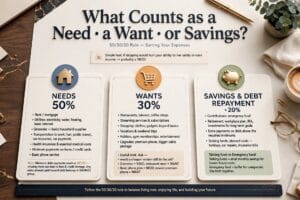
  • 50% for needs: the essentials you must pay to live and work, such as housing, utilities, groceries, and transportation.
  • 30% for wants: everything that improves your life but is not essential, such as dining out, hobbies, and entertainment.
  • 20% for savings and debt repayment: money that builds your future, including emergency savings, retirement contributions, and extra debt payments.

The idea behind the 50/30/20 rule is balance. Instead of cutting all enjoyment from your budget or ignoring your future, you give every part of your life a fair share. That balance is what makes this method easier to stick with than strict budgets that feel like punishment.

50/30/20 rule budget breakdown chart showing needs, wants and savings

How to Calculate the 50/30/20 Rule

To use the 50/30/20 rule, you start with your after-tax income, also called take-home pay. This is the amount that actually lands in your bank account after taxes and payroll deductions. If your income changes from month to month, use a conservative average of the last three to six months instead.

Then multiply that number by 0.50, 0.30, and 0.20. The results are your monthly spending limits for each group. Here is an example based on $4,000 of monthly take-home pay:

Category Percentage Monthly Amount
Needs 50% $2,000
Wants 30% $1,200
Savings and debt repayment 20% $800

In this example, the 50/30/20 rule tells you to keep needs at or below $2,000, limit wants to $1,200, and move $800 into savings or extra debt payments every month. The percentages stay the same at any income level, so only the dollar amounts change.

What Counts as a Need, a Want, or Savings?

The hardest part of the 50/30/20 rule is sorting your expenses into the right group. A simple test helps: if skipping it would hurt your ability to live safely or earn income, it is probably a need.

Needs (50%)

  • Rent or mortgage payment
  • Utilities such as electricity, water, heating, and basic internet
  • Groceries and basic household supplies
  • Transportation to work, including fuel, public transit, car insurance, and car payments
  • Health insurance and essential medical costs
  • Minimum payments on loans and credit cards
  • Basic phone service

Notice that minimum debt payments count as needs, because missing them leads to fees and credit damage. Any extra amount you pay toward debt belongs in the savings group instead.

Wants (30%)

  • Restaurants, takeout, and coffee shops
  • Streaming services and subscriptions
  • Shopping for clothes and gadgets beyond the basics
  • Vacations and weekend trips
  • Hobbies, gym memberships, and entertainment
  • Upgrades such as a premium phone or a bigger cable package

A useful trick is to ask whether a cheaper version would still do the job. Groceries are a need, but a restaurant meal is a want. A phone plan is a need, but the newest premium phone is a want.

Savings and Debt Repayment (20%)

  • Contributions to your emergency fund
  • Retirement savings, such as a workplace plan or an IRA
  • Investments for long-term goals
  • Extra payments on debt above the required minimums
  • Sinking funds for planned costs such as holidays, car repairs, or insurance bills

Sinking funds, which are small monthly savings for known future costs, fit well in this group. Our guide to sinking fund vs emergency fund explains how to use both together.

50/30/20 rule budget breakdown chart showing needs, wants and savings

How to Start Using the 50/30/20 Rule Step by Step

You do not need special software to begin. Follow these six steps and you will have a working budget in less than an hour.

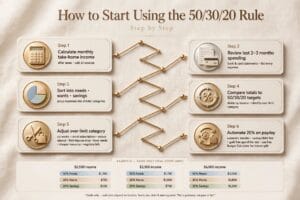
Step 1: Calculate your monthly take-home income. Use the amount that reaches your bank account after taxes. If you have more than one source of income, add them together.

Step 2: Review the last two or three months of spending. Open your bank and card statements and list every expense. This shows what you really spend, not what you think you spend.

Step 3: Sort each expense into needs, wants, or savings. Use the lists above. When an item could fit two groups, choose the stricter one.

Step 4: Compare your totals with the 50/30/20 targets. Add up each group and divide it by your income. You will quickly see which category is too high.

Step 5: Adjust the category that is over its limit. Most people find the extra money in wants first, such as subscriptions, takeout, and impulse shopping. You can also lower needs by shopping for cheaper insurance or negotiating a bill.

Step 6: Automate your 20% on payday. Set up an automatic transfer to savings or debt payments the day your paycheck arrives. When saving happens first, you spend the rest without guilt. To make the math easy, try our free Budget Calculator, which shows your 50/30/20 split instantly.

50/30/20 Rule Examples at Different Incomes

The 50/30/20 rule works the same way at any income level. These examples show how the dollar amounts change:

Monthly Take-Home Pay Needs (50%) Wants (30%) Savings and Debt (20%)
$2,500 $1,250 $750 $500
$3,500 $1,750 $1,050 $700
$6,000 $3,000 $1,800 $1,200

These numbers are only a guide. Your real costs depend heavily on where you live, your family size, and your debts, so treat the percentages as a starting point rather than a pass or fail test.

50/30/20 rule budget breakdown chart showing needs, wants and savings

What If Your Needs Cost More Than 50%?

For many people, especially in expensive cities, housing alone can swallow half of their income. If that sounds familiar, the 50/30/20 rule is not broken, and neither are you. It is a guideline, not a law, and you can adapt it to your situation:

  • 60/20/20: needs get a larger share, wants shrink, and you still save 20%.
  • 70/20/10: a tight-income version that protects a small amount of savings while you work on raising income or lowering costs.
  • 50/20/30: a debt-focused version where you shift part of your wants budget toward paying off high-interest balances faster.

The goal is to keep the habit of dividing your income on purpose. Even if you start with a 70/20/10 split, you can slowly move closer to the 50/30/20 rule as your income grows or your expenses fall.

Using the 50/30/20 Rule to Pay Off Debt

The 20% portion of the 50/30/20 rule is your debt-fighting budget. After you cover minimum payments in your needs category, send everything in this group above those minimums to the debt you want to eliminate first. If you want a complete plan for doing that, read our step-by-step guide on how to get out of debt.

If your debt is large or expensive, it is reasonable to temporarily pull a little from your wants category as well. A short period of tighter spending can shorten your payoff timeline and reduce the total interest you pay. Once the debt is gone, you can redirect that same money to savings and investing.

Using the 50/30/20 Rule to Build Savings

If you have little or no savings, a smart way to use the 50/30/20 rule is to split the 20% into two parts. First build a starter emergency fund, then add retirement and other long-term goals. A common starting target is one month of essential expenses, which you can grow over time.

Keep your emergency money in an easy-to-access account that is insured. You can check whether a bank is covered by deposit insurance on the FDIC website. For a full walkthrough, see our guide to building an emergency fund.

50/30/20 rule budget breakdown chart showing needs, wants and savings

Pros and Cons of the 50/30/20 Rule

Pros

  • Simple: three categories are easy to remember and track.
  • Flexible: you decide exactly how to spend within each group.
  • Balanced: it protects both your present enjoyment and your future security.
  • Beginner friendly: you do not need detailed categories or special software.
  • Scales with income: the percentages work whether you earn a little or a lot.

Cons

  • Not ideal for high living costs: needs can exceed 50% in expensive areas.
  • Not ideal for very low incomes: there may be little room for wants or savings.
  • Too general for some goals: if you are paying off large debt or saving aggressively, you may need a more customized plan.
  • Depends on honest sorting: calling every purchase a need makes the budget meaningless.

Common Mistakes When Using the 50/30/20 Rule

  • Using gross income instead of take-home pay. Percentages based on pre-tax income will overstate what you can actually spend.
  • Calling wants “needs.” A premium cable package or a top-tier phone plan is a want, even if it feels necessary.
  • Forgetting irregular expenses. Annual insurance, holiday gifts, and car repairs can break a budget if you do not plan for them.
  • Skipping the 20%. Saving whatever is left over rarely works. Pay yourself first.
  • Quitting after one bad month. One overspent month is a data point, not a failure. Adjust and keep going.

50/30/20 rule budget breakdown chart showing needs, wants and savings

Tips to Make the 50/30/20 Rule Work for You

  • Review your budget monthly. Prices, income, and goals change, and your budget should change with them.
  • Use separate accounts. A dedicated savings account makes it harder to spend your 20% by accident.
  • Lower your biggest needs first. Cutting rent, insurance, or car costs has a bigger effect than skipping small treats.
  • Keep a little fun in the plan. A realistic wants category helps you stay consistent.
  • Use free, trusted tools. The Consumer Financial Protection Bureau offers free guides on budgeting and managing money.

Frequently Asked Questions About the 50/30/20 Rule

What is the 50/30/20 rule in simple terms?

It is a budgeting method that divides your take-home pay into 50% for needs, 30% for wants, and 20% for savings and debt repayment. It gives you a simple structure without tracking dozens of categories.

Should the 50/30/20 rule use gross or net income?

Use net income, which is your pay after taxes and deductions. That is the money you can actually spend and save each month.

Is the 50/30/20 rule realistic?

It can be, but it depends on your income and cost of living. If your needs exceed 50%, use a modified split such as 60/20/20 and work toward the standard version over time.

Where do debt payments go in the 50/30/20 rule?

Minimum payments belong in needs because they are required. Any extra payments above the minimum belong in the 20% savings and debt category.

Can I change the percentages in the 50/30/20 rule?

Yes. The percentages are a guideline, and many people adjust them to fit high rent, large debts, or aggressive savings goals. The key is to keep a clear plan for every dollar.

Is the 50/30/20 rule good for beginners?

Yes, it is one of the best budgeting methods for beginners because it is simple, flexible, and easy to start in an hour or less.

Final Thoughts

The 50/30/20 rule will not solve every money problem, but it gives you something many budgets lack: a clear, balanced structure you can actually follow. Start by calculating your take-home pay, sorting your last two months of spending, and moving your 20% into savings or debt payments on payday. Then fine-tune the percentages until they fit your real life.

Ready to put your numbers to work? Try our free Budget Calculator to see your personal 50/30/20 split in seconds, and check back for more simple guides on budgeting, saving, and investing.

This article is for educational purposes only and is not financial advice. Consider speaking with a qualified professional about your specific situation.
Sinking Fund vs Emergency Fund: 5 Key Differences Explained

If you’ve been researching ways to save smarter, you’ve probably run into both terms and wondered about sinking fund vs emergency fund — what’s the actual difference, and do you need both? The short answer is yes, you need both, and they serve completely different purposes. This guide breaks down the 5 key differences, when to use each one, and how to set both up correctly.

Quick Definitions Before We Compare

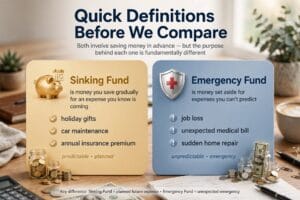
A sinking fund is money you save gradually for an expense you know is coming — holiday gifts, car maintenance, an annual insurance premium. An emergency fund is money set aside for expenses you can’t predict — a job loss, an unexpected medical bill, a sudden home repair. Both involve saving money in advance, but the purpose behind each one is fundamentally different.

sinking fund vs emergency fund differences

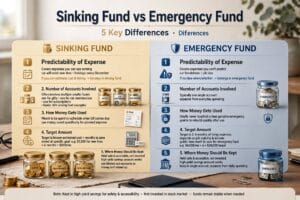
Sinking Fund vs Emergency Fund: 5 Key Differences

1. Predictability of the Expense

This is the core difference in the sinking fund vs emergency fund comparison. A sinking fund covers expenses you can see coming — you know your car will eventually need new tires, or that the holidays happen every December. An emergency fund covers the expenses you can’t predict at all — you don’t know when your car will break down unexpectedly or when you might lose your job.

If you can reasonably estimate the cost and timing, it belongs in a sinking fund. If you have no idea when or whether it will happen, it belongs in your emergency fund.

2. Number of Accounts Involved

An emergency fund is typically one single account, kept separate from your everyday spending money. A sinking fund strategy, on the other hand, often involves multiple smaller funds — one for holiday gifts, one for car maintenance, one for annual subscriptions, and so on. Our guide on 50 sinking fund examples covers the most common categories people save for separately.

3. How the Money Gets Used

Your emergency fund should ideally never get touched unless a genuine emergency occurs — and when it is used, the goal is to rebuild it as quickly as possible afterward. A sinking fund, by contrast, is meant to be spent on schedule. When your car insurance bill comes due, you’re supposed to use the money you saved specifically for that purpose — that’s the fund doing exactly what it was designed to do.

4. Target Amount

Emergency fund targets are typically based on a multiple of your monthly expenses — commonly three to six months’ worth, depending on your job stability and income type. Our guide on how much you should save for an emergency fund breaks this down in detail. A sinking fund target is simply the known or estimated cost of the specific upcoming expense, divided by the number of months you have to save for it.

5. Where the Money Should Be Kept

Both should be kept somewhere safe and accessible — not invested in the stock market, where the value could drop right when you need it. A high-yield savings account works well for both, though many people prefer a single account for their emergency fund and either a separate account or clearly labeled sub-accounts for multiple sinking funds, so the money doesn’t get mixed up.

sinking fund vs emergency fund differences

Side-by-Side Comparison

Feature Sinking Fund Emergency Fund
Purpose Known, planned expenses Unknown, unplanned expenses
Number of accounts Often several, by category Usually one
Meant to be spent? Yes, on schedule Only in true emergencies
Typical target Cost of the specific expense 3-6 months of expenses

Why You Need Both, Not Just One

Some people try to simplify their savings by keeping just one general fund for everything — but this usually backfires. Without separating a sinking fund from an emergency fund, planned expenses quietly eat into money meant for real emergencies, leaving you underprepared when something unexpected actually happens. Our guide on what a sinking fund is explains this in more depth, including why combining the two categories is one of the most common budgeting mistakes.

Think of it this way: your emergency fund protects you from financial shock, while a sinking fund protects you from financial surprise. Both prevent debt — they just prevent different kinds of debt.

sinking fund vs emergency fund differences

How to Set Up Both the Right Way

Step 1: Build Your Emergency Fund First

Most financial experts recommend prioritizing at least a starter emergency fund — $500 to $1,000 — before focusing heavily on sinking funds, since an emergency fund protects you from the most disruptive, unpredictable expenses first.

Step 2: Identify Your Top 3-5 Predictable Expenses

Rather than trying to create a sinking fund for every possible category at once, start with the ones most likely to catch you off guard — holiday spending, car maintenance, or an annual bill you’ve forgotten about before.

Step 3: Calculate Monthly Contributions for Each

Divide the expected cost by the number of months until you need it. If holiday gifts cost $600 and you start saving in January, that’s $50 a month set aside specifically for that purpose.

Step 4: Keep the Funds Clearly Separated

Whether through separate accounts or clearly labeled sub-accounts, make sure your sinking fund money and emergency fund money never blend together, so you always know exactly what each dollar is for.

Step 5: Automate Both

Set up automatic transfers for your emergency fund and each active sinking fund on payday, so consistent saving happens without requiring a decision every month. Our free Budget Calculator can help you find room for both in your monthly budget.

sinking fund vs emergency fund differences

Real-Life Example: Sinking Fund vs Emergency Fund in Action

Imagine your car breaks down unexpectedly — a $900 repair. If you have an emergency fund, that cost gets covered without stress or new debt. Now imagine a few months later, your annual car insurance premium of $1,200 comes due. If you’ve been contributing $100 a month to a car-related sinking fund, that bill is also already covered — without touching your emergency fund at all.

This is exactly why the sinking fund vs emergency fund distinction matters in practice: one protects you from the unexpected repair, the other protects you from the bill you knew was coming all along.

Common Mistakes People Make

  • Using the emergency fund for predictable expenses. This leaves you exposed when a real emergency eventually happens.
  • Never restarting a sinking fund after spending it. Once the holiday gift fund is used in December, contributions should resume immediately for next year.
  • Trying to build both at full speed simultaneously with limited income. It’s usually fine to prioritize a starter emergency fund first, then build sinking funds gradually.
  • Keeping everything in one undefined “savings” account. Without separation, it becomes nearly impossible to know whether you’re actually prepared for either type of expense.

For additional guidance on building healthy savings habits, the Consumer Financial Protection Bureau offers resources on automating savings effectively.

sinking fund vs emergency fund differences

Final Thoughts

The sinking fund vs emergency fund comparison isn’t really an either-or decision — both play distinct, complementary roles in a solid financial plan. Your emergency fund protects you from the unpredictable, while sinking funds protect you from being caught off guard by the predictable. Together, they prevent nearly every common reason people turn to debt.

Ready to start building both? Use our free Emergency Fund Calculator and Sinking Fund Planner to set clear targets for each one today.

This article is for educational purposes only and is not personal financial advice.

High-Yield Savings Account: 7 Things to Know Before You Open One

If your savings are sitting in a traditional bank account earning close to nothing, moving that money to a high-yield savings account is one of the easiest financial upgrades available — it takes minutes to set up and costs nothing to do. This guide covers 7 things to know before you open one, how they actually work, and how to choose the right account for your situation.

What Is a High-Yield Savings Account?

A high-yield savings account is a savings account that pays a significantly higher interest rate than a traditional bank savings account — often many times higher. These accounts are usually offered by online banks, which have lower overhead costs than traditional branch-based banks and pass some of those savings on to customers through better rates.

Your money in a high-yield savings account works the same way as a regular savings account in every other respect: it’s federally insured up to the standard limit, it’s liquid (you can withdraw when needed), and it’s meant for money you want to keep safe rather than invest for growth.

high-yield savings account guide

1. The Interest Rate Difference Adds Up More Than You’d Expect

The gap between a traditional savings account and a high-yield savings account can be substantial. On $10,000 in savings, the difference between near-zero interest and a competitive high-yield rate can mean hundreds of dollars a year in extra earnings — money you’d otherwise be leaving on the table for doing nothing differently except choosing where to keep your cash.

This makes a high-yield savings account one of the simplest wins in personal finance: no risk, no extra effort, just better math on money you already have.

high-yield savings account guide

2. Rates Are Variable, Not Fixed

Unlike a certificate of deposit, the rate on a high-yield savings account can change over time, usually in response to broader interest rate trends. This means the rate you open an account with isn’t guaranteed to stay the same. It’s worth checking your rate periodically and comparing it against competitors, since some banks are slower to pass on rate increases — or quicker to cut rates — than others.

high-yield savings account guide


3. Your Money Is Still Federally Insured

A common concern with online-only banks is safety. As long as the bank is FDIC-insured (or NCUA-insured for credit unions), your deposits are protected up to the standard federal insurance limit, exactly the same protection as a traditional brick-and-mortar bank. Always confirm FDIC or NCUA insurance before opening any account — this information is typically displayed clearly on the bank’s website.


4. It’s the Right Home for Your Emergency Fund

A high-yield savings account is widely considered one of the best places to keep an emergency fund, because it balances two priorities: your money stays fully accessible when you need it, while still earning meaningfully more than it would sitting idle. If you haven’t built your emergency fund yet, see our guide on how much you should save for an emergency fund, or use our free Emergency Fund Calculator to set a target.

Avoid keeping emergency savings in investments like stocks, since the entire purpose of that money is stability, not growth potential that comes with market risk.

high-yield savings account guide

5. Watch for Fees and Minimum Balance Requirements

Not all high-yield savings accounts are created equal. Before opening one, check for:

  • Monthly maintenance fees — the best accounts typically charge none
  • Minimum balance requirements — some accounts reduce your rate or charge fees if your balance drops below a threshold
  • Minimum opening deposit — varies significantly between banks, from $0 to several hundred dollars
  • Withdrawal limits — some accounts limit the number of free withdrawals per month

A high interest rate doesn’t help much if fees quietly eat into your returns every month.


6. Online Banks Usually Offer Better Rates Than Traditional Banks

Because online-only banks don’t maintain physical branches, they generally offer more competitive rates on a high-yield savings account than traditional banks with branch networks. The tradeoff is that you won’t have in-person banking access, though most online banks offer strong mobile apps, 24/7 customer support, and easy transfers to and from linked external accounts.

For most people using this account purely for savings — not daily transactions — this tradeoff is minor compared to the rate advantage.

high-yield savings account guide

7. It’s Not the Right Place for Long-Term Investing

While a high-yield savings account is excellent for emergency funds and short-term savings goals, it’s not designed to compete with long-term investment growth. Historically, diversified investments have significantly outpaced savings account interest rates over long time periods, though with more volatility and risk. Our guide on how compound interest works explains why the right tool depends on your timeline — savings accounts for money you need soon, investments for money you won’t touch for years.

How to Choose the Right High-Yield Savings Account

Compare Annual Percentage Yield (APY), Not Just Advertised Rates

APY reflects your actual annual return including compounding, making it the most accurate number to compare across different banks rather than a simple interest rate.

Check for FDIC or NCUA Insurance

This should be non-negotiable — never open an account, no matter how attractive the rate, without confirming federal deposit insurance.

Read the Fee Schedule Carefully

Look specifically for monthly fees, minimum balance penalties, and any charges for excessive withdrawals.

Consider How Easily You Can Move Money

Check how long transfers take between the high-yield savings account and your everyday checking account — this matters if you ever need funds quickly in an emergency.

Look at Customer Service Options

Since most high-yield accounts are online-only, confirm the bank offers support channels you’re comfortable with, whether that’s phone, chat, or email.

high-yield savings account guide

High-Yield Savings Account vs. Other Savings Options

Account Type Liquidity Typical Return
Traditional savings account High Very low
High-yield savings account High Moderate, variable
Certificate of deposit (CD) Low (until maturity) Fixed, often slightly higher
Index fund investments Moderate Higher long-term, with risk

How Much Should You Keep in a High-Yield Savings Account?

As a general guideline, this account type works best for money you’ll need within the next few years — your emergency fund, short-term savings goals, or sinking funds for known upcoming expenses. Our guide on sinking fund examples covers common categories people save for this way.

Money you won’t need for 5-10+ years is generally better suited for long-term investment accounts, where growth potential outweighs the value of daily liquidity.

Common Mistakes to Avoid

  • Never checking your rate after opening the account. Rates change, and staying on top of them ensures you’re not missing out on better options elsewhere.
  • Ignoring FDIC or NCUA insurance status. This is the single most important safety check before depositing any money.
  • Using it for money needed within days. Transfers between banks can take a few business days, so keep a small buffer in your regular checking account for immediate needs.
  • Treating it as an investment account. It’s a savings tool, not a growth tool — don’t expect investment-level returns.
  • Overlooking minimum balance requirements. Falling below the threshold can trigger fees or a reduced rate on some accounts.

For general guidance on choosing safe savings products, the Consumer Financial Protection Bureau offers additional consumer resources on comparing account types and understanding your rights as a depositor.

high-yield savings account guide

Final Thoughts

A high-yield savings account is one of the simplest, lowest-risk upgrades you can make to your finances — better returns on money you were already saving, with no added risk or effort beyond choosing the right bank. It’s particularly well suited for emergency funds and short-term goals where safety and accessibility matter more than growth potential.

Ready to see how much your emergency fund should be before you decide where to park it? Try our free Emergency Fund Calculator and set a clear savings target today.

This article is for educational purposes only and is not personal financial advice.

How Much to Save for Retirement: A Guide by Age in 2026

One of the most common financial questions people ask is how much to save for retirement — and the honest answer is that it depends on your age, income, lifestyle goals, and when you started saving. This guide breaks down savings targets by age, explains the most common rules of thumb, and gives you a realistic path forward whether you’re just starting or feel behind schedule.

Why There’s No Single “Magic Number”

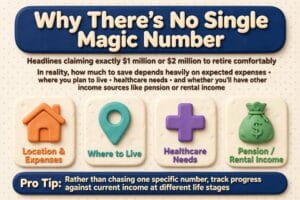
You’ve probably seen headlines claiming you need exactly $1 million or $2 million to retire comfortably. In reality, how much to save for retirement depends heavily on your expected expenses, where you plan to live, healthcare needs, and whether you’ll have other income sources like a pension or rental income. Rather than chasing one specific number, it’s more useful to track your progress against your current income at different life stages.

how much to save for retirement by age

Retirement Savings Targets by Age

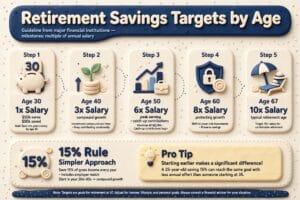
A widely used guideline from major financial institutions suggests these savings milestones, expressed as a multiple of your annual salary:

By Age 30: 1x Your Annual Salary

If you earn $50,000, aim to have roughly $50,000 saved across retirement accounts by 30. This is an ambitious target for many, and falling short here isn’t a crisis — it’s simply a starting point to work toward.

By Age 40: 3x Your Annual Salary

By your 40s, compound growth should be doing more of the heavy lifting, assuming consistent contributions throughout your 30s.

By Age 50: 6x Your Annual Salary

This is often when people hit their peak earning years, making it a good time to maximize contributions, especially with catch-up contribution options available in many retirement accounts starting at age 50.

By Age 60: 8x Your Annual Salary

As retirement approaches, the focus shifts from aggressive growth toward protecting what you’ve built while still growing steadily.

By Age 67 (Typical Retirement Age): 10x Your Annual Salary

This target is designed to support a retirement lifestyle similar to your working years, combined with other income sources like Social Security.

These are general guidelines, not strict rules — someone with lower expenses or additional income sources may need less, while someone planning an expensive retirement lifestyle may need more.

The 15% Rule: A Simpler Approach

If tracking savings multiples feels overwhelming, a simpler rule many financial planners recommend is saving 15% of your gross income for retirement every year, starting in your 20s or 30s and continuing consistently through your career. This includes any employer match you receive, not just your own contributions.

Starting earlier makes a significant difference due to compound growth. Want to see how consistent contributions compound over decades? Try our free Investment Growth Calculator to visualize your own numbers.

how much to save for retirement by age

What If You’re Behind on Retirement Savings?

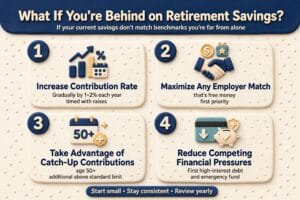
If your current savings don’t match these benchmarks, you’re far from alone — many people fall behind due to debt, lower-earning years, or simply starting late. Here’s how to catch up:

1. Increase Your Contribution Rate Gradually

Rather than jumping straight to 15%, increase your contribution rate by 1-2% each year, especially timed with raises, so the change is barely noticeable in your take-home pay.

2. Maximize Any Employer Match

If your employer offers a retirement plan match and you’re not contributing enough to get the full match, that’s leaving free money on the table — this should be the first priority before any other savings goal.

3. Take Advantage of Catch-Up Contributions

Once you reach age 50, most retirement accounts allow additional “catch-up” contributions above the standard limit, specifically designed to help people who started saving later accelerate their progress.

4. Reduce Competing Financial Pressures First

High-interest debt and a lack of emergency savings often prevent people from saving adequately for retirement. Building a small emergency fund and tackling high-interest debt can free up more room for consistent retirement contributions. Our Emergency Fund Calculator and debt payoff guide can help with both.

how much to save for retirement by age

Where Should You Actually Save for Retirement?

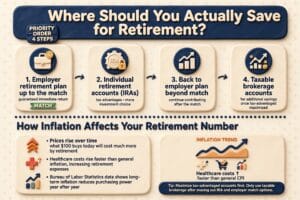
The right accounts depend on your situation, but a common priority order is:

  1. Employer retirement plan up to the match — this is guaranteed, immediate return that shouldn’t be skipped
  2. Individual retirement accounts (IRAs) — offering tax advantages and more investment choice than many employer plans
  3. Back to your employer plan beyond the match — if you still have room to save more after maxing an IRA
  4. Taxable brokerage accounts — for additional savings once tax-advantaged options are maximized

how much to save for retirement by age

How Inflation Affects Your Retirement Number

When calculating how much to save for retirement, it’s easy to underestimate the impact of inflation over a multi-decade timeline. Prices that feel manageable today will be significantly higher by the time you retire, especially for healthcare costs, which tend to rise faster than general inflation. According to data from the Bureau of Labor Statistics, long-term inflation trends reinforce why retirement projections should assume rising costs, not today’s prices, when planning decades ahead.

Common Retirement Savings Mistakes to Avoid

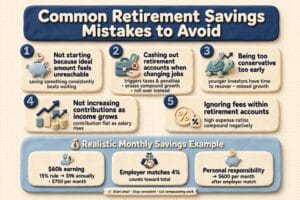
  • Not starting because the “ideal” amount feels unreachable. Saving something consistently beats waiting until you can save the “right” amount.
  • Cashing out retirement accounts when changing jobs. This triggers taxes and penalties while erasing years of compound growth — rolling over to a new account preserves your progress instead.
  • Being too conservative too early. Younger investors with decades until retirement generally have time to recover from market volatility, making overly cautious allocations a missed growth opportunity.
  • Not increasing contributions as income grows. Keeping your contribution percentage flat as your salary rises means your retirement savings rate effectively shrinks over time relative to your lifestyle.
  • Ignoring fees within retirement accounts. High expense ratios compound negatively over decades just as much as returns compound positively.

how much to save for retirement by age

A Realistic Monthly Savings Example

To make this more concrete: someone earning $60,000 a year aiming for the 15% rule would need to save $9,000 annually, or $750 per month, across all retirement accounts combined — including any employer match. If their employer matches 4%, that reduces their personal contribution responsibility to around $600 per month, illustrating why maximizing employer matches matters so much.

Final Thoughts

There’s no universal answer to how much to save for retirement that fits everyone perfectly, but the age-based benchmarks and the 15% rule give you a realistic framework to measure your progress against. If you’re behind, focus on gradual increases, employer matches, and catch-up contributions rather than trying to close the gap all at once.

The most important factor isn’t hitting an exact number by an exact age — it’s building the consistent habit of saving something every month and increasing it over time. Ready to see how your own contributions could grow? Try our free Investment Growth Calculator and map out your retirement savings trajectory.